Sunday, August 28, 2011

Time to think about potatoes again


Our neighbour popped her head through the hedge that separates our two properties at the weekend, to pass on some women’s magazines to the Head Gardener, and to ask whether we wanted a few ‘Cliff’s Kidney’ potatoes, as she had bought too many for her garden.
I was forced to say that I have reluctantly come to the conclusion that I will not be planting any potatoes this season, as there are only two of us in the house now, and the Head Gardener is no great fan of potatoes – I still have a lot of tubers left from last year’s crop and I would not be able to get through them all.
There was a time when all vegetable gardens featured a mass planting of potatoes – in fact, many gardens were literally established out of a potato patch.  The custom has long gone, but it was traditional to plant a crop of potatoes on a new section, before you had even built the house, the theory being that the deep cultivation required for the potatoes would help set the land up for the later gardens and lawns.  Once the house was built and beds laid out, most garden would feature extensive plantings of a range of varieties, with ‘Cliff’s Kidney’ and ‘Jersey Benne’ being the favourites for earlier in the season, while’ Red King Edward’ and ‘Rua’ were two favourite main crop types.
If you have enough people in the family eating potatoes still, they are an easy and worthwhile crop for the home gardener, and I think all newbie gardeners should try their hand at growing a crop or two of these.  In fact, I suspect that I will be unable to resist putting just a few tubers down myself, because I do not think Christmas would be quite right without an early morning trip down to the vege patch to bandicoot a few  shining new potatoes for the dinner table.
Last year I planted two different varieties – the white fleshed ‘Rocket’ for an early variety, and the pink skinned ‘Desiree’ as a main cropper.  The idea of  ‘early’ and ‘late’ sometimes confuses new gardeners, as it does not refer to the time of the season the tubers need planting, instead being a reflection of  the amount of time needed from planting to cropping – that is, early varieties mature more quickly than main crop or late varieties.  That means that, once the season has moved on and it is getting late for planting potatoes, you are better off to plant ‘early’ types as they will crop quickly, before the frosts arrive.

Sunday, August 21, 2011

Silver trees of red and yellow


Today the Head Gardener and I went down to the nursery to look at some Leucodendrons.  I have to say it felt a little odd looking at South African plants after such a cold week, but most Leucodendrons will cope alright with the sort of weather we have just had, as long as they are in a well drained site.
There are about 80 species of Leucodendrons, with a staggering number of sub-species, forms and varieties, many of them bred in New Zealand and Australia.  They are all native to the Cape area and have their flowers non separate male and female plants.  The flowers themselves are relatively insignificant, but they are surrounded by often very decorative bracts.
In the wild they grow in the same sort of conditions they require in the garden – they need well-drained, acidic soil (not too rich in humus either) and they need full sun for the bracts to colour up properly.
I suspect the Latin name for the genus, with means “Silver Tree” must have been given after a botanist saw the remarkable Cape silver tree, L. argenteum, with its large green leaves totally covered in silky silver hairs, giving the impression of a silvery sheen.  In the wild it can grow quite scruffily but in the garden it is a delightful sight, staying well clothed and performing well, especially if kept clipped when young.  It seems to need better drainage than most varieties, and it is definitely less frost hardy than most common species, but if you have a warm spot this is a spectacular plant.
The most popular of all Leucodendrons is undoubtedly ‘Safari Sunset’, a hybrid raised in the 1960s and very quickly developed as a cut flower.  At one time it seemed to be in every garden, and in vases in every American television programme as the epitome of chic.  It is less planted nowadays but it is still a very valuable plant for the winter garden, providing a great dash of colour at a time of the year when there is little else around.
It is an enthusiastic growing plant and is inclined to get away a little if not kept clipped when young., reaching up to about three metres if allowed.  Trimming is fun of course, because you can pick the stems for the house.  They look especially good at this time of the year when the dark burgundy colouring of earlier in the year has faded a little and the centre is starting to go yellow.
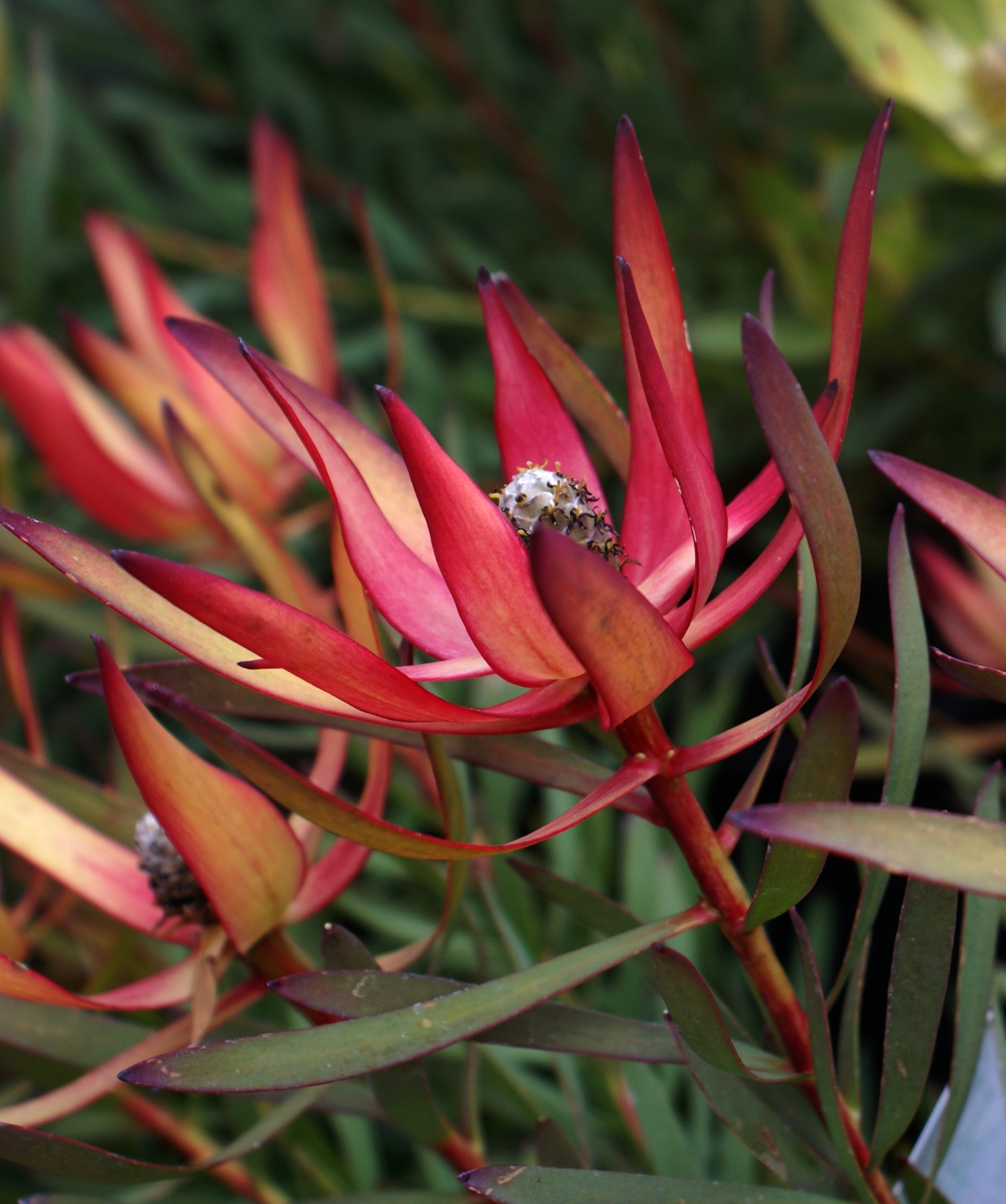
‘Rising Sun’ (photograph above)  is another good red coloured variety, probably intermediate in size between the two foregoing types.  It has bright bred bracts over winter fading to cream for the spring.  This is another good variety for picking. 

Sunday, August 14, 2011

Currant news


When there is snow quickly accumulating on the back lawn and it is freezing cold outside what else would a garden writer be doing but thinking about summer fruits, and how we should be making sure we have any new plants well and truly tucked into their garden beds soon.
My parents were not great small fruit growers , although my mother was keen on black currants and had a row of bushes that straggled across the back garden, and there were a few ferocious gooseberry plants too, but they were only looked after in a desultory fashion.  Although I quite liked Mum’s black currant jam, I certainly could not raise too much enthusiasm about going out to help her pick the thousands of berries needed for her jamming exploits.
I was a bit remiss really, as they are excellent plants for the novice gardener to start their fruit growing career with, being relatively easy to grow and very hardy.  In fact, coming as they do from the hard northern climes, the will probably be relishing a bit of snow at this time of the year – they need winter chilling to fruit well.
The variety you are most likely to come across is ‘Magnus’, which has very tart fruit until the very last minute before they ripen – the kids will certainly not be thieving them to eat them half-ripened!   The plants do best in humus-rich slightly moist soils, and prefer it to be slightly acidic – Rhododendron country suits them well – so make sure they are not planted in thin dry soil.
When you plant a new bush it pays to prune it back to two buds above the ground then leave it to grow and do not prune for two seasons. After that you will need to prune to shape by removing the old stems to a new low bud, removing at least a third of the old canes. Plants do best with about ten shoots per bush, none of which should be older than three years. To foster young wood you should cut down old wood to new buds in winter.
Red and white currants are also great for the home garden, and although they are related to black currants, they need a different planting and pruning strategy.  When you first plant you should prune to establish a short main trunk. The following season, chose four main branches making a vase shape with an open centre. Each winter, prune these branches back and allow a few more to develop until you have established a framework with about eight main branches. Each year prune these back by about half, and then at the fourth year remove one or two of the main arms back to its lowest new shoot each year as these currants bear from permanent spurs and will bear for a few years.  You should aim to have an open growth habit with main wood in the two to three year bracket.
All these currants have attractive shape and they would make a pleasant boundary hedge around the edge of your vegetable garden if they were carefully managed.  If you had a variety of different types you would also have an attractive fruiting feature in summer.

Sunday, August 07, 2011

A lot of flannel

I wonder how many garden writers are going to be spending time over the next few weeks pondering whether we are having an early spring or not.  It seems to me we are – there are Magnolias in full bloom and I have buds on some of my irises that should not be in flower for months yet – but I would not be so sure that spring is nearly here.  It does not take too much to make the God of Spring withdraw again until a more appropriate time.
I have been enjoying the slightly milder weather though, walking to work most days, taking circuitous routes so I can check up on some different gardens and see what is doing well this year and  I have noticed a couple of Phylica pubescens bushes putting on great displays.
These flannel flowers, or featherheads as they are also called,  are South African shrubs, from the buckthorn family although they have more than a passing resemblance to some of the many African proteaceous plants, in that their true flowers are hidden in the middle of (in this case, slightly) showier bracts.   The whole shrub has attractive almost-grey foliage, and is a welcome addition to the shrubbery for that fact alone, but over the winter flowers (and the bracts) are formed and by now the the hairy leaves are topped with golden flowers.  It is a fabulous plant for the winter garden, and anyone who likes picking flowers for the house will love this, as the flowers last for weeks in the vase.  In the garden it prefers conditions pretty much like those you would expect a South African to prefers– dry, well-drained and not overly rich soils, in an open situation.  They look tender but seem to be able to cope with most frosts our conditions throw at them, growing to about 1.5 metres high and the same around.  Like many South African shrubs, they are not long lived, but should last more than ten years.
I think they go really well with some of the other  South African plants that are in flower now – the Leucodendrons and Proteas look similar enough, but also different enough, to blend well with these shrubs.  Thespecimen I photographed this week is growing in dampish soil in an open position in the middle of a lawn – not the sort of location I would have recommended but it is doing fine.

Monday, August 01, 2011

Glorious Hellebores

Despite it being "clean the tools weekend" I did not spend the whole time in the tool shed – when Sunday turned out fine I took the chance to do some pricking out in the glasshouse, with the last of the iris seedlings to line out, and the Delphinium seedlings I grew from the seed from Dowdeswells to put into pots. I got a lot done but ran out of potting mix and needed to go to the local garden centre, always dangerous because there are going to be things there I am going to covet.

This time it was a great display of Hellebores, with singles, doubles and all sorts of in between forms on display. Commonly known as ‘Winter Roses’ (although they are not remotely related to roses) these are fabulous plants for the late winter/early spring garden, available in a range of subtle colours, very apt for this time of the year.

Hellebores are not too fussy about where they grow as long as the soil is not too dry, and as long as it does not become bogged over winter. They are perfectly happy in semi-shade, or even complete
shade, but they will equally well cope with full sun, as long as the soil they are planted in has plenty
of organic matter.

Once you have got them established trim off the dying leaves of deciduous varieties and remove the
seed heads as well, encouraging good strong growth and more flowers.

One of the first species to flower is Helleborus niger, mainly seen in the stunning form called ‘White
Magic’. This has brilliant white porcelain–like flowers, relatively large and carried close to the
foliage, which remains tidy over the summer. I think this is one that looks best planted in clumps if
you can afford to be extravagant. It is also long-lived – our plant was one of the first we bought and
it is still thriving after nearly fifteen years.

I was intrigued to see a new variety – to me anyway – H. ‘Ivory Prince’. 'Ivory Prince' is a complex
hybrid with beautiful, dark blue-green foliage thick and ivory-white flowers that age to pink and
eventually green. It seems to be very vigorous and I am sure will quickly become a form favourite.

The showiest species is undoubtedly H. orientalis. I remember these well from my grandparents’
garden, where they grew in wilderness-like semi-shade, in a profusion of shades from greenish-
white, through to a sort of carmine pink, some of the flowers stained with deeper colours.

I wonder what my grandparents would say if they saw modern forms with their improved range of
colours and forms – I think they would hardly recognise them. There are now some very deep red,
almost block forms, and some that verge on gun metal grey, with the appearance of a bloom on the
blooms, so to speak.

I am very taken with bi-coloured flowers, and there are some fantastic seed raised varieties available
in this range. They generally have a ground colour that is white, light pink, or the chartreuse-like
colour Hellebore growers call yellow. The ground colour is enhanced by dark highlights, usually deep
carmine.

Another form that I am taken with is the anemone centred form, with a little ruff of quill shaped
petals surrounding the stamen at the centre of the flower. When this is combined with a bicoloured
flower the effect is remarkable.

There are also many double forms available now, the doubling varying greatly from quite neat
rounded petals, to Raggedy Ann mish mashes of petals – very informal and not quite to my taste
although I can see how they would appeal to others.

All the above forms were on display at my local garden centre – as they are seed raised you really
need to see them in flower to ensure you are getting what you want. And they are not just valuable
for the garden – they perform very well when picked for the house, so useful at this time of the year
when the spring flush is still a month or two away. You’d go a long way to find more attractive long-
term perennials for the garden and house.

Sunday, July 17, 2011


This weekend I ran into a plant-loving friend in a local bookstore.  I am sure we must have frustrated the owner and her staff as we stood alongside the plant books and talked for over an hour, largely about native plants.
He works for DOC, his specialty being plants although he is also active among wild birds.  He had been very busy during the week, helping look after bids blown ashore by the severe westerly wind s we were subjected to last week. 
He had found time to read last week’s column and had some interesting things to say about the use of native plants in the garden, basically agreeing with me that we should use natives when appropriate, but we are creating gardens not botanical reserves and should feel free to plant whatever we want to in our gardens.
He had some interesting things to say about planting grasses, saying that they are much misused in the garden, often being planted without too much thought about the way they are going to end up looking.
I totally agree – well spaced and planted grasses can be an absolute highlight in the garden, but less than clever plantings can end up looking absolutely dreadful.  There is a large commercial planting I go past each day where some light brown Carex  comans (not strictly speaking grasses I know) were used to provide frontage to some Pittosporum ‘Irene Patterson’.  They were planted too close to each other, and have not been cared for in the years since they were planted and now present the garden with a messy brown smudge in front of the shrubs.
The interesting thing about grasses (and similar plants like sedges) is that they can basically be used one of two ways.  They can make wonderful accent plants if allowed to grow in a very natural manner amongst other plants.  This applies especially to those with a naturally weeping habit – they simply must have space around them to develop their proper shape.
Their other use is as a bulk groundcover, and here they need to be planted a little closer, but should still be spaced well enough for the individual shapes of the plants to be clear.
Most grasses have a light feel to the garden, and they usually also give the feeling of movement, twisting in the slightest breeze, adding an extra element to the environment.
Starting with the native grasses, I guess my favourite would be the colourful Carex testacea, a sea-loving plant usually seen growing in sand dunes and open scrub land. It has a mix of dark green and orange leaves, with a characteristic weeping form.  At this time of the year it colours up to a brilliant orange-red shade.  I walk past a planting of this growing in a mat of grey-green leaves of rock roses Helianthemum and it looks great.  I have never noticed the rock roses flowering but there are terra cotta forms and it would look stunning with them.  A further contrast is given by a planting of one of the blue-leaved Yuccas, the spiky growth complementing the flowing growth of the Carex.  The bed narrows at the far end, where an upright conifer of some kind is planted – perhaps Juniperus ‘Spartan’.  The only jarring note is a plant of Zantedeschia aethiopica ‘Green Goddess’, no doubt planted for its large leaves, but I am sure I could think of better options.
My friend’s favourite native grass is the red tussock Chionochloa rubra. Whoever named this tussock red must have been suffering from snow blindness as you would need very rosy spectacles to call this plant red but the bronze-ish leaves do take a reddish tinge if planted in full sun. A mountain plant, this one is taller growing, getting to over a metre high, with a similar spread.  It is easily grown, and will flourish in either dry or wet conditions.
I am not sure this is even my favourite Chionochloa as I am great fan of the dwarf toe toe, C. flavicans.  This has green leaves, looking a little like a finer leaved flax rather than a grass, but it also has beautiful flower heads, nearly  lime green when opening, but eventually  but fading  to cream coloured. This is another that looks great when planted in groups, but can also be an effective specimen plant in a smaller garden.
There are plenty of wonderful grasses, and grass-like plants among the exotics for the garden.
If you are looking for a bright blue I think the best bet is the blue oat grass, Helictotrichon sempervirens which has erect true blue leaves and delicate flower heads. If you have a modern house this is the one for your massed planting as it looks gloriously funky, especially if combined with contracting colours and foliage types.

Monday, June 13, 2011

Those mid-winter smellies


Although we have been having a very mild winter thus far and temperatures have been very benign, we are rapidly approaching the shortest day.  It is horrible leaving for work in the gloom and arriving home again in the dark, but the light will start flooding in with more power again and we will be back on the road to spring.
Those of you who are new to vegetable gardening are probably thinking there will not be too much to do at this time of the year – perhaps a bit of tidying up and some turning of the compost pile – but there are a couple of worthwhile crops that need to be planted at this time of the year , both members of the large onion tribe.
The first of these is garlic, the bulbs of which are now in your local garden centre.  Their culinary use has increased tremendously over my lifetime – I can well remember a time when someone who used garlic in cooking was looked at askance, as being more than a little eccentric.  That has all changed of course, and we use it more or less liberally in lots of cuisine.
Apparently it is an ancient vegetable, and is mentioned as being provided to the men building the pyramids.  It has been used as a medicine for a long time too, and there are all sorts of alternative medicines that contain it.
I have not grown garlic for a few years, but this weekend I was working at weeding last year’s new garden, and it came to me that the soil is so friable at the moment, and just perfect for planting, so I raced down to my local nursery and got some garlic and shallots.
Garlic must be one of the easiest crops to raise.  All you have to do is prise the bulb apart and plant the individual cloves, discarding the smallest ones to one side as the bigger cloves will grow bigger bulbs.  Each clove needs to be planted about 5cm deep, and they should be about 15 cm apart.  Ideally they should be in good fertile soil, well drained and in a very sunny location. My soil is a very compost-rich mix so I did not need to add any humus, but if your soil is thin it would pay to do so.  A light sprinkling of general fertiliser would not go amiss either.
As long as you keep the weeds down there should not be too much trouble growing these plants – they seem to be almost disease free, and most insects seem to leave them alone as well.  During the drier months you might want to keep an eye on them to make sure they are kept well enough watered, but apart from that, there is nothing much else to worry about.
Shallots are similarly easy to grow, and require somewhat similar growing conditions.  Even though they are closely related to onions – having a similar but more complex, milder and sweeter flavour – they grow much more like garlic, forming a head with multiple cloves.  At midwinter – the traditional time for planting both shallots and garlic – the heads are pulled apart and the bulbs planted in a similar manner to garlic, but don’t expect the same number of cloves as you will get from the garlic as there are not so many.  This also explains why shallots are quite expensive to buy – all the more reason to grow your own.
There are a number of different types of shallot available for cooking with, but not all of them are grown in New Zealand – the reddish-browned skin type seems to be the most common.
Shallots ( I suspect this applies to garlic too) are sometimes imported into New Zealand after being treated with anti-sprout chemicals, which is fabulous for the cooks, but bad news for the gardener.  Make sure you buy your bulbs from a reputable garden supplier.

Wednesday, June 08, 2011

Breeding and seeding


I took advantage of this weekend’s fine weather to spend a bit of time in the glasshouse, pricking out some of this season’s iris seedlings.  Each year I troll through my Pacific Coast Iris plants and try to work out which ones present opportunities to further the way I want my irises to look, and then cross pollinate these flowers.
With irises this is not too difficult a task as the flower’s sexual reproduction organs are easily found and crossing them is not too tricky.  All the breeder has to do is gather the pollen from the ‘father’  flower while it is nice and fresh and the bees and bumble bees have  not found it, then transfer it to the stigmatic lip of the selected mother flower.  Again, it is important to do this before the bees find the intended mother and pollinate her with rogue pollen, so we usually take the falls off the flower, removing the bee’s landing pad.  If all goes to plan we should have the selected pollen reaching the selected stigma, resulting in a new hybrid.
Trouble is, my mouth is bigger than my stomach when it comes to breeding Pacific Coast Irises, and I have far many more seedlings than I could ever hope to plant out.  I have germinated seedlings in nearly fifty pots, each one a different cross, and up to a hundred plants in some pots.  Absolute madness!
It is this sort of passion on the part of breeders that has lead to the many changes obvious in many garden flowers.  Even highly bred plants, like roses and bearded irises, are still being improved, by very controlled breeding and a thorough understanding of the genes that influence their eventual display.  In order to be a successful breeder with these plants it is almost a necessity to be raising and selling plants fulltime, very difficult in a country like New Zealand.  The best rose breeders, for example, raise tens of thousands of seedlings each year, expecting to introduce perhaps five of them to the market. 
Under these conditions most seedlings do not survive their first flowering – they are ruthlessly culled and only the very best make it through for a second flowering season.
Most florists’ flowers are now produced by professional breeders, usually based in the United States, Japan or Europe.  Carnations are a good example, as the only people working with these plants are now cut flower breeders, and they are not producing varieties that are well suited for the garden.  As a result, gardeners find it harder and harder to find varieties that suit them, and the plants gradually go out of favour.
Some plants are still largely produced by keen amateurs but they tend to be those that do not have a large cut flower demand.  Across the paddocks from the back of my house (all built on now unfortunately) live a couple of the world’s most successful dahlia breeders, their varieties being voted as among the most popular in the United States.  I was once treated to a look around their garden at the height of the flowering season, and was intrigued to see they did not practise the sort of hand pollinating techniques I am more familiar with.  Instead, they grew the two varieties they were keen to cross alongside each other and left the bees to do the job.
Partly that is because the technical issues around desexing compound flowers like dahlias – it is a very tricky and time consuming method, and in reality, results are generally disappointing with successful pollination rates being low.
I have found similar troubles when trying to breed hebes – it is just too finicky to try and desex all the various flowers on the raceme – and they do not all open at the same time of course – so it is once again best left to the bees.

Tuesday, March 01, 2011

Irises on my mind

The dreadful effects of the Christchurch earthquake are still on my mind – it is hard not to be
affected by the scenes we have seen played out on our television screens each night, and read
about in our newspapers each day. We have seen news of people we know, and heard their singular
stories about how they escaped from the shakes, and how they are trying to adjust their minds to
the new city they live in.

Like most New Zealanders, I have friends and family in Christchurch – an uncle and auntie, and their
three daughters. The older generation has passed on, and the girls live in rural town in Canterbury –
Oxford, Ashburton and Geraldine – and they are all safe.

Not so the street they were brought up on, and where I stayed as a teenager on my first visit to the
South Island. Woodville Street did not fare very well in the quake – there was terrible liquefaction in
some of the sections, and I caught a glimpse of it in a news item about neighbours pulling together
to help each other.

My uncle and auntie were great gardeners, and both long term members of the New Zealand Iris
Society, Uncle Ron serving a term as its president. He was induced to join when he started courting
my auntie – my grandparents, who were great iris fans, gave the newlyweds a dollop of iris plants for
their wedding present!

I lived across the road from my grandparents for a number of years and their enthusiasm for irises
was passed on to me, and I have in turn managed to pass it on to at least one of my sons, who loves
some of the oddly coloured Dutch irises.

These bulbous irises are interesting plants, being complicated hybrids that were bred in the
Netherland although the species involved actually come from North Africa and southern Europe,
the Spanish Iris, I. xiphium being the foundation species. It has lovely blue and yellow flowers, but
crossed with other species, has given rise to a wide range of attractive and hardy bulbs.

There are blue, purple, white and yellow varieties around, but the ones that are most likely to draw
attention, and the ones that my son loves, are the unusually shaded varieties, with a mix of brown,
mauve, purple and tan. ‘Tigers Eye’ has brown lower petals with striking veins and dark blue upright
ones, while ‘Mystic Beauty’ is mauve and bronze.

These need to be planted in light soils, preferably in full sun. They do not have any special needs but
they do need to be kept watered during the growing season, as they are prone to attacks from thrips
later in the spring if they are kept too dry.

Dutch Irises start flowering in late winter, with the delightful old variety ‘Wedgwood’ betraying its
ancestry from the notoriously shy flowering species I. tingitana. Other varieties will flower through
until mid November.


Hard as it is to remember at this time, life does go on – Christchurch will recover, much as Napier did
in 1931, and Wairarapa did in 1942. My uncle and auntie understood that - each autumn they would
scratch their dry soil aside and planted a new set of bulbs, for a new flush of flowers in the upcoming
spring.

Sunday, February 06, 2011

Waingawa River

I tried to celebrate a warm weekend by taking a trip down the Ruamahanga River yesterday.  I soon found the river had too much water in it, which was a slight problem.  I had taken my car out to the Gladstone Hotel, and Jill dropped me off at Wardell's Bridge at Te Whiti, intending to walk down to the pub.  A coiupl,e of crossings, especially once I had got past the confluence with the Waingawa, determined that it was too dangerous for a sole walker - the flow was too strong to safely cross the river.  I was hacked off!
I thought I'd be best to walk back to Wardell's, then walk along the road to the car, but as I walked back upstream past the Waingawa, I decided I could also walk up the Waingawa to the aerodrome, then walk home and get Jill to take me back to the Gladstone, figuring I could bribe her with an offer of lunch at the Gladdy.
It ended up being great fun - about a three hour tramp in all, and wonderful fun.  I even managed to have my blackberry with me!

 Oh, and yes, lunch at the Gladstone was lovely.  Jill and I arrived in one car and left in two - must have had some tongues wagging!

Spurges

It is one of the interesting things about gardening that many species we love and treasure in the garden have close relatives that are thuggish and not to be tolerated.  This week I have been engaged in a deadly battle with a plant that was given to me by a friend some years ago, and unidentified member of the Polygonum family, related to the lovely ‘Painters Palette’.  For nearly ten years it has been in my perennial garden, slowly increasing but this year it has had a rush of blood to the head and has decided to make a takeover bid for the whole garden, sending out envoys all over the place in an attempt to colonise any available land.  I have dug most of it out, but I am not fooled – I know there will be some roots waiting a bit of rain to burst into life. 
There are plenty of weeds in the family, but also a few choice garden plants, including some lovely tall perennials and some great groundcovers. I feel pretty ambivalent about them though, as I do about the feature plant this week – the spurges, the remarkable Euphorbias. When you consider that there are over 2,000 species of this cosmopolitan genus it is hardly surprising that there are some lovely charmers – and some of the most despicable thugs as well.  They range from tiny ground cover plants right through to trees, and almost all have a milky, acrid sap, earning some the moniker of milk weed.
To start with the charmers – and bearing in mind that I am writing this on Waitangi Day, we have to start with the native sea spurge, Waiuatua,  E. glauca.  This occurs in all the major islands of New Zealand, in coastal areas, but is now very rare in the wild and regarded as an endangered species.  As the Latin name suggests, this robust herbaceous plant has bluish-grey leaves in the best forms, contrasting nicely with its reddish stems.  Like many coastal herbs, it spreads with underground runners, and in well tilled soil will wander about a little, but is unlikely to become a problem in most gardens.  It has become a favourite with municipal gardeners who value its value as a contrast to either grassy foliage, or deeper coloured forms of flax.  It will grow to about 90 cm high and is surprisingly hardy for a costal plant.
There are a couple of Euphorbias released in New Zealand over the past couple of years that you could be fooled into thinking are natives – they are called ‘Kea’ and ‘Tui’, but do not be fooled – these are alien intruders, bred in England from overseas species.  They are both interesting plants for the garden, is misleadingly named. ‘Tui’ has deep purple, almost black foliage which in early spring produces flower spikes of plum to dark purple flowers.  ‘Kea’ is a different bird altogether – it has a tight, compact habit with late winter flower spikes which flush pink red before opening to a mass of continuous lime gold blooms throughout spring and summer.  These two varieties grow to about 60 cm high and are both reliable garden plants.
‘Kea’ is a form of Euphorbia characias as is one of the oddest of these spurges – the brightly variegated ‘Silver Swan.’ Again originating in England,  this variety makes a tight mound of green and white variegated foliage. In late winter to early spring, the terminal flower spikes open to green and white variegated blooms. Like most Euphorbias, this is best grown in full sun in well drained soil to give of its best.  There is similar variety hailing from Australia called ‘Tasmanian Tiger’.
The chameleon spurge, Euphorbia dulcis 'Chameleon', has leaves that open purple and deepen throughout the growing season to a rich red by the time autumn comes. Like most purple-leaved plants, it serves as an accent amidst the dominant green foliage of most gardens so place it where it will make a good contrast.  Its bracts are yellow and it grows about 40 cm.

Tuesday, January 25, 2011

Little bottlers of shrubs


When I was first learning gardening there were about five shrubs you would be able to guarantee most New Zealand gardens would contain – a lemon tree, a Photinia ‘Red Robin’, the ubiquitous Daphne odora, a purple Ake ake, Dodonaea viscosa 'Purpurea' and the glorious bright red Australian bottlebrush, Callistemon citrinus ‘Splendens’.
The others all had their good points, but it was the bottlebrush, hanging over our fence line from the neighbours, that intrigued me, with its flaming red flowers, usually covered with bees, and then it’s strange small nut-like seed capsules hanging grimly to the gently decumbent branches, their maturation seemingly taking years.  What fun it was for my brothers and I to roughly strip these seedpods off and throw them at each other, and other neighbourhood kids!
The common name for this popular and hardy shrub derives from its floral pattern – a bunch of bright stamen that spring outwards from the entire circumference of the branches holding them, giving a cylindrical flower that puts on an amazing floral display each spring.
The most commonly grown bottlebrushes are generally members of the Callistemon genus, although that can be misleading, as some botanists like to put all these into the wider Melaleuca genus, which also has many botttlebrushed flowers.  There are about 35 species of Callistemon in Australia, members of the wider Myrtle family that includes obvious relatives like Australia gums and New Zealand pohutukawas.   They are usually found in the eastern states, and generally grow in quite moist areas, so are best grown in similar conditions in New Zealand gardens.
The old ‘Splendens’ variety that I knew so  well is still available, and is good if you have a big shrubbery, and if you like tending your plants a little.  If left to its own devises the shrub will grow into a small tree, with a rather ungainly habit – the bottom will open up and the branches will all hang awkwardly.  On the other hand, if you prune it regularly, you will have a compact growing shrub that will take many years to reach two metres, and will reward you with a spectacular show in the spring.
Perhaps the best known variety in New Zealand today is the much smaller growing ‘Little John’.  This is a hybrid of C. viminalis, the other parent being unknown, and features lovely blue-green foliage and deep red flowers.  The flowers can be relied on to bloom for Christmas each year.
Red is not the only colour available in these reliable Australian shrubs – colours range from white through yellowish-green, mauve and pink.  ‘Reeve’s Pink’ is quite a popular variety, perhaps not quite as hardy as the two above, but still perfectly fine in a warm spot in our climate.  Even better, in my opinion, is a seedling raised from ‘Reeve’s Pink’ – ‘Mauve Mist’, which was selected from about 300 that were raised.  It forms a dense shrub to a height of about two meters with an equal or slightly wider spread. The new tip growth is pink and densely covered with silky hairs and the flowers, which are produced in usual  botttlebrush  fashion, are pinkish mauve and about 70mm long by about 50mm wide and will be carried as late as Christmas.
Among other forms available in New Zealand are the pink ‘John Mashlan’, which can be planted as a low hedge if kept trimmed; ‘Kings Park Special’ which is another bright red form and very hardy; ‘Captain Cook’; which has orange/red flowers, and ‘Rocky Rambler’ which is a new semi-prostrate form with smaller light green leaves and reduced flowers.
Perhaps the most unusual variety is one released a couple of years ago and heavily promoted as a hedge plant – ‘Great Balls of Fire’.  Despite its name, it does not have red flowers, the bottlebrushes being white in this case, but it is primarily marketed as a great hedging plant, mainly grown for the extremely pretty flush of pink when the foliage is new.

Sunday, January 09, 2011

Favourite foaming flowers


When we come to planning our flower gardens we often pay a lot of attention to the various colours we want to use, but do not give so much thought to the role texture can play, and how important the form of foliage and flower is.
The solid blocks of colour offered by most bedding plants stand at one extreme of the range of floral effects - the bright gold, yellow and orange shades of marigolds might be very appropriate in some places but hideously out of place in others – while the lighter effect of foamier flowers are at the opposite end of the scale.
At the moment the Head Gardener has a couple of plants of one of my favourite of these flowers out in her shaded garden at the moment – some two meter high examples of the glorious meadow rue, Thalictrum delavayi.   This is one of over 100 species of Thalictrum found in the wild – no-one seems to be quite sure exactly sure how many species there are, and the boundaries between species are poorly understood. They are not related to the true rues, but are members of the buttercup family, and mainly found in damp and areas.  The forms most commonly grown in the garden hail from meadowland and prefer garden soils that are on the heavy side.
They are a bit of a conundrum really, as they tend to have very dainty foliage – maidenhair fern-like in many species – which might lead the gardener to think they are frail, but they are remarkably hardy plants.  They flower late in the season and thus add colour to the woodland garden at a time when it is slightly bereft of interest.
The Head Gardener’s plants give a run of drama through the spring and early summer as they prepare to flower.  Over the winter they die down to become totally dormant.  Early spring sees them kick into life again; forming a clump of fine ‘maidenhair’ foliage from which the flower stalks will eventually emerge.  These shoot up and branch as they go until they form a graceful framework. The flower buds are to be found at the end of each of these branches.  At first green and in little clusters, they eventually turn lilac and strike out on their own, each  unfolding to become a perfect lilac parasol, with creamy white anthers dangling from pendulous stamens.
The double form of the species, ‘Hewitt’s Double’, has some of the showiest flowers any of the meadow rues, carrying its tight, pompom-like clusters of lilac-mauve flowers atop wiry, purple tinted stems.  There is also a pretty single white flowered form of this species, but I think the mauves are the best ones to go for.
Thalictrum aquiegiifolium is earlier flowering, with thousands of heads of tiny blooms that make a fluffy head of soft mauve in nearly summer, while T. flavum has pale yellow flowers..

These plants are all easily grown.  Any good soil will do, preferably in a sunny position or in dappled shade. They need adequate drainage, as a site that is waterlogged, even for part of the year, may prove fatal.
The natural tiered shape of the Thalictrum is spoilt by heavy staking. It is important to allow them to be themselves. Give them the protection of a more substantial neighbour on their windward side and plant them among other herbaceous plants that can lend a shoulder to lean on.  If you do need to stake them try to use as thin and unobtrusive a stake as you can.

Sunday, December 19, 2010

Santa's approaching!


It is that time of the year again – Santa is New Zealand-bound as I write, relatives galore are streaming back to their hometowns, and in all the fuss about the festive season, the poor old garden is likely to be overlooked.
Flowers play a large part in the way we celebrate the season though, with some plants intrinsically intertwined into the season, including the heavily scented Christmas lily, Lilum regale.   This Chinese species always has a place in our garden, although my family did not have a tradition of using them.  The Head Gardener’s family, on the other hand, coveted them dearly and some of our original stock came from her grandmother’s garden.   We were given some other bulbs when we shifted here and these plants turned out to be giants - at over two metres tall they were twice the size of the other forms we grow.  I decided it might be environmental and grew some from seed of the tall ones - and they are just as tall, so I have two strains here, each distinct.
They do, of course, have some things in common, including trumpet shaped flowers, wine-coloured on the outside as the trumpet expands, then pearly-white inside, with a marked golden throat.  The anthers carry bright orange pollen, which stains the inside of the flower on wet days, and the clothes of those careless when picking them.  And of course they share that magnificent heady perfume.  I find it a little oppressive when the flowers are picked for the house, but love it in the garden when the white flowers shine in the evening air.
Another plant we associate with Christmas is a cultivated relative of the milkweed that is currently a curse in our new vegetable garden.  The wede species I am referring to is the little yellow-green flowered annual, Euphorbia peplus.  This is a common weed of cultivated ground, easily removed, but the milky sap is a skin irritant and many a gardener has cursed after accidentally getting some of the sap on their lips.  Smoking gardeners beware!
The poinsettia is a widely grown pot plant, a Mexican relative of milkweed, and has the same milky sap, but the flowers are altogether more exciting.  The varieties that we are most familiar with have bright red bracts – the flowers are small and insignificant in the middle of these modified leaves – but there are also pink, white and cream varieties around, as well as combinations of these.
If looked after, poinsettias will be long-lived house plants.  They need a good amount of light but should be kept out of direct sunlight as sun can scorch the leaves. They prefer a warm and well-lit room so should be kept near a sunny window, or on a table in the middle of a sunny room. They should definitely be kept out of cool breezes, as they can be sensitive to the cold.
If you want to keep your plant happy and healthy it is very important to get the watering right – poinsettias like to be kept damp, but resent being over wet. Use the finger test – if the soil is moist the slightly spongy then the plant will be fine, but if it feels dry you should water until water flows freely out the bottom of the pot.  Do not sit the pot in a puddle of water though - you are better the sit the pot in a sink until the water has stopped flowing out of the bottom before putting it back. There is no hard and fast rule about when to water – just use your common sense and check it every few days. 

Sunday, November 28, 2010

Mountain laurel


I was wandering around my local garden centre the other day and saw the most amazing display of that exquisite American shrub, Kalmia latifolia, with a wide range of varieties on display in full flower.  This is one of those shrubs that has never attained the degree of popularity it deserves, and if you are looking for a small to medium sized evergreen shrub which flowers in early summer you could not do better than this wonderful species.
Commonly called Mountain Laurel in its native country, it is a member of the vast Ericaceous tribe.  It is found from Maine down to northern Florida and extends westwards as far as Indiana and Louisiana.  
Unsurprisingly for a member of the same family as heaths and rhododendrons, it is usually found on soils with a very low pH – about 4.5 to 5.5. is the norm – and like rhododendrons, is toxic to most stock. Some related species are known as “sheep kill” so it gives you a good idea of the danger of planting this beauty along a fence line on a farm!  You might also want to avoid major plantings if you are a hay fever sufferer, as the pollen is said to be a bad irritant, although it flowers as the same time as so many grasses that I do not think you would notice it unless you popped your nose into the flowers.
In the wild Kalmias have rounded clusters of beautiful light pink to white flowers, each dotted with a little “stitch” where the stamen have been pushing against the inside of the petals – it is sometimes called the Calico Bush.  Even the buds are very attractive, crimped and pointed like little buttons of icing on top of a sweet cake.
To be grown very well the Kalmia needs to be placed in well-drained but moisture retentive soil, preferably with low pH.  It can cope with light shade but it is equally happy at home in full sun.  As it flowers late in the season the flowers are not usually prone to frost damage and it can be relied on for a glorious flowering season.
About ten years ago I was determined to grow one here although our soil conditions are not really ideal.  I found a fairly sheltered spot and dug bag after bag of compost into the soil before purchasing a well-grown specimen from a Rotorua nursery. It has flourished and each year at this time I marvel at how well it has done, and how much it flourishes.
But when I see the great range of colours available now, I feel cheated, and I have to say I am scanning around the garden to see where I could make some room for a new shrub or two of these beauties.
Among the varieties that took my eye the other day, ‘Carousel’ was probably the pick.  This is an American bred cultivar, from the extensive planned crosses by the doyen of Kalmia breeders Richard Jaynes. It has light pink buds, and flowers that are light pink but dominated by the bands of cinnamon red.  The effect is off a brightly banded bouquet of flowers. It is relatively slow growing and should not be more than 1.5 metres high and across by the end of ten years.
I was also taken with the brightly flowered ‘Minuet’, a smaller growing variety with large flowers.   The light pink buds open to dark pink flowers with a light pink centre and bands of bright cinnamon red.  This variety, which is smaller growing as the name indicates, also bears unique, dark green narrow leaves.  This is another of Richard Jaynes’ varieties.
‘Yankee Doddle’ is another stunning type. The buds of this cultivar are bright red-pink and they open to show a pink corolla with a narrow maroon band, giving the effect of a strawberry parfait.  Despite its very American sounding name, this cultivar was actually bred in Germany, where Kalmias are very popular garden plants. 


Sunday, November 21, 2010

Hostas


Let’s face it – we live on the eastern side of the country’s main mountain ranges and the weather comes from the west.  That means we live in a rain shadow and that little fact should act as a guide as to what we plant in our gardens – but of course, it doesn’t! 
If we live in a dry zone where we should be planting Mediterranean and Australian shrubs, we naturally want to construct gardens out of rhododendrons and hostas, while those gardeners who inhabit wetter regions like Taranaki yearn to grow bearded irises, lavenders and sun-loving plants.  It is just human nature to be contrarian I guess.
I do not grow huge numbers of hostas but I do have a row of healthy specimens filling up a long thin south-facing bed along the front of house.  The bed was so narrow I could not think of anything else that would cope with the peculiar conditions that a cool but dry situation offered.  They have flourished and steadily increased to such as extent that I can divide the plants up every few years and take small colonies to plant in other parts of the garden.
The best of these plants is a delightful blue foliaged form I grew from seed about twenty years ago.  A friend had an extensive country garden and wanted to bulk up some areas in shade with mass plantings of hostas.  The garden was on a large sheep station tot he eats of Masterton, and the gardener’s wife was a very tolerant man – he had to be as the home paddocks kept disappearing into the garden! – but his acceptance of the expanding garden did not stretch to buying hundreds of hostas as about $10 each. 
As we were discussing the problem she said she had lots of need on her plants, so I asked her to bring some in and we sowed them into big seed boxes, and eventually pricked out many hundreds of plants, none of the named varieties of course, but many of them perfectly fine for the garden, and some quite pretty forms.
I gave my friend hundreds of plants, but still had plenty to grow of for myself, best of which were the blue ones, which resembled the popular H. sieboldiana ‘Glauca’ perhaps the best known of the older blue forms. Blue varieties are very much in fashion at the moment being the best selling forms, sometimes with a golden variegation.   If you like large leaved forms then ‘Big Daddy’ is probably as good as any, but if you would prefer a smaller form for the edge of the border, ‘Hadspen Blue’ is  lovely little plant with the most gorgeous blue-green foliage with summer spikes of pale lavender flowers above the foliage.
I am not absolutely sure but I think one of my other forms is the old favourite ‘Thomas Hogg’, also known as Hosta undulata ‘Albo marginata’.  This variety with green leaves edged with a bright white margin and was supposedly introduced to western horticulture by the New York nurseryman Thomas Hogg in 1875.  Hogg, who was a great fan of hostas, or Funkias as they were then known, had spent a lot of time in Japan, seeking out new varieties for his nursery.  This old variety does not have the strong foliage of more modern hybrids, and as such is a little prone to slug attacks, but it is reliably hardy and will even cope with more or less full sun as long as the soil is not too thin and does not dry out too much.

Tuesday, November 16, 2010

Getting under cover


The spring appears to have almost missed our inland valley and we have rushed headlong from winter into summer.  We seem to have traversed from cool, sunless days into gloriously shining days bereft of rain.  The lawns, always a good indicator of how the season is going, have been sluggish this year, not having their usual mid-spring burst, and they are now looking suspiciously as though they are starting to dry off.
What it all means is anyone’s guess – are we in for a sustained drought this year, or are the anticyclones going to head south, leaving us with a muggy, La Nina summer, with plenty of rain?  I guess only time will tell.
Plenty of first time vegetable gardeners will be looking with interest at their new plots, wondering what else they can plant, and asking themselves what they should be doing.  Well, watering is a good place to start.  It is not going to be long before most towns and cities start their annual water restrictions, so it is a good time to get things prepared by ensuring all plots are well watered, and all soil is well covered.  If you have bare soil (as I have in the old vegetable garden) make sure you get something into it, or onto it.  If you are planting, get it done before the real dry weather arrives and then apply a generous mulch of some kind.  In the vegetable garden a compost or straw mulch is very beneficial, helping keep the weeds down as well as keeping soil moisture contained, and it works just as well in the flower garden.
If you have planted small fruits or tomatoes for the first time, don’t forget to cover them from the depredations of birds.  I do not mind the occasional fruit being sacrificed to help keep the local avifauna alive, but I do object to the feathered fiends figuring they are entitled to strip all my crops.  They have already found the new strawberry bed and took the first few fruits before I realised what they were up to.  Of course, I had to shift the old strawberry bed away from the swimming pool at the same time as I relocated the vegetable garden, and the old cover does not fit the new bed, so I had a rushed job after work one night, hastily putting a new cover with plastic bird netting over it.
The raspberry canes will have to be covered too as they have set a nice crop.  I cover them each year and manage to keep the birds at bay – now I just have to figure how to stop the light-fingered little girls from taking the bulk of the crop.
Tomatoes are more of a problem, one I have really only had for the past few years.  I think it started with a bumper crop of Sweet 100 a few years ago, but once the birds had learnt to take the little brightening fruit they just swapped over to pecking away at all the crop.  I have had to resort to covering all the plants once the fruit start to lighten, but I resent it!  I use the white netting that you see on grapevines later in the season, and peg them to the stakes.  It works alright.
Others gardeners have an even worse problem, and find that their leaf crops are being attacked.  We have had this problem in the past, especially with young plants grown from seed, and I found the best answer was to make little cloches out of chicken wire, easily movable, and I just covered the young plants with them until they were established.    You could also try the time honoured technique of stringing defunct CDs on pieces of wire.  The reflections from the discs as they spin in the breeze is said to freak the birds out and they desist.

Monday, October 25, 2010

Lilacs


The little girls next door are world experts in “pink”- it is their favourite colour and it is not unusual to see them dressed in pink from head to toe, riding pink bikes.  I tease them, telling them I hate pink things.  I have not told them that pinks, Dianthus species and hybrids, are in fact among my favourite plants.  I cannot tell them now, or all my complaints about their colour will be ruined!
It has made me think about some other plants that have given their names to colours, in particular the lilacs and lavenders that are now in flower.
Of the two, lavenders are by far the more popular, but at one time lilacs were among the most planted of shrubs.  I guess their deciduous nature is now counting against them, as most modern gardeners are intent on creating gardens composed entirely of evergreens, but they are fabulous spring flowering plants. 
Botanically the 20 or so species of lilac glory in the name Syringa – brings unfortunate word associations with visits to the doctor does it not? – although in old books you might see that name attributed to mock oranges, Philadelphus.  If you hunt around you can probably find a few of the less common species, but in the garden centres you are most likely to come across forms of the common lilac, S. vulgaris.
I was staggered to see that there are about 1500 different hybrids and varieties available worldwide.  There is certainly nothing like that number around New Zealand – you would probably be lucky to find twenty or so varieties in most nurseries.  These are mainly older hybrids, and funnily enough, not very many of them are actually lilac coloured.  Perhaps the best of those that are actually ‘lilac’, is’ Madam F Morel’, a single flowered, fragrant pinkish-lilac.  ‘Alice Eastwood’ is a double flowered form with similar colouring, although it has a more spreading habit of growth.
I am not sure which “non-lilac” variety is my favourite.  I like ‘Charles Joly’, another older form but in this case with very deep reddish purple flowers, but I also like ‘Mme Lemoine’, a lovely white flowered form which seems to have lighter green foliage than most hybrids.
One of the most interesting forms is ‘Sensation’, which has rich purple single flowers with each petal edged with white and carried  in large semi-open panicles produced freely on a medium to tall shrub. This one is well worth seeking out.
If you are looking for something with a finer, lighter feel than the old lilac varieties you should keep an eye out for Syringa 'Bellicent’, an upright deciduous shrub which bears fragrant pink in panicles in late spring and early summer.  These are carried over dark green foliage often with light variegations. It is hardy and well suited to a shrub border or as a specimen.
Lilacs are not too fussy as to their growing conditions.  They certainly prefer a well-drained soil and a position in the sun or light shade. It is best if the soil is neutral to a slightly limey as lilacs grow very poorly in acid soils and heavy clay. For good flower production a moist soil, full of well-rotted compost or farmyard manure is recommended. In recent years New Zealand has discovered an export market for these flowers, and numbers of growers are slowly increasing.

Sunday, October 17, 2010

It is Labour Weekend and that means we are all going to be exhorted to get into the garden centre and spend, spend, spend on our summer vegetable gardens.  In our cooler climes I think it pays to wait for a week or two before planting the most summery of crops, but I do not know about this year.  Even though it has not been very sunny, we have had a mild spring, with next to no frosts.  Even when we have had a southerly outbreak, we have dodged the icy bullet by having easterlies with their attendant clouds.
So, let’s just go ahead this year and get planting tomatoes, peppers and the like this weekend – or maybe next. 
This is all predicated on the soil being ready to receive the plants.  If you are a traditional dirt patch sort of gardener (as opposed to the newer “raised bed filled with potting mix” sort) you should have already worked your soil up, by adding some compost and fertiliser.  
 I have a slight problem this year.  As you will be aware we have had to dig a new garden, and I have made about half of it out of soil from the recycling centre.  This will have been made largely out of a mix of clippings from the local recycling centre and some treated soil, but the clippings present a threat.  They will almost certainly include some week-killed grass clippings and some plants, including tomatoes, absolutely hate even a trace of these chemicals.  I will have to take care to make sure I put the plants into the old soil.
I have already worked some fertiliser into the soil, but I will also add some dolomite to help keep the nutriment balance right and will add some slow release general fertiliser to the soil when I plant, as I know I am unlikely to remember to give the plants the amount of side dressings they ideally need. The next step is to put the stakes in place.  You do not want to wait until the tomatoes are already planted as you will damages the young roots as you hammer the stakes into place.
I am assuming you have not saved your own seed, and are going to have to buy some plants in from the nursery.  If you have been growing F1 hybrid plants (and I think you should be) then you cannot save your own seed as they will not come true to type.  If you have been growing an open pollinated variety you could have saved the seed last autumn, and have sown about a month ago, but it is probably a bit late now.
You will probably find a slightly bewildering array of plants on offer, with old favourites like ‘Moneymaker’ and ‘Grosse Lisse’ available, as well as a wide range of both heritage types and more modern hybrids.  Personally I think you should go for modern F1 hybrids for the bulk of your plants.  I know many people believe they are not as flavoursome as the old types, but I think that is a misapprehension based on supermarket fruit, which are picked before they are properly ripe.  Grow a modern type like ‘Taupo’ and you will never go back to the older ones.
Among the good modern ‘Moneymaker’ types you could look out for are ‘Taupo’, ‘Hamlet’ and ‘Better Boy’, while larger fruited types include ‘Better Boy’, ‘Big Boy’ and ‘Big Beef’.  If you are a fan of Italian types you will probably prefer the old fashioned ‘Italiano’, which I think is as good as any, but you might struggle to find that. ‘Roma’ and ‘San Mazarno’ are two good modern types.

Sunday, October 03, 2010

Wisterias


I had a phone call from a friend the other day telling me that his wisteria was about to flower and asking if I would like to call and see it in a few days.  I was glad of the call as he and his wife have one of the most interesting plantings in front of a very appealing 1920s bungalow.  A wisteria is wound across the top of a verandah, underplanted with a pair of majestic weeping standard roses which grow above a mix of green and purple weeping maples, the whole bed edged with a clean row of box.  The overall effect is very sophisticated and looks attractive all year round, but it looks at its best right now.
The wisterias are Northern Hemisphere climbers, mainly from Asia but also with one or two species from America.  The ones we grow in the garden are almost without fail the Asian ones, especially the Japanese W. floribunda and the Chinese W. sinensis, both of which are firm favourite s with gardeners the world over.
The various forms of the Chinese wisteria are the most commonly grown forms.  It a very vigorous deciduous climber which can get to an enormous size if left unchecked and in spring has long racemes of lilac or mauve flowers, always heavy with a heady scent.  It flowers in the middle of spring with a big burst of fragrance before the leaves appear and always gives a dramatic show.
These climbers are usually grown in the way my friend has grown his plant – as climbers that twine their way across wires, pergolas and trellises, or sneak along fences, but they can be kept as handsome shrubs – even as weeping standards.  I have a friend who even has a small example in a large bonsai pot and the effect is amazing.
The most commonly available variety now is W. sinensis ‘Caroline’ which has fragrant lilac flowers.  This is a real weather tamer, seeming to flower through the worst of the nor-westers without being shredded, and also coping with the rain without marking too badly.   She will usually throw a second crop of flowers in summer – a lot smaller crop of slightly pinker flowers.
The other named varieties you are likely to come across are more likely to be from the Japanese species W. floribunda, and are almost certain to have longer racemes.  The longest of all are from the variety called ‘Macrobotys’, which has blue/purple racemes of pea-shaped flowers that can be as long as a metre, although in their home country plants have produced racemes as long as 1.8 metres!  The long racemes give a longer flowering season too as the flowers open from the base, slowly working their way along to the tip. Obviously, this plant needs to be trained high enough to take account for its long clusters of flowers.
There are the usual lilac coloured forms of this species too, ‘Cascade’ and ‘Lavender Lace’ perhaps being the best known,  but it  has also given rise to a wonderful range of coloured varieties as well.   W. floribunda ‘Alba’ and ‘Snow Showers’ are delightful white varieties, as their names suggest.  They both flower at about the same time as the new leaves open, but as the leaves are bright lime green the effect is appealing enough. 
At the opposite end of the colour range is the intriguing but somewhat misnamed ‘Black Dragon’ – do not expect to get jet black flowers.  In this case the flowers are actually very dark purple in the bud, but they open to deep violet.  The flowers are unusually doubled (the only variety I have ever seen that are) and very fragrant, so they are well worth having.
If you are like the little girls that live next door to our garden, you will be delighted to know  there are some pink forms too!  With both the varieties ‘Lipstick’ and ‘Pink Ice’ the buds are pinker than the flowers, but the light coloured flowers definitely have a pink cast.