Sunday, October 30, 2011

In the garden this weekend


This weekend felt like it might have been the first of the summer-like days – mild temperatures, light breezes and no rain for the first time in ages. I spent most of it in the garden, doing a wide variety of chores.   Primary among those was working among my Pacific Coast Iris seedlings, recording the blooms as they opened, selecting those that will live to see another day and removing those destined for the compost heap, and making new crosses.  Each year I plant about 300 seedlings and about ten will make it through to flower the second time, so it is a slightly upsetting process, but one that most be carried out – we already have far too many irises around here and if I did not cull out rigorously we would have tens of thousands.
I did manage to get a bit of time in the vegetable garden too, getting my tomatoes in the ground.  I know many of you will have put yours in last weekend, but I like to let the ground warm up a little more before I plant mine out.  I bought some advanced grade F1 hybrids a week or two back and grew them on in the glasshouse to make them even bigger – it is the early crop that makes the difference when growing tomatoes at home.
I had prepared the soil well by digging in some extra compost and also boosting the soil with fertiliser.  I placed the stakes in the ground before planting, and then dug some holes a little bigger than the bags the plants were growing in.  This allowed me to plant each tomato slightly deeper than it had been in the bag – the theory is that tomatoes planted slightly too deep will form roots from the exposed stem.  If you chose to do this, remember not to plant deeper that the first leaves.
I also bought some basil plants when I got the tomatoes, but these will stay in the glasshouse for a few weeks yet, as basil needs the soil to be even warmer than tomatoes before it will establish well. I usually grow a few plants of the normal sweet basil, but I prefer the more interesting flavour of the spicy globe variety.  This has smaller leaves – it makes a neat little bush and could be used as an edging if you were looking for one for the vegetable plot over summer.  If you prefer more pungent types you should probably go for Thai basil, which is commonly used in Asian cuisine and has a star anise overtone.  There is also a nice lemon scented variety which has a strong citrus fragrance.
All basils prefer moist conditions in as warm a spot as you can provide.  If you want to see basil growing very fast and with succulent leaves try popping a few in a tunnel house or in the glasshouse.  It grows like a weed, but retains that wonderful pungent flavour.  In the garden, a warm spot with lots of water and lots of food will suit them well – I grown them among the tomatoes, where they get a bit of shade at the height of the day.  Later in the season they can look a bit tatty, so I just cut them back (use the leaves for a pesto that you can keep) and give some extra fertiliser, and the plants soon bounce away again.
If you are new to gardening and have constructed a box-like structure for growing your vegetables, you can probably plant your basil straight away.  These elevated gardens will warm up a lot quicker than garden soil, and will be ready for planting a week or two earlier than most open gardens.  You should already have good crops of lettuces and other summer salad greens underway.  Don’t forget to try one or two other leaves for your salad greens – young beet leaves are tender and luscious, and mizuna and rocket leaves provide a lovely sharper taste. 

Monday, October 24, 2011

I nearly got the blues!


Last week I wrote about an All Black garden – and for a while this weekend I thought I was going to have to describe a garden full of the blues – “Les Blues” certainly had this gardener’s heart in his mouth for far too many minutes on Sunday evening!
Actually, a blue garden would not be a bad thing, but there are blues and blues, so you would need to be careful about which ones you mixed in, keeping the pink blues away from the true blues.  When the Head Gardener and I first established our combined garden last century we fairly quickly came to the conclusion that it might be a good idea if we had our own separate parts of the garden.  I had lived on my own for a while, and had discovered a passion for gardening and wanted a different sort of garden to her.  One of her first gardens was a blue and yellow creation.
I was thinking about that the other day, when my neighbour popped her head through the hedge that divides our gardens, grasping a flower in her hand, asking what it was.  She thought it might be a member of the bluebell family, but it looked unlike most bluebells she had seen.
She was right – it is a bluebell, one with one of the funniest botanical mix ups you can imagine.  When Carl Linnaeus, the man who invented the binomial system of botanical naming, was first shown this bluebell, he asked where it had come from.  He was told it had come from Spanish ship called the Peru, so he called it Scilla peruviana, and for the next 350 years people have assumed it comes from South America.  It is actually a wild plant of Spain and Portugal, glorying under the “official” common name of Portuguese Squill, although it is also called the Hyacinth of Peru, Peruvian Scilla, or Cuban Lily.
It is a clump forming bulb which tries to retain some leaves over winter, and in the spring slowly pushed up strong racemes of purple blue flowers in late spring.  It is very hardy and is a great plant for the front of the border.  It can also be naturalised but it is not easily come by in the trade so you might need to look around for it.
I saw masses of it last week, as I wandered around Napier’s hillside cemetery one warm evening.  As well as the more common blue form there were also some clumps of the white form, which probably stood out as bit better in the evening light.

Sunday, October 16, 2011


It must be because it is spring, and because of the heroic exploits of a certain rugby football team, but I have been thinking about an all black garden again.  You might recall that I planted one a few years ago, but became disenchanted with it and removed it.  I would not want to plant a garden with only black foliaged plants again, because it looks very flat and is not very appealing.
But I do think very dark coloured flowers have a place in the summer garden, as they provide a good contrast to the happier and brighter colours we associate with the hot season, and they often proved a textural contrast as well, as many of them have velvety flowers.

A couple of weeks ago I saw for the first time, the black petunia that everyone has been talking about, and I was impressed with its “blackness”.  Often colour break are nowhere near as good as they are trumpeted to be – think “blue” roses and “red’ irises for example, but in this case, ‘Black Velvet’ lives up to its name.  It is black, and it is velvety.

It was bred by flower breeder Jianping Ren for the Ball Colegrave Company, using old fashioned hand pollination and selection – no genetic modification here.  She has come up with a stunning addition to the range of plants available for summer colour, and I am already thinking about how I might use it in my garden.
I have a new perennial border with lots of space in it – the plants were only planted a couple of months ago and I had always intended to plant a lot of annuals in the bed this year.  I am wondering whether light green flowers might go well with deep velvety colour – perhaps the cool lime green Nicotiana variety called –wait for it – ‘Lime Green’.  This is a cousin of the petunia, from the same part of the world, and likes similar conditions so it should do well alongside ‘Black Velvet’.  They have similar shaped flowers though, so it might be better to introduce a bit of contrast, and maybe go for the chartreuse green of Zinnia ‘Envy’.  This has semi-double dahlia-shaped flowers and will look spectacular alongside the petunia, or even better, behind it, as it grows a little taller.
Of course, I could go for the opposite effect, and try and plant some white flowers alongside the petunia.   It is not a very subtle idea, but then who said I was subtle?  I was thinking I might put some of a new Arenaria montana ‘Avalanche’ in the front of the bed.  This is a new and improved form of a cousin to the garden pinks.  It grows flat along the ground and in spring and early summer has an – dare I say it? – avalanche of starry white flowers spilling over the ground.  It has attractive green-grey foliage (not unlike a Dianthus actually) and even when not in flower would make a good foil for the petunia.
Or how about a soft pink like the delicious looking Diascia ‘Strawberry Splash’?  This is one of the newer hybrid Diascias (cousins to the perennial Nemesias) and has delicate soft pink flowers which keep coming and coming all over the summer, especially if the plants are trimmed back occasionally.  I have a soft spot for these slightly tender South African perennials, as growing some of them set me off on my nursery-owning career, and they are perfect plants for the home garden, as they are hardy, can cope with a bit of dry if you forget to water them for a day or two, and they just keep on flowering.  There are brighter colours around – some very bright in fact – so you might prefer one of them, but the contrast with the black makes me plump for ‘Strawberry Splash’.


Sunday, October 02, 2011

Little Aussie orchids


Whenever I am asked what my favourite flower is, I have a choice of two answers.  The first and strictly speaking the more correct answer is to reply “Irises”.  They were plants I was brought up with and they remain my most favoured flower, at least partly because of the long flowering season and their relative ease of cultivation.
The other answer I give is also nearly true – “Whatever is in flower at the moment.”  Right now I am just getting over loving daffodils, and I still have a passion for tulips.  In the weeks ahead I will fall in love with flowering cherries all over again, and when the irises finish I will reconnect with roses.
But this weekend my favourite flowers will be orchids, in all their glorious variety, because the Wairarapa Orchid Circle are holding their annual show in the Town Hall, and I will once again be enamoured of this most sophisticated of all flowers.
One of the things I love about orchids is the huge range of flower and plant types, and the way there seems to be something that will suit most gardeners, from those who love big, bold, brassy flowers, through to those whose interest is in the tiny gems of the plant world.  There are wonderfully scented varieties, some with the most garish colours imaginable, and others with white flowers pure en ought to make the most avid “white garden” fan swoon.
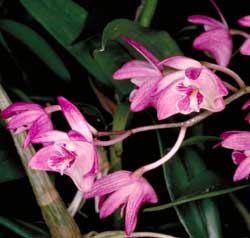
In my glasshouse I have a little collection of Australian Dendrobium hybrids and I am watching their buds expand at the moment.   There are a lot of different species which basically fall into two groups, those that grow best in the cool and those that prefer warmer temperatures.  Because my glasshouse is unheated and also houses a lot of different kinds of plants I have restricted myself to cool growing forms, which tend to be smaller flowering but more robust.  They are often forms of D. kingianum, an eastern Australia native, usually found growing on rocks and known to locals as the Pink Rock Orchid. It is generally a small plant which produces stems of light pink to dark purple flowers held on long inflorescences above the plant. There are white varieties and a few spotted and variegated varieties, and some bicoloured forms too.  My plants are growing in orchid mix in quite small pots, and they are flourishing, but I absolutely drool when I see the large clumps that I see in the annual show – huge plants with hundreds of flower stems holding shimmering butterflies of flowers.
These attractive little flowers do not take a lot of care – they cannot if I can look after them.  They are watered every couple of days and given the occasional feed of dilute fertiliser in spring and summer, but apart from that get no special treatment.  They do not need to be grown in a glasshouse either – they will flourish in any cool frost-protected area, such as a porch or a patio as long as they get enough dappled light.

Sunday, September 25, 2011

Scents and sensibility


The Head Gardener and I took advantage of the warm weather at the top end of the weekend to go for a stroll down to the Kuripuni village for lunch.  It was very pleasant walking along in the sun, looking at the gardens and noticing how much spring has moved along in the past few weeks.  At one garden we stopped to look at a shrub growing over the fence line with wonderful racemes of chartreuse-yellow flowers.  The Head Gardener looked at me and said “That’s it, that’s it!”
I must have looked a little puzzled, as she gently reminded me that I had failed to identify a plant she had come home and asked about.  A work colleague had been given a bouquet which featured what she had described to me as “Lily of the Valley flowers, but from a shrub”. I knew she would not have meant the shrub usually called the Lily of the Valley, the Pieris as we have a couple of them in the garden.
At the time I just could not picture what she was walking about, but I really ought to have thought of this lovely shrub.  It is Stachyurus praecox, a deciduous plant so it has gone out offavour a little but it has a lot going for it, with a charming display of flowers in the spring before the glossy coppery-brown leaves unfurl.  At this time of the year it is very valuable for picking, the colour seeming to go with most colours, especially the golden colour we associate with daffodils and Forsythias.
There was another attraction in a garden a few houses down the road and I could not quite work out what it was at first.  A beautiful scent was drifting over the footpath – heady and sweet and fruity all at the same time.  I thought it was perhaps Daphne, but then I thought it was a bit sharper than that. When I had a closer look through the shrubbery I was astonished to see that it was a mix of at least three different scents, all within the same small garden.
Against the wall was a trimmed specimen of that charming semi-deciduous charmer, the hybrid Viburnum x burkwoodi. It is undoubtedly the most popular of the scented Viburnums in New Zealand, with tight clusters of pure white flowers at this time of the year, carrying a soft fragrance that I have seen described as being like that of baby powder – certainly less heady than Daphne. It has nice green foliage in the spring but grows a little sparsely and can look a little straggly until it is mature.  Clipping will help that but you need to be careful as if you clip it too hard you will knock the flowering back as well.
The semi-deciduous behaviour it shows is understandable as it is a hybrid between the evergreen V. utile and V. carlesii.  The former is a rare species in New Zealand, and I have never seen it offered, probably because it is not very attractive, but V. carlesii is usually findable and is a very fine deciduous shrub. It grows to about two metres and at this time of the year is covered with the most delightful pink-budded flowers, opening to white, and scented even better than V. x burkwoodii in my opinion.  You will find this in garden centres at this time of the year and it is well worth seeking out.  It always reminds me of my old gardening friend Henry Carle, who used to write this column when I was first interested in gardening, and who encouraged me over the years.

Sunday, September 18, 2011

A lot of rot


I was working out in the garden on Sunday morning, getting the first of the spring flush of weeds out of the way of the daffodils, hyacinths and irises, and as I often do on Sunday morning, catching up with the National Radio programmes.  There was an interesting discussion about the costs of recycling, and the presenters briefly covered the amount of green waste that goes to the recycling centre.  In some councils’ case it amounts to about 50% of the waste stream, by volume.
New gardeners and perhaps quite a few of us “oldie” gardeners as well, have not realised the economic advantages of composting, quite aside from their advantages to the soil profile.
The activity of growing things uses up the humus in the soil, and depletes some of the soil’s fertility.  In the wild there is a never ending stream of humus and nutriment being returned to the soil in the form of leaf litter, but in our gardens that does not happen.  We harvest our crops – whether that be grass on the lawn, flowers in the house garden or vegetables in the kitchen garden – and often forget to return that goodness to the ground we are working with.
The chemical value of the nutriment, the nitrogen, phosphorous and potassium can be replenished by applying commercial fertilisers, but these products, useful though they are, do not restore the humus levels – to do that we need to return organic matter to the soil.  We can pay the recycling centre to do that, by paying to take it to the centre, and then later on, purchasing the processed compost (and I do that sometimes) but it is easier and more efficient to manufacture your own compost at home.  As well as improving the soil fertility and structure, compost aids the micro-biology of the soil, nourishing a wide variety of life from earthworms down to microscopic bacteria, and as it improves the structure of the soil it also aids in improving the soil’s ability to retain moisture, reducing the need to water so often.
I run a system with four plastic compost bins (a bit of an anachronism but there you go) as well as a large open-formed bin.  My large bin is built against a strong fence, with a buffer of chicken wire to stop leakage, and chicken wire fencing on the two sides.  The front is composed of slats which can be lifted, enabling me access to get in and dig out the compost when it is made.
When I start to fill one of the bins I like to put a layer of twiggy material at the bottom, to help provide the sharp drainage that is so necessary for the bins to work properly.  I always keep some of these when I am pruning in the garden, and have a little heap alongside the bins for when I start a new batch.
When you make your new brew it is important to keep a mixture of ‘greens’ and ‘browns’, the greens being types that are full of nitrogen while the browns tend are high in carbon and also tend to have more fibrous material.  The obvious ‘green’ is the weekly catcherful of lawn clippings but also includes kitchen food scraps, fruit peels, coffee grounds, tea bags, and chopped weeds.  Make sure not to include any of the bad weeds in your mix – you do not want to go spreading convolvulus or oxalis through the garden
‘Brown’ material includes straw, dried leaves and twigs, sawdust, wood shavings and wood ash (all from untreated sources) and  egg shells.  I like to have a few bales of pea straw around all the times, as they are the perfect ‘brown’ material, although by the time I get to use them they have started to rot down and almost become ‘green’!
Well-made compost is made from a mix of organic materials containing both 'green' and 'brown' materials, usually applied in layers of about 100 cm thickness.  I find I always have a steady stream of ‘green’, with clippings, garden waste and kitchen scraps, but the ‘brown’ stream is harder to reliably source, hence the straw bales.

Sunday, September 11, 2011

Mount Inspiring


This week is Conservation Week and the local Department of Conservation office has arranged some fun activities out at Mount Holdsworth, including frisbee golf and geo caching.  If you are unfamiliar with the latter sport/activity it is sort of like hi-tech hide-and-seek, with treasures secreted away at GPS locations.
You might be wondering what such activities have to do with gardening - apart from all the above being great fun of course. The answer is - an awful lot actually.  The DOC officers are also offering a couple of walks - one along the banks of the Atiwhakatu River and the other up the Gentle Annie  track up to Rocky Lookout, and if you are looking for gardening inspiration you could do worse than take the time to partake in one of these strolls.
I try to battle my way up to the top of Mount Holdsworth a couple of times each year, partly for exercise but also because the varying gardens you pass through are a constant source of inspiration.
Let’s assume you have a small garden and cannot think of establishing a piece of suburban beech forest, and you are going to think more about some of the smaller growing plants you will find on your trip in the forest.  One of the first plants you are likely to see is the stunning white flowering native iris, Libertia.  These are great plants for the home garden, coping with varying amounts of shade and flowering with abandon usually.  I am fond of the graceful L. grandiflora which has more arching leaves and large flowers.  The more common L. ixioides has stiffer leaves and smaller flowers, but it seems to cope better with full sun.  There are a number of yellow coloured forms of this species that are worth growing for their foliage alone.
Just once I found a nice clump of the diminutive L. pulchella growing on a damp bank just this side of Rocky Lookout.  It only grows about 100mm high, but spreads widely when it is happy in a moist site.  This is available from specialist nurseries - the other types are much more commonly found in garden centres.
 Among the other herbaceous plants to be found at lower levels on the mountain are lovely blue berried turutu, Dianella nigra.  At this time of the year this plant will be looking a little like a small flax, with arching green leaves.  It will soon have tiny white flowers are followed by bright blue berries in summer.  These are usually deep blue but I have seen some light blue forms in the forest at Mount Holdsworth. 
One of the most common ferns growing in association with Dianella is the stunning Crown Fern, Blechnum discolour. I think this makes one of the most amazing garden-like scenes on the mountain, as it appears in large clumps at various along the tracks, looking like a garden carefully constructed by a high priced landscape consultant.   The fronds are dark green but at this time of the year the new young fronds are starting to unravel, their lighter and brighter stems looking like a cluster of flowers in the centre of the fern.   The fronds can grow up to a metre long, and when well suited the plant will eventually form a small trunk. 
I think this looks at its best when it is massed planted under trees, just the way it grows in the wild. It is often available in smaller grades making it economically feasible to be used in this manner.  I even have a cluster of them growing among my iris seedlings in the shade of a Magnolia tree.

Sunday, September 04, 2011

Parsnips beet carrots


My expressed intention of not planting any potatoes this year turned out to have been hollow – a week after I told everyone I was not planting any I found myself looking at the remains of last year’s crop and thinking – “The ‘Rockets’ have sprouted really well “and I succumbed to the temptation and planted short row of both ‘Rocket’ and ‘Desiree’.   They will be ready to harvest in time for Christmas, which will make the Dunedin-based son happy, as he had made comment when he rang for Father’s Day.
I spent the afternoon of ‘Father’s Day’ in the garden, well togged up because it was quite cold.  I was mainly working in the flower beds, as there were a lot of weeds germinating and I like to get them out early, but I also made the time to do some work in the vegetable garden.  It is important to get the garden ready for spring at this time of the year, and as soon as the soil is dry enough to be worked, it is a good idea to get any fertilising and composting needed under way.
The first thing I did was to shift the carrot bed.  We find carrot rust fly to be a problem, and nothing chemical has worked for us.  We were almost at the stage of giving up growing carrots when we decided to try a bit of physical exclusion, firstly by using a large white shade cloth covered cloche, then by using small wooden walls around the edge of the carrot patch.  It does not need to be very high – 100mm would probably be enough – and it does certainly help.  The theory is that the fly comes in at ground level, so an obstruction stops the fly getting in to lay the eggs that later hatch and cause the unsightly damage to the carrots.
Soil preparation is very important with carrots.  They need fertile soil, but do not like fresh manures at all, so it is best to plant them in soil that was prepared for a leaf crop the previous year – brassicas or lettuces perhaps.  If you want to add a fertiliser, any good general one will do the trick, but you could also consider one of the slow release types as well.
If the rust fly has been a problem, try and sow as thinly as you can, as the flies will hone in on the scent of the thinnings, so the less you need to thin the better.  I did not sow any seed this weekend – I want the bed to settle down a little – but it is the right time to put the first sowing in.  I like to mix the seed up with some sand as it helps sow more thinly.
There are many different varieties around but I think it pays to try and find some F1 seed if you can – it is quite a bit dearer but the crop is more reliable and the crop is hearty.  We grew a purple variety the year before last, which was great fun, but to be honest they were not the best croppers, and I do not think we will be doing that again.

Sunday, August 28, 2011

Time to think about potatoes again


Our neighbour popped her head through the hedge that separates our two properties at the weekend, to pass on some women’s magazines to the Head Gardener, and to ask whether we wanted a few ‘Cliff’s Kidney’ potatoes, as she had bought too many for her garden.
I was forced to say that I have reluctantly come to the conclusion that I will not be planting any potatoes this season, as there are only two of us in the house now, and the Head Gardener is no great fan of potatoes – I still have a lot of tubers left from last year’s crop and I would not be able to get through them all.
There was a time when all vegetable gardens featured a mass planting of potatoes – in fact, many gardens were literally established out of a potato patch.  The custom has long gone, but it was traditional to plant a crop of potatoes on a new section, before you had even built the house, the theory being that the deep cultivation required for the potatoes would help set the land up for the later gardens and lawns.  Once the house was built and beds laid out, most garden would feature extensive plantings of a range of varieties, with ‘Cliff’s Kidney’ and ‘Jersey Benne’ being the favourites for earlier in the season, while’ Red King Edward’ and ‘Rua’ were two favourite main crop types.
If you have enough people in the family eating potatoes still, they are an easy and worthwhile crop for the home gardener, and I think all newbie gardeners should try their hand at growing a crop or two of these.  In fact, I suspect that I will be unable to resist putting just a few tubers down myself, because I do not think Christmas would be quite right without an early morning trip down to the vege patch to bandicoot a few  shining new potatoes for the dinner table.
Last year I planted two different varieties – the white fleshed ‘Rocket’ for an early variety, and the pink skinned ‘Desiree’ as a main cropper.  The idea of  ‘early’ and ‘late’ sometimes confuses new gardeners, as it does not refer to the time of the season the tubers need planting, instead being a reflection of  the amount of time needed from planting to cropping – that is, early varieties mature more quickly than main crop or late varieties.  That means that, once the season has moved on and it is getting late for planting potatoes, you are better off to plant ‘early’ types as they will crop quickly, before the frosts arrive.

Sunday, August 21, 2011

Silver trees of red and yellow


Today the Head Gardener and I went down to the nursery to look at some Leucodendrons.  I have to say it felt a little odd looking at South African plants after such a cold week, but most Leucodendrons will cope alright with the sort of weather we have just had, as long as they are in a well drained site.
There are about 80 species of Leucodendrons, with a staggering number of sub-species, forms and varieties, many of them bred in New Zealand and Australia.  They are all native to the Cape area and have their flowers non separate male and female plants.  The flowers themselves are relatively insignificant, but they are surrounded by often very decorative bracts.
In the wild they grow in the same sort of conditions they require in the garden – they need well-drained, acidic soil (not too rich in humus either) and they need full sun for the bracts to colour up properly.
I suspect the Latin name for the genus, with means “Silver Tree” must have been given after a botanist saw the remarkable Cape silver tree, L. argenteum, with its large green leaves totally covered in silky silver hairs, giving the impression of a silvery sheen.  In the wild it can grow quite scruffily but in the garden it is a delightful sight, staying well clothed and performing well, especially if kept clipped when young.  It seems to need better drainage than most varieties, and it is definitely less frost hardy than most common species, but if you have a warm spot this is a spectacular plant.
The most popular of all Leucodendrons is undoubtedly ‘Safari Sunset’, a hybrid raised in the 1960s and very quickly developed as a cut flower.  At one time it seemed to be in every garden, and in vases in every American television programme as the epitome of chic.  It is less planted nowadays but it is still a very valuable plant for the winter garden, providing a great dash of colour at a time of the year when there is little else around.
It is an enthusiastic growing plant and is inclined to get away a little if not kept clipped when young., reaching up to about three metres if allowed.  Trimming is fun of course, because you can pick the stems for the house.  They look especially good at this time of the year when the dark burgundy colouring of earlier in the year has faded a little and the centre is starting to go yellow.
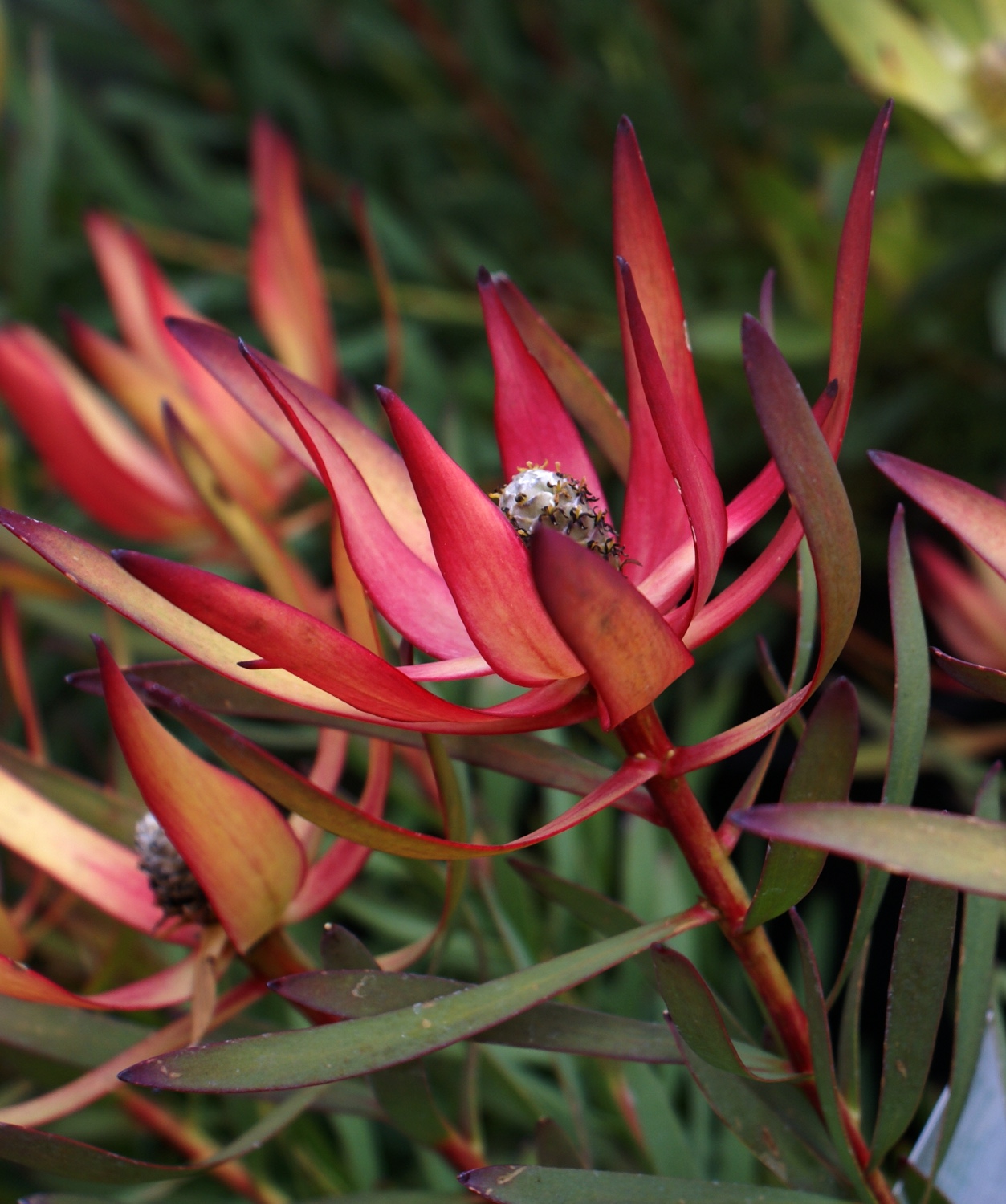
‘Rising Sun’ (photograph above)  is another good red coloured variety, probably intermediate in size between the two foregoing types.  It has bright bred bracts over winter fading to cream for the spring.  This is another good variety for picking. 

Sunday, August 14, 2011

Currant news


When there is snow quickly accumulating on the back lawn and it is freezing cold outside what else would a garden writer be doing but thinking about summer fruits, and how we should be making sure we have any new plants well and truly tucked into their garden beds soon.
My parents were not great small fruit growers , although my mother was keen on black currants and had a row of bushes that straggled across the back garden, and there were a few ferocious gooseberry plants too, but they were only looked after in a desultory fashion.  Although I quite liked Mum’s black currant jam, I certainly could not raise too much enthusiasm about going out to help her pick the thousands of berries needed for her jamming exploits.
I was a bit remiss really, as they are excellent plants for the novice gardener to start their fruit growing career with, being relatively easy to grow and very hardy.  In fact, coming as they do from the hard northern climes, the will probably be relishing a bit of snow at this time of the year – they need winter chilling to fruit well.
The variety you are most likely to come across is ‘Magnus’, which has very tart fruit until the very last minute before they ripen – the kids will certainly not be thieving them to eat them half-ripened!   The plants do best in humus-rich slightly moist soils, and prefer it to be slightly acidic – Rhododendron country suits them well – so make sure they are not planted in thin dry soil.
When you plant a new bush it pays to prune it back to two buds above the ground then leave it to grow and do not prune for two seasons. After that you will need to prune to shape by removing the old stems to a new low bud, removing at least a third of the old canes. Plants do best with about ten shoots per bush, none of which should be older than three years. To foster young wood you should cut down old wood to new buds in winter.
Red and white currants are also great for the home garden, and although they are related to black currants, they need a different planting and pruning strategy.  When you first plant you should prune to establish a short main trunk. The following season, chose four main branches making a vase shape with an open centre. Each winter, prune these branches back and allow a few more to develop until you have established a framework with about eight main branches. Each year prune these back by about half, and then at the fourth year remove one or two of the main arms back to its lowest new shoot each year as these currants bear from permanent spurs and will bear for a few years.  You should aim to have an open growth habit with main wood in the two to three year bracket.
All these currants have attractive shape and they would make a pleasant boundary hedge around the edge of your vegetable garden if they were carefully managed.  If you had a variety of different types you would also have an attractive fruiting feature in summer.

Sunday, August 07, 2011

A lot of flannel

I wonder how many garden writers are going to be spending time over the next few weeks pondering whether we are having an early spring or not.  It seems to me we are – there are Magnolias in full bloom and I have buds on some of my irises that should not be in flower for months yet – but I would not be so sure that spring is nearly here.  It does not take too much to make the God of Spring withdraw again until a more appropriate time.
I have been enjoying the slightly milder weather though, walking to work most days, taking circuitous routes so I can check up on some different gardens and see what is doing well this year and  I have noticed a couple of Phylica pubescens bushes putting on great displays.
These flannel flowers, or featherheads as they are also called,  are South African shrubs, from the buckthorn family although they have more than a passing resemblance to some of the many African proteaceous plants, in that their true flowers are hidden in the middle of (in this case, slightly) showier bracts.   The whole shrub has attractive almost-grey foliage, and is a welcome addition to the shrubbery for that fact alone, but over the winter flowers (and the bracts) are formed and by now the the hairy leaves are topped with golden flowers.  It is a fabulous plant for the winter garden, and anyone who likes picking flowers for the house will love this, as the flowers last for weeks in the vase.  In the garden it prefers conditions pretty much like those you would expect a South African to prefers– dry, well-drained and not overly rich soils, in an open situation.  They look tender but seem to be able to cope with most frosts our conditions throw at them, growing to about 1.5 metres high and the same around.  Like many South African shrubs, they are not long lived, but should last more than ten years.
I think they go really well with some of the other  South African plants that are in flower now – the Leucodendrons and Proteas look similar enough, but also different enough, to blend well with these shrubs.  Thespecimen I photographed this week is growing in dampish soil in an open position in the middle of a lawn – not the sort of location I would have recommended but it is doing fine.

Monday, August 01, 2011

Glorious Hellebores

Despite it being "clean the tools weekend" I did not spend the whole time in the tool shed – when Sunday turned out fine I took the chance to do some pricking out in the glasshouse, with the last of the iris seedlings to line out, and the Delphinium seedlings I grew from the seed from Dowdeswells to put into pots. I got a lot done but ran out of potting mix and needed to go to the local garden centre, always dangerous because there are going to be things there I am going to covet.

This time it was a great display of Hellebores, with singles, doubles and all sorts of in between forms on display. Commonly known as ‘Winter Roses’ (although they are not remotely related to roses) these are fabulous plants for the late winter/early spring garden, available in a range of subtle colours, very apt for this time of the year.

Hellebores are not too fussy about where they grow as long as the soil is not too dry, and as long as it does not become bogged over winter. They are perfectly happy in semi-shade, or even complete
shade, but they will equally well cope with full sun, as long as the soil they are planted in has plenty
of organic matter.

Once you have got them established trim off the dying leaves of deciduous varieties and remove the
seed heads as well, encouraging good strong growth and more flowers.

One of the first species to flower is Helleborus niger, mainly seen in the stunning form called ‘White
Magic’. This has brilliant white porcelain–like flowers, relatively large and carried close to the
foliage, which remains tidy over the summer. I think this is one that looks best planted in clumps if
you can afford to be extravagant. It is also long-lived – our plant was one of the first we bought and
it is still thriving after nearly fifteen years.

I was intrigued to see a new variety – to me anyway – H. ‘Ivory Prince’. 'Ivory Prince' is a complex
hybrid with beautiful, dark blue-green foliage thick and ivory-white flowers that age to pink and
eventually green. It seems to be very vigorous and I am sure will quickly become a form favourite.

The showiest species is undoubtedly H. orientalis. I remember these well from my grandparents’
garden, where they grew in wilderness-like semi-shade, in a profusion of shades from greenish-
white, through to a sort of carmine pink, some of the flowers stained with deeper colours.

I wonder what my grandparents would say if they saw modern forms with their improved range of
colours and forms – I think they would hardly recognise them. There are now some very deep red,
almost block forms, and some that verge on gun metal grey, with the appearance of a bloom on the
blooms, so to speak.

I am very taken with bi-coloured flowers, and there are some fantastic seed raised varieties available
in this range. They generally have a ground colour that is white, light pink, or the chartreuse-like
colour Hellebore growers call yellow. The ground colour is enhanced by dark highlights, usually deep
carmine.

Another form that I am taken with is the anemone centred form, with a little ruff of quill shaped
petals surrounding the stamen at the centre of the flower. When this is combined with a bicoloured
flower the effect is remarkable.

There are also many double forms available now, the doubling varying greatly from quite neat
rounded petals, to Raggedy Ann mish mashes of petals – very informal and not quite to my taste
although I can see how they would appeal to others.

All the above forms were on display at my local garden centre – as they are seed raised you really
need to see them in flower to ensure you are getting what you want. And they are not just valuable
for the garden – they perform very well when picked for the house, so useful at this time of the year
when the spring flush is still a month or two away. You’d go a long way to find more attractive long-
term perennials for the garden and house.

Sunday, July 17, 2011


This weekend I ran into a plant-loving friend in a local bookstore.  I am sure we must have frustrated the owner and her staff as we stood alongside the plant books and talked for over an hour, largely about native plants.
He works for DOC, his specialty being plants although he is also active among wild birds.  He had been very busy during the week, helping look after bids blown ashore by the severe westerly wind s we were subjected to last week. 
He had found time to read last week’s column and had some interesting things to say about the use of native plants in the garden, basically agreeing with me that we should use natives when appropriate, but we are creating gardens not botanical reserves and should feel free to plant whatever we want to in our gardens.
He had some interesting things to say about planting grasses, saying that they are much misused in the garden, often being planted without too much thought about the way they are going to end up looking.
I totally agree – well spaced and planted grasses can be an absolute highlight in the garden, but less than clever plantings can end up looking absolutely dreadful.  There is a large commercial planting I go past each day where some light brown Carex  comans (not strictly speaking grasses I know) were used to provide frontage to some Pittosporum ‘Irene Patterson’.  They were planted too close to each other, and have not been cared for in the years since they were planted and now present the garden with a messy brown smudge in front of the shrubs.
The interesting thing about grasses (and similar plants like sedges) is that they can basically be used one of two ways.  They can make wonderful accent plants if allowed to grow in a very natural manner amongst other plants.  This applies especially to those with a naturally weeping habit – they simply must have space around them to develop their proper shape.
Their other use is as a bulk groundcover, and here they need to be planted a little closer, but should still be spaced well enough for the individual shapes of the plants to be clear.
Most grasses have a light feel to the garden, and they usually also give the feeling of movement, twisting in the slightest breeze, adding an extra element to the environment.
Starting with the native grasses, I guess my favourite would be the colourful Carex testacea, a sea-loving plant usually seen growing in sand dunes and open scrub land. It has a mix of dark green and orange leaves, with a characteristic weeping form.  At this time of the year it colours up to a brilliant orange-red shade.  I walk past a planting of this growing in a mat of grey-green leaves of rock roses Helianthemum and it looks great.  I have never noticed the rock roses flowering but there are terra cotta forms and it would look stunning with them.  A further contrast is given by a planting of one of the blue-leaved Yuccas, the spiky growth complementing the flowing growth of the Carex.  The bed narrows at the far end, where an upright conifer of some kind is planted – perhaps Juniperus ‘Spartan’.  The only jarring note is a plant of Zantedeschia aethiopica ‘Green Goddess’, no doubt planted for its large leaves, but I am sure I could think of better options.
My friend’s favourite native grass is the red tussock Chionochloa rubra. Whoever named this tussock red must have been suffering from snow blindness as you would need very rosy spectacles to call this plant red but the bronze-ish leaves do take a reddish tinge if planted in full sun. A mountain plant, this one is taller growing, getting to over a metre high, with a similar spread.  It is easily grown, and will flourish in either dry or wet conditions.
I am not sure this is even my favourite Chionochloa as I am great fan of the dwarf toe toe, C. flavicans.  This has green leaves, looking a little like a finer leaved flax rather than a grass, but it also has beautiful flower heads, nearly  lime green when opening, but eventually  but fading  to cream coloured. This is another that looks great when planted in groups, but can also be an effective specimen plant in a smaller garden.
There are plenty of wonderful grasses, and grass-like plants among the exotics for the garden.
If you are looking for a bright blue I think the best bet is the blue oat grass, Helictotrichon sempervirens which has erect true blue leaves and delicate flower heads. If you have a modern house this is the one for your massed planting as it looks gloriously funky, especially if combined with contracting colours and foliage types.

Monday, June 13, 2011

Those mid-winter smellies


Although we have been having a very mild winter thus far and temperatures have been very benign, we are rapidly approaching the shortest day.  It is horrible leaving for work in the gloom and arriving home again in the dark, but the light will start flooding in with more power again and we will be back on the road to spring.
Those of you who are new to vegetable gardening are probably thinking there will not be too much to do at this time of the year – perhaps a bit of tidying up and some turning of the compost pile – but there are a couple of worthwhile crops that need to be planted at this time of the year , both members of the large onion tribe.
The first of these is garlic, the bulbs of which are now in your local garden centre.  Their culinary use has increased tremendously over my lifetime – I can well remember a time when someone who used garlic in cooking was looked at askance, as being more than a little eccentric.  That has all changed of course, and we use it more or less liberally in lots of cuisine.
Apparently it is an ancient vegetable, and is mentioned as being provided to the men building the pyramids.  It has been used as a medicine for a long time too, and there are all sorts of alternative medicines that contain it.
I have not grown garlic for a few years, but this weekend I was working at weeding last year’s new garden, and it came to me that the soil is so friable at the moment, and just perfect for planting, so I raced down to my local nursery and got some garlic and shallots.
Garlic must be one of the easiest crops to raise.  All you have to do is prise the bulb apart and plant the individual cloves, discarding the smallest ones to one side as the bigger cloves will grow bigger bulbs.  Each clove needs to be planted about 5cm deep, and they should be about 15 cm apart.  Ideally they should be in good fertile soil, well drained and in a very sunny location. My soil is a very compost-rich mix so I did not need to add any humus, but if your soil is thin it would pay to do so.  A light sprinkling of general fertiliser would not go amiss either.
As long as you keep the weeds down there should not be too much trouble growing these plants – they seem to be almost disease free, and most insects seem to leave them alone as well.  During the drier months you might want to keep an eye on them to make sure they are kept well enough watered, but apart from that, there is nothing much else to worry about.
Shallots are similarly easy to grow, and require somewhat similar growing conditions.  Even though they are closely related to onions – having a similar but more complex, milder and sweeter flavour – they grow much more like garlic, forming a head with multiple cloves.  At midwinter – the traditional time for planting both shallots and garlic – the heads are pulled apart and the bulbs planted in a similar manner to garlic, but don’t expect the same number of cloves as you will get from the garlic as there are not so many.  This also explains why shallots are quite expensive to buy – all the more reason to grow your own.
There are a number of different types of shallot available for cooking with, but not all of them are grown in New Zealand – the reddish-browned skin type seems to be the most common.
Shallots ( I suspect this applies to garlic too) are sometimes imported into New Zealand after being treated with anti-sprout chemicals, which is fabulous for the cooks, but bad news for the gardener.  Make sure you buy your bulbs from a reputable garden supplier.

Wednesday, June 08, 2011

Breeding and seeding


I took advantage of this weekend’s fine weather to spend a bit of time in the glasshouse, pricking out some of this season’s iris seedlings.  Each year I troll through my Pacific Coast Iris plants and try to work out which ones present opportunities to further the way I want my irises to look, and then cross pollinate these flowers.
With irises this is not too difficult a task as the flower’s sexual reproduction organs are easily found and crossing them is not too tricky.  All the breeder has to do is gather the pollen from the ‘father’  flower while it is nice and fresh and the bees and bumble bees have  not found it, then transfer it to the stigmatic lip of the selected mother flower.  Again, it is important to do this before the bees find the intended mother and pollinate her with rogue pollen, so we usually take the falls off the flower, removing the bee’s landing pad.  If all goes to plan we should have the selected pollen reaching the selected stigma, resulting in a new hybrid.
Trouble is, my mouth is bigger than my stomach when it comes to breeding Pacific Coast Irises, and I have far many more seedlings than I could ever hope to plant out.  I have germinated seedlings in nearly fifty pots, each one a different cross, and up to a hundred plants in some pots.  Absolute madness!
It is this sort of passion on the part of breeders that has lead to the many changes obvious in many garden flowers.  Even highly bred plants, like roses and bearded irises, are still being improved, by very controlled breeding and a thorough understanding of the genes that influence their eventual display.  In order to be a successful breeder with these plants it is almost a necessity to be raising and selling plants fulltime, very difficult in a country like New Zealand.  The best rose breeders, for example, raise tens of thousands of seedlings each year, expecting to introduce perhaps five of them to the market. 
Under these conditions most seedlings do not survive their first flowering – they are ruthlessly culled and only the very best make it through for a second flowering season.
Most florists’ flowers are now produced by professional breeders, usually based in the United States, Japan or Europe.  Carnations are a good example, as the only people working with these plants are now cut flower breeders, and they are not producing varieties that are well suited for the garden.  As a result, gardeners find it harder and harder to find varieties that suit them, and the plants gradually go out of favour.
Some plants are still largely produced by keen amateurs but they tend to be those that do not have a large cut flower demand.  Across the paddocks from the back of my house (all built on now unfortunately) live a couple of the world’s most successful dahlia breeders, their varieties being voted as among the most popular in the United States.  I was once treated to a look around their garden at the height of the flowering season, and was intrigued to see they did not practise the sort of hand pollinating techniques I am more familiar with.  Instead, they grew the two varieties they were keen to cross alongside each other and left the bees to do the job.
Partly that is because the technical issues around desexing compound flowers like dahlias – it is a very tricky and time consuming method, and in reality, results are generally disappointing with successful pollination rates being low.
I have found similar troubles when trying to breed hebes – it is just too finicky to try and desex all the various flowers on the raceme – and they do not all open at the same time of course – so it is once again best left to the bees.

Tuesday, March 01, 2011

Irises on my mind

The dreadful effects of the Christchurch earthquake are still on my mind – it is hard not to be
affected by the scenes we have seen played out on our television screens each night, and read
about in our newspapers each day. We have seen news of people we know, and heard their singular
stories about how they escaped from the shakes, and how they are trying to adjust their minds to
the new city they live in.

Like most New Zealanders, I have friends and family in Christchurch – an uncle and auntie, and their
three daughters. The older generation has passed on, and the girls live in rural town in Canterbury –
Oxford, Ashburton and Geraldine – and they are all safe.

Not so the street they were brought up on, and where I stayed as a teenager on my first visit to the
South Island. Woodville Street did not fare very well in the quake – there was terrible liquefaction in
some of the sections, and I caught a glimpse of it in a news item about neighbours pulling together
to help each other.

My uncle and auntie were great gardeners, and both long term members of the New Zealand Iris
Society, Uncle Ron serving a term as its president. He was induced to join when he started courting
my auntie – my grandparents, who were great iris fans, gave the newlyweds a dollop of iris plants for
their wedding present!

I lived across the road from my grandparents for a number of years and their enthusiasm for irises
was passed on to me, and I have in turn managed to pass it on to at least one of my sons, who loves
some of the oddly coloured Dutch irises.

These bulbous irises are interesting plants, being complicated hybrids that were bred in the
Netherland although the species involved actually come from North Africa and southern Europe,
the Spanish Iris, I. xiphium being the foundation species. It has lovely blue and yellow flowers, but
crossed with other species, has given rise to a wide range of attractive and hardy bulbs.

There are blue, purple, white and yellow varieties around, but the ones that are most likely to draw
attention, and the ones that my son loves, are the unusually shaded varieties, with a mix of brown,
mauve, purple and tan. ‘Tigers Eye’ has brown lower petals with striking veins and dark blue upright
ones, while ‘Mystic Beauty’ is mauve and bronze.

These need to be planted in light soils, preferably in full sun. They do not have any special needs but
they do need to be kept watered during the growing season, as they are prone to attacks from thrips
later in the spring if they are kept too dry.

Dutch Irises start flowering in late winter, with the delightful old variety ‘Wedgwood’ betraying its
ancestry from the notoriously shy flowering species I. tingitana. Other varieties will flower through
until mid November.


Hard as it is to remember at this time, life does go on – Christchurch will recover, much as Napier did
in 1931, and Wairarapa did in 1942. My uncle and auntie understood that - each autumn they would
scratch their dry soil aside and planted a new set of bulbs, for a new flush of flowers in the upcoming
spring.

Sunday, February 06, 2011

Waingawa River

I tried to celebrate a warm weekend by taking a trip down the Ruamahanga River yesterday.  I soon found the river had too much water in it, which was a slight problem.  I had taken my car out to the Gladstone Hotel, and Jill dropped me off at Wardell's Bridge at Te Whiti, intending to walk down to the pub.  A coiupl,e of crossings, especially once I had got past the confluence with the Waingawa, determined that it was too dangerous for a sole walker - the flow was too strong to safely cross the river.  I was hacked off!
I thought I'd be best to walk back to Wardell's, then walk along the road to the car, but as I walked back upstream past the Waingawa, I decided I could also walk up the Waingawa to the aerodrome, then walk home and get Jill to take me back to the Gladstone, figuring I could bribe her with an offer of lunch at the Gladdy.
It ended up being great fun - about a three hour tramp in all, and wonderful fun.  I even managed to have my blackberry with me!

 Oh, and yes, lunch at the Gladstone was lovely.  Jill and I arrived in one car and left in two - must have had some tongues wagging!

Spurges

It is one of the interesting things about gardening that many species we love and treasure in the garden have close relatives that are thuggish and not to be tolerated.  This week I have been engaged in a deadly battle with a plant that was given to me by a friend some years ago, and unidentified member of the Polygonum family, related to the lovely ‘Painters Palette’.  For nearly ten years it has been in my perennial garden, slowly increasing but this year it has had a rush of blood to the head and has decided to make a takeover bid for the whole garden, sending out envoys all over the place in an attempt to colonise any available land.  I have dug most of it out, but I am not fooled – I know there will be some roots waiting a bit of rain to burst into life. 
There are plenty of weeds in the family, but also a few choice garden plants, including some lovely tall perennials and some great groundcovers. I feel pretty ambivalent about them though, as I do about the feature plant this week – the spurges, the remarkable Euphorbias. When you consider that there are over 2,000 species of this cosmopolitan genus it is hardly surprising that there are some lovely charmers – and some of the most despicable thugs as well.  They range from tiny ground cover plants right through to trees, and almost all have a milky, acrid sap, earning some the moniker of milk weed.
To start with the charmers – and bearing in mind that I am writing this on Waitangi Day, we have to start with the native sea spurge, Waiuatua,  E. glauca.  This occurs in all the major islands of New Zealand, in coastal areas, but is now very rare in the wild and regarded as an endangered species.  As the Latin name suggests, this robust herbaceous plant has bluish-grey leaves in the best forms, contrasting nicely with its reddish stems.  Like many coastal herbs, it spreads with underground runners, and in well tilled soil will wander about a little, but is unlikely to become a problem in most gardens.  It has become a favourite with municipal gardeners who value its value as a contrast to either grassy foliage, or deeper coloured forms of flax.  It will grow to about 90 cm high and is surprisingly hardy for a costal plant.
There are a couple of Euphorbias released in New Zealand over the past couple of years that you could be fooled into thinking are natives – they are called ‘Kea’ and ‘Tui’, but do not be fooled – these are alien intruders, bred in England from overseas species.  They are both interesting plants for the garden, is misleadingly named. ‘Tui’ has deep purple, almost black foliage which in early spring produces flower spikes of plum to dark purple flowers.  ‘Kea’ is a different bird altogether – it has a tight, compact habit with late winter flower spikes which flush pink red before opening to a mass of continuous lime gold blooms throughout spring and summer.  These two varieties grow to about 60 cm high and are both reliable garden plants.
‘Kea’ is a form of Euphorbia characias as is one of the oddest of these spurges – the brightly variegated ‘Silver Swan.’ Again originating in England,  this variety makes a tight mound of green and white variegated foliage. In late winter to early spring, the terminal flower spikes open to green and white variegated blooms. Like most Euphorbias, this is best grown in full sun in well drained soil to give of its best.  There is similar variety hailing from Australia called ‘Tasmanian Tiger’.
The chameleon spurge, Euphorbia dulcis 'Chameleon', has leaves that open purple and deepen throughout the growing season to a rich red by the time autumn comes. Like most purple-leaved plants, it serves as an accent amidst the dominant green foliage of most gardens so place it where it will make a good contrast.  Its bracts are yellow and it grows about 40 cm.

Tuesday, January 25, 2011

Little bottlers of shrubs


When I was first learning gardening there were about five shrubs you would be able to guarantee most New Zealand gardens would contain – a lemon tree, a Photinia ‘Red Robin’, the ubiquitous Daphne odora, a purple Ake ake, Dodonaea viscosa 'Purpurea' and the glorious bright red Australian bottlebrush, Callistemon citrinus ‘Splendens’.
The others all had their good points, but it was the bottlebrush, hanging over our fence line from the neighbours, that intrigued me, with its flaming red flowers, usually covered with bees, and then it’s strange small nut-like seed capsules hanging grimly to the gently decumbent branches, their maturation seemingly taking years.  What fun it was for my brothers and I to roughly strip these seedpods off and throw them at each other, and other neighbourhood kids!
The common name for this popular and hardy shrub derives from its floral pattern – a bunch of bright stamen that spring outwards from the entire circumference of the branches holding them, giving a cylindrical flower that puts on an amazing floral display each spring.
The most commonly grown bottlebrushes are generally members of the Callistemon genus, although that can be misleading, as some botanists like to put all these into the wider Melaleuca genus, which also has many botttlebrushed flowers.  There are about 35 species of Callistemon in Australia, members of the wider Myrtle family that includes obvious relatives like Australia gums and New Zealand pohutukawas.   They are usually found in the eastern states, and generally grow in quite moist areas, so are best grown in similar conditions in New Zealand gardens.
The old ‘Splendens’ variety that I knew so  well is still available, and is good if you have a big shrubbery, and if you like tending your plants a little.  If left to its own devises the shrub will grow into a small tree, with a rather ungainly habit – the bottom will open up and the branches will all hang awkwardly.  On the other hand, if you prune it regularly, you will have a compact growing shrub that will take many years to reach two metres, and will reward you with a spectacular show in the spring.
Perhaps the best known variety in New Zealand today is the much smaller growing ‘Little John’.  This is a hybrid of C. viminalis, the other parent being unknown, and features lovely blue-green foliage and deep red flowers.  The flowers can be relied on to bloom for Christmas each year.
Red is not the only colour available in these reliable Australian shrubs – colours range from white through yellowish-green, mauve and pink.  ‘Reeve’s Pink’ is quite a popular variety, perhaps not quite as hardy as the two above, but still perfectly fine in a warm spot in our climate.  Even better, in my opinion, is a seedling raised from ‘Reeve’s Pink’ – ‘Mauve Mist’, which was selected from about 300 that were raised.  It forms a dense shrub to a height of about two meters with an equal or slightly wider spread. The new tip growth is pink and densely covered with silky hairs and the flowers, which are produced in usual  botttlebrush  fashion, are pinkish mauve and about 70mm long by about 50mm wide and will be carried as late as Christmas.
Among other forms available in New Zealand are the pink ‘John Mashlan’, which can be planted as a low hedge if kept trimmed; ‘Kings Park Special’ which is another bright red form and very hardy; ‘Captain Cook’; which has orange/red flowers, and ‘Rocky Rambler’ which is a new semi-prostrate form with smaller light green leaves and reduced flowers.
Perhaps the most unusual variety is one released a couple of years ago and heavily promoted as a hedge plant – ‘Great Balls of Fire’.  Despite its name, it does not have red flowers, the bottlebrushes being white in this case, but it is primarily marketed as a great hedging plant, mainly grown for the extremely pretty flush of pink when the foliage is new.

Sunday, January 09, 2011

Favourite foaming flowers


When we come to planning our flower gardens we often pay a lot of attention to the various colours we want to use, but do not give so much thought to the role texture can play, and how important the form of foliage and flower is.
The solid blocks of colour offered by most bedding plants stand at one extreme of the range of floral effects - the bright gold, yellow and orange shades of marigolds might be very appropriate in some places but hideously out of place in others – while the lighter effect of foamier flowers are at the opposite end of the scale.
At the moment the Head Gardener has a couple of plants of one of my favourite of these flowers out in her shaded garden at the moment – some two meter high examples of the glorious meadow rue, Thalictrum delavayi.   This is one of over 100 species of Thalictrum found in the wild – no-one seems to be quite sure exactly sure how many species there are, and the boundaries between species are poorly understood. They are not related to the true rues, but are members of the buttercup family, and mainly found in damp and areas.  The forms most commonly grown in the garden hail from meadowland and prefer garden soils that are on the heavy side.
They are a bit of a conundrum really, as they tend to have very dainty foliage – maidenhair fern-like in many species – which might lead the gardener to think they are frail, but they are remarkably hardy plants.  They flower late in the season and thus add colour to the woodland garden at a time when it is slightly bereft of interest.
The Head Gardener’s plants give a run of drama through the spring and early summer as they prepare to flower.  Over the winter they die down to become totally dormant.  Early spring sees them kick into life again; forming a clump of fine ‘maidenhair’ foliage from which the flower stalks will eventually emerge.  These shoot up and branch as they go until they form a graceful framework. The flower buds are to be found at the end of each of these branches.  At first green and in little clusters, they eventually turn lilac and strike out on their own, each  unfolding to become a perfect lilac parasol, with creamy white anthers dangling from pendulous stamens.
The double form of the species, ‘Hewitt’s Double’, has some of the showiest flowers any of the meadow rues, carrying its tight, pompom-like clusters of lilac-mauve flowers atop wiry, purple tinted stems.  There is also a pretty single white flowered form of this species, but I think the mauves are the best ones to go for.
Thalictrum aquiegiifolium is earlier flowering, with thousands of heads of tiny blooms that make a fluffy head of soft mauve in nearly summer, while T. flavum has pale yellow flowers..

These plants are all easily grown.  Any good soil will do, preferably in a sunny position or in dappled shade. They need adequate drainage, as a site that is waterlogged, even for part of the year, may prove fatal.
The natural tiered shape of the Thalictrum is spoilt by heavy staking. It is important to allow them to be themselves. Give them the protection of a more substantial neighbour on their windward side and plant them among other herbaceous plants that can lend a shoulder to lean on.  If you do need to stake them try to use as thin and unobtrusive a stake as you can.