Sunday, April 08, 2012


Narcissus 'Thalia' 

As much as those of us who love and grow bulbs may want it to be otherwise, for the majority of people spring flowering bulbs means one thing – daffodils.  My guess is that the daffodil probably accounts for nearly half of total bulb sales in the autumn. 
For us in the Wairarapa the daffodil has another special meaning as it is the floral symbol of Carterton, derived from the wonderful ‘Middle Run’ open days, dating back to the 1930s.  There the late Alfred Booth bred daffodils and spread his resulting seedlings and many other varieties he purchased through the paddocks at the front of his farm, creating a five hectare wonderland of yellow and white in the spring. 
Most of us are not privileged with that amount of land to dedicate to naturalising daffodils and have to settle for some clumps in parts of the garden.  If you have an extensive backyard, with perhaps a small orchard, you could consider establishing your own little naturalised area – just grab some bulbs of the hardiest varieties (usually sold as “farmers’ mix” or something similar) and broadcast them by hand, planting them where they land.
For myself, I have a bit of as thing for the smaller varieties, growing some in pots and containers so I can appreciate their subtle beauty, as well as scattering them about the garden – almost anywhere there is room.
One of my favourites is the pretty little ‘Jetfire’, often found in supermarkets in the middle of winter as it one that responds well to being forced into flower. The happy little flowers betray their origins in the cyclamen shaped Narcissus cyclamineus with their bright yellow backwards curving petals and a long orange cup.  The cup becomes deeper as the flower ages. This is a very reliable little plant and has steadily increased in our garden.
Another with reflexing petals is the prettily named ‘Tete-a-tete’ , a tiny variety with one to three very small delicately scented with long yellow cup and reflexed petals.  As the French name suggests, the flowers are borne in pairs facing each other.  This is another very reliable variety, being more elegant than ‘Jetfire’.
‘Rise and Shine’ is another pert little scented flower, with backwards curving white petals and small cups.  They open slightly orange then fade to yellow – another great garden plant.
My favourite of these little flowers is the wonderful white ‘Thalia’, a very old hybrid of the delightful Narcissus triandrus , the Spanish species sometimes called ‘Angel’s Tears.’  The flowers in the species (and this hybrid) hang down, softly suggesting sadness.  ‘Thalia’, nearly four hundred years old, is surely one of the loveliest of its hybrids with its pure white, pendulous flowers, two or three flowers on each stem.  I grow mine in a pot and delight in bringing them up onto the back porch where I can catch their wonderful sight and subtle scent each morning.


Sunday, March 18, 2012


I have been planting out some birthday presents this week.  It seems I am officially so old now that I am reduced to selecting my own presents, and also so old that the most exciting things I can think of to brighten up my life are some new plants for the garden.   Having an autumn birthday means I often get bulbs as a presents (and welcome they are, always) but this year I decided I wanted to jazz up my perennial border for autumn so I picked out a few things to brighten and better colour coordinate it.
The first of these was a pretty coloured Verbascum called ‘Sierra Sunset’.  Verbascums are commonly called “mulleins” and some species have made a bit of a nuisance of themselves by seeding alongside roadways and through riverbeds.  The most common of these, but not the only one, is the world-wide weed V. thapsus, the woolly mullein.  This has very woolly silver leaves and sends up large spikes of yellow flowers.  It is not normally too much of a problem in crops or in the garden as it really prefers very disturbed soil (roadside gravel seems to suit it well, as does a gravelly river bed).
There is quite a range of garden hybrids available now, mainly in earthy tones of peach and apricot, although there are also a lot of purple coloured forms.  Verbascums are lovely plants, with spikes of flowers that look like refined hollyhocks, although they generally only grow about 150 cm high.   They also tend not to be very perennial, and often die out after a year or so (some species are biennial) but they also self seed slightly.  The resulting seedlings  are generally pretty close to the original plant in colour.
‘Sierra Sunset’ is more compact than many forms, growing less than 100 cm high,  and has large peachy orange flowers borne on sturdy stems, which pop up from rosettes of soft green leaves from early to midsummer.  I am especially keen on using its soft orange colour to combine with the more orange Crocosmia ‘Lucifer’ which is growing nearby.
I also fell for another subtly flowered plant, a “yellow” Shasta daisy.  Leucanthemum  ‘Banana Cream’.  I am not a great fan of white daisies – apart from those in the lawn I do not have any in the garden – and there is no shortage of yellow daisies in flower through the summer, but this is something slightly different.  It has large, soft lemon daisy blooms stand on top of sturdy stems above dark green foliage.  The flowers definitely fade as the age, and they end up being pretty close to white, but the soft cream is a very attractive colour, and like most Shasta Daisies, this will pick well for the house.
My mother always had clumps of pure white Shasta Daisies in her garden, and they did very well for her, so I am hoping this recent introduction will prove as hardy as and generous with new growth.  It will flower through most of the summer if the flowers are kept picked, and flowers at about 45 cm high – perfect for the front of the border.


Sunday, March 04, 2012


I normally like March.  It is usually the start of the slow slide into autumn, where February’s treacherously high temperatures are starting to be tempered a little and, usually later in the month, we can expect a little rain to help break the drought.  This year, though, March came clattering in with a hiss and a roar, a trans-Tasman weather bomb bringing wind and rain in equal measure.  Trees were downed, bridges closed and even the Martinborough Fair, a 35-year veteran of coping with the vagaries of autumnal vicissitudes, decided a little discretion was called for and the bi-annual craftarama was abandoned.
When I had seen the bad weather was on its way I made a point of harvesting all I could from the vegetable garden, and what a mixed harvest it was, with a surfeit of smelly alliums (onions, garlic and shallots) providing armfuls of pungency, while the rich bounty from the tomato vines gave some compensatory sweetness. 
It was the tomatoes I was primarily worried about.  There are very full of fruit despite the slightly lousy growing season, and it is all on the turn and I thought the fruit would get bruised, and it was even possible some of the vines might get toppled by the winds.
As it turns out, I need not have worried. The fruit has escaped without too much blemish and all the vines are upright and looking well.  Despite only having half a dozen vines, we are unable to keep up with the ripening fruit, and have been in the lovely position of giving some away.  Even the strawberries have keep on fruiting well this year, and we have been able to have some on the breakfast cereal in the morning.  It feels like the height of decadence.
The Head Gardener is most excited about another fruit though – the passionfruit vine she planted a couple of years ago has got hundreds of fruit, and they are starting to colour up. If you can find a nice north facing wall this is a relatively easy climber to grow, but it does need to be given some sort of frost protection in all but the warmest spots in Wairarapa.  The Head Gardener had been on at me for a while to plant one for her but I kept telling here we did not have an appropriate site.  In the end she bought one and told me she was going to plant it along the edge of our back patio.
I have to say I was a little dubious (I should have known better really) and told her I did not think it was a suitable position.  There is no surfeit on the patio roof, and the soil in that area is very poor.  She was undaunted, and got me to dig out some of the stony soil and replace it with lots of compost.  She then planted her precious climber in the fresh soil, applied some slow release fertiliser, and carefully tied the vine to the patio trellising.
I looked on indulgently, thinking that the effort would all be in vain, and opinion I was able to express as the plant very slowly tried to gain a foothold in the dry soil at the patio’s edge.  My amusement was short-lived – the passionfruit grew, slowly at first, but then with the vigour and enthusiasm that climbing plants often display. It is now in full triffid mode, snaking its way through the trellis, sneaking past the corner and eyeing up the drainpipe to see if it can make it to the roof.
It has also made an impressive number of fruit - one of the little visitors to the garden counted them the other day, and if her maths is to be believed there are over 100 fruit on board.  The first of them are starting to lose their green lustre and are turning dusky purple.  

Sunday, February 19, 2012

Hibiscus


It is one of the unwritten rules of life (and of gardening) that the grass is always greener on the other side of the fence.  That maxim manifests itself in some very uncomfortable ways in our private lives, but it also causes pain in the garden.  I am sure Aucklanders, who can grow an incredible range of plants, are upset that many cold-requiring plants will not flourish there.  I have seen the saddest flowering cherries and hardy Rhododendrons sulking away in Auckland gardens, when far more appropriate plants would grow much better.
In reverse, those who garden in the far south would love to be able to grow many of the subtropical plants that Aucklanders take for granted, willingly swapping their swedes and turnips for some bougainvilleas and orchids growing in the garden.
We are sort of stuck in the middle here.  Some plants will not grow because our climate is not cold enough – I despair of ever successfully flowering that doyen of Fritillaries, Fritillaria imperialis despite many attempts – and our frosts mean we have to be very careful about providing any tender plants with special shelter.
For my own part, there is one group of plants I would love to be able to grow with the ease that those further north can – the shrubby Hibiscus.  Whenever we go on a summer break to northern climes I rush around with my camera, snapping the glorious silken flowers these flamboyant plants bear each year, insanely jealous, recognising that growing them around my place is just a pipedream.  They are very frost tender and in Wairarapa they need to be placed against a north-facing wall, preferably in full sun, and in well-drained soil.  None of the many varieties can cope with poor drainage, so clay soils are out too.  If you are stuck with sticky soil, and you have a warm spot for one of these beauties, I think it probably pays to invest in a nice big pot and some free-draining potting mix.
We took this step about ten years ago, when one of the boys became interested in growing some ‘indoor’ Hibiscus – they are sold that way but they will be temporary Hibiscus if grown inside for very long.   We bought a couple of these small flowered hybrids and potted them into large earthenware containers on the patio in an east-facing spot.  They did very well for the first few years, but their performance has fallen away – the yellow one is very spindly and the red one has gone to the great garden in the sky.
To grow Hibiscus successfully in pots you need to start feeding them as once they are established, as Hibiscus are hungry feeders.  The easiest way to provide them with nourishment is a good application of some slow release tree and shrub fertiliser in early summer. Hibiscus only flower on new wood so it is good to clean out the old branches each winter and let the plant renew itself.  You can be tough with the pruning – if the plants are starting to get a bit leggy and woody you can cut them back very hard.  Within a year they will have bounced back with a new framework of growth of and more crops of flowers.  Most varieties branch near to ground level and make attractively thick growth.  If you have a mind to, Hibiscus can be trained to make wonderful espaliered shrubs, an  especially good way to grow them in our climate as they are well suited to growing up under the eaves of a north-facing wall.

Sunday, February 12, 2012


Lapageria up close

This crazy weather has been driving us all mad – even the usually reliable kick start to hotter weather – the return of children to school – has not brought any relief from the dull and cool weather of this so-called summer. Plants are confused too.  I have two types of spring flowering irises that seem to think spring has returned and have put out a few flowers, and Magnolias and Michelias have also been fooled into throwing a few blooms.
Thankfully, a few plants have been able to thrive over the season and have provided their usual generous display of flowers.  One that has impressed me this year is the neighbour’s brightly coloured Bouganvillea, which is clambering over a north facing wall of her house, in a very warm and dry spot. 
These South American plants come from really warm climates – more tropical than subtropical – and need as warm a spot as possible in our climate, away from any frosts, but at the same time sheltered from the worst of the winds.  Ideally, a north-facing wall under the eaves of the house would be the right place.
They are not fussy as to soil, but will not thrive if the drainage is poor.  Remember that soil alongside houses can be quite dry and also thin, so a good application of some humus as a soil conditioner is a good idea.  Newly planted Bougainvilleas need careful watering, with care taken to ensure they do not dry out, but once they have got their feet well and truly into the bed, they will happily thrive with next to no water.
You need to be a bit careful with feeding these beauties though – they do not mind some occasionally, but make sure you do not use any formulation high in nitrogen as that will stimulate leaf growth at the expense of flowers.  It can also cause the plant to go crazy, with long whippy growths that will need careful pruning.
In Wairarapa we are a little restricted to the types we can grow.  The bright crimson ‘Scarlet O’Hara’ and the slightly lurid purple ‘Magnifica Traillii’ are the most vigorous and hardiest varieties for our climate, and are certainly the ones I have seen growing best around here. The more subtly coloured Hawaiian varieties are nowhere near as hardy.  There are also some dwarf varieties, suggested as being suitable for containers, but I have not seem them in any local gardens.
As Bougainvilleas can make a lot of growth over the season, and because they are actually clambering shrubs rather than true climbers, they need to be pruned carefully.  They flower on new wood and can be pruned back quite hard during winter and will bounce back to bloom again the following summer. As a general guide, you can cut back the stems that have flowered to within 5cm of the older wood.   Over the summer just keep an eye on any watery shoots appearing near the base of the plant and remove them.  When doing any pruning, don’t forget these plants do not twine to hold onto the plants they grow over, they grab them with the harsh thorns that line the stems, thorns that are just as happy to grab at the gardener.
If you are looking for a colourful climber, but do not have a hot north facing wall but rather a cool south facing wall, another South American could be the one you are looking for – the luxuriant Chilean Bellflower, Lapageria rosea.
These are evergreen climbers from the cool temperate forests of Chile, and like most climbers, they prefer a situation where their heads are in the sun but their feet are in the cool of the forest floor litter.  Being forest dwellers, they will take colder temperatures but they cannot stand any frost. They have a flush of flowers any time from now until later in autumn, but they have flowers most of the time. And what flowers they are!  Large bell-shaped flowers that have such a heavy texture as to appear almost wax-like, they take weeks to fully open, and then stay on the plant for many more. 
They are generally a rosy red, as you will have worked out, but the flowers usually have a subtle checkered pattern over them, so they look even more intriguing up close.  There are white forms too, which seem to have an even thicker texture.
These are hard to find at the garden centre but I know some local nurseries stock them.  They are never cheap because they are a nurseryman’s nightmare.  They are difficult to grow from seed, as you need two different clones for the flowers to set seed, then they take many years before they are sellable as they are very slow to get under way.  As if that was not enough, snails love them and seem to be able to sniff out a new shoot from a mile away, and quickly (at least as quickly as a snail can) get over to eat them.
I have a couple of plants growing along a south facing wall – a red and a white.  I hand pollinate them each year and get seed about one year in three, and then lose about a third of plants in the glasshouse.  I am not trying to pout you off growing one of these – I think they are one of the choicest of all climbing plants, and if you have got a south facing wall with a cool root run, you should try and hunt one out.  They are very long lived, and apart from the snails do not seem to get any pests.  And even better – they do not seem to be badly affected by a bad string of summer weather.

Monday, February 06, 2012


We have interesting discussions in our family about the role ‘nature’ and ‘nurture’ play in shaping our personalities.  On the one had we have the geneticist son, on the other the teacher Mum, each arguing their corner, until finally agreeing that both have a part to play even if they do not agree on the ratio.
This argument is especially interesting at the moment as our younger son has re-developed an interest in gardening now he is established in his Wellington flat.  He had gardens in the nursery, filled with miniature roses, and a small garden here which is nominally his although he has never done any work on it.  Now he is settled in a flat his innate (or nurtured, depending on where you sit on that debate) love of gardening has come to the fore and he has made his first real gardens.
Interestingly, he has planted lots of colourful annuals, including bedding dahlias, petunias, Livingstone daisies and marigolds, despite saying he saw far too many of them as he grew up helping in the bedding plant nursery we owned.
But he has also got interested in succulents, which I guess is only to be expected as it where so many of us find our interest in gardening first stimulated.  I still have a pot of a small Aloe species that came to my from my grandparent’s sunroom, via my parents patio.  I think it is Aloe aristata, a species that was once very common as a pot plant, mainly because it was so easy to keep going.  Just pop it in a well lit area and it will flourish, eventually sending up a 30 cm tall stalk of pinkish-red tubular flowers.  Over time the mother plant will form little offspring around her bas and will eventually develop a nice clump of dark green, tight leaved rosettes. 
There are so many different succulent plants, with an almost infinite number of different hybrids that it may pay us to define exactly what we mean.  Generally speaking, succulents are regarded as being plants that in the wild grow in arid regions, and have developed water retention tricks to help survive sustained dry periods.  They usually store water in their leaves, although some do so in their stems, and a few have evolved to do it in their roots.  Many of them have also developed silver foliage as a way of combating excessive heat.
Many can be grown as pot plants, and they are good plants for beginner gardeners to start with as they will forgive the errant waterer.  On the other hand, of course they do not like too much water, so will quickly die of kept damp.  In the garden they can provide a very useful counterpoint to other foliage colours, and they are well adapted to growing in those difficult warm and dry spots near houses or on banks.
The most common of these are the Echeveria species and hybrids, part of a group of over 150 species native to the Americas, from Texas to Argentina.  The leaves, which are usually silver, form symmetrical rosettes either sitting on the ground or at the end of long stems. Some types make multi-stemmed shrubs growing to a metre tall.  They can withstand long periods of drought and will grow in a variety of garden situation, but for or really intense colour they prefer to be in a well drained position with plenty of sun and air movement and regular water.  The most commonly-grown forms are the smaller growing silver leaves species that are used for edging in dry conditions. They generally flower with a spike of orange/yellow flowers in early summer.

Sunday, January 29, 2012

A sticky end


One of the delights of gardening is its very seasonality, the way as gardeners we become attuned to the ebb and flow of the year.  In spring we relish the emergence of the daffodils, and we plan for the upcoming planting season for the vegetable garden.  In summer we glory in the harvest of our sub-tropical crops (capsicums, tomatoes, cucumbers), while in autumn we marvel at the glory of the changing colours of the leaves.   In winter … well, in winter we hibernate, pull out our plant catalogues and plan another growing season.
But there are other regular patterns too, ones that garden writers come to experience.  One of these concerns an unusual and interesting plant that seems to puzzle people about every seven years or so.  Late last year the enquiries started about it again.
People get in touch to ask about a strange plant they have in their garden that looks a bit like a flax on a stem, or perhaps some kind of Agave (if they know what that is!) that has grown a trunk, and then flowered with an enormous and odd looking inflorescence.  This flowering stem, with pale white flowers, then does another unusual trick – instead of setting seed it produces small bulbils that can easily be detached and will thrive if potted up. 
And when they get in touch I know that it is a flowering season for Furcraea parmentieri (formerly F bedinghausii) – and that might cause heartache for the gardeners who get in touch, but more about that in a second.
Furcraea parmentieri is a wonderfully dramatic plant with great architectural value, its handsome blue-grey foliage making it a popular garden plant in many parts of the temperate regions of the world. Although it comes from the arid regions of central southern Mexico at altitudes of 2500m-3000m and thrives in dry, free-draining poor soils it is hardy.  I have seen clumps of this plant used to great effect in the Dunedin Botanic Gardens.
But there is heartbreak for those who love this plant – like many of its relatives it is monocarpic – it flowers just once, in an amazingly dramatic fashion with a spike that can reach up to three metres, then goes into a rapid decline and dies.
The odd thing is that many of the plants in the region seem to die together.  I assume they have come been planted at the same time and whatever climatic trigger causes one plant to flower affects others raised at the same time.  A recent Times-Age photograph showed three plants along the front of a house, no doubt planted for their architectural value, now in full flower and about to die!
The last time we had a mass flowering of these plants I collected up some bulbils, and grew them on in the glasshouse, intending to plant them out.  I never actually got to put them in the garden, and gave most of them away, but I have two growing in large pots and they look very attractive.

Friday, January 27, 2012

In my newly replanted perennial garden a funny thing has happened.  Some of you might remember me writing this last year when I was writing about removing a lot of plants from this garden: “Another clump to go was a big patch of Crocosmia ‘Lucifer’, a plant that I have failed with - incredibly enough bearing in mind it is simply an improved Montbretia, one of the weediest of the South African bulbs.  The catalogue assured me it had wonderful foliage and ‘amazing heads of flame-red blooms’ but it has never flourished with us, perhaps being too crowded, but the flowers seem to fall to botrytis and the foliage gets very diseased looking, so out it came.”

Turns out I did not get rid of it all, and also that the clean out must have allowed better air circulation around it as it has been stunning this season, the foliage being nice and clean and the flowers, which are opening now, showing no sign of any disease. It looks just superb, although slightly at odds with the rest of the garden, as I planted a lot of light pink and blue flowers around it.

Other funny things have been happening too – lots and lots of white Gladiolus flowers have been appearing. It is one of the prime tenets of garden writing that Gladiolus most emphatically do not revert to white, despite many gardeners thinking they do.  Well, I have to say I have never planted any white Gladiolus in this (or any other) garden, so they are either reversions from other varieties, or they are very vigorous seedlings.  The stems on the (non-reverted) Gladiolus are most impressive – they reach up to two metres and when the flowers at the tip open, there is a little branch of new flowers appearing at the base of the stem as a little bonus.
It may be that strictly speaking these have not reverted to white, but they could have been seedlings from a non-white plant.  Either way, I have a patch of white Gladiolus where I once had coloured varieties.

Tigers for the summer


Mid to late summer can be a tricky time in the flower garden, with many perennials having had their main burst of flowering and now concentrating on growing a little to store some more fat to ensure a good flowering next season.  Thank God for those long term flowering plants like Dahlias and day lilies that seem to just keep on giving more months on end, and of course, for those annuals that have prolonged flowering periods.
Fortunately there are also some that flower at this time of the year, including a few very attractive bulbs with spectacular flowers.  I have a great love of the exuberant Central and South American show offs, the Jockeys Caps, or Tigridias to give them their proper name.  These are members of the vast Iris family (immediately noticeable by their arrangement for floral parts in threes) and are mainly forms of the one species, T. pavonia, although there are other species in cultivation, sometimes to be found on the lists of bulb specialists.  I have grown a number of these rarer species, but they are quite tender and it is difficult to over winter the bulbs.  They rot in the soil and are attacked by aphids if stored dry.
 The hardier garden hybrids are a different kettle of fish. As long as they are grown in well drained soil and in a sunny aspect, they will thrive in Wairarapa conditions and multiply nicely, without ever getting to be a nuisance.  The most commonly grown form is probably the bright red form, although a quick look around plant catalogues shows the pink form is the one most offered.  I like the red form, as it is a bright cherry red unseen in any true irises, but I think my favourite colour is probably yellow. 
You would think that with a name like Tigridia, these bulbs would have been named after tigers, and would accordingly have striped flowers.  Not so – they are solid coloured across the main part of the petals, but the central area of each flower is spotted and splotched with a co0ntrasting colour, usually deep red.  In the red flowered forms the central portion is yellow based, with red /maroon spots.  The most spectacularly different form I have grown is the species T. duranguense, a Mexican species with mauve flowers that are prominently mottled all over the flower.  There are many other species, mostly unavailable in New Zealand, to tempt the keen bulb collector.
These cheery flowers only last a day each, but they are carried in a long succession, with flowering lasting for over a month usually.  I find it pays to grow the different colours in different parts of the garden as the plants set seed very easily, and the red strain seems to swamp the other colours.  Tigridias are very easily raised from seed, and a range of colours would soon give rise to some interesting forms for the person interested in starting out plant breeding, as they flower from seed within two years.
There might be another reason for growing these plants – they are apparently delicious to eat! Luther Burbank, the great American plant fiddler and creator of the Burbank plum, the Plumcot and the Shasta Daisy, discovered that these lovely bulbs were edible.  He said: “When cooked like potatoes, or made into a stew, they constitute a really delicious vegetable.  To my taste the bulb of the tiger plant is at least the equal of any vegetable under cultivation. It is also highly nutritious. I am not sure that it has an equal among the vegetables of our gardens in its combination of nutritiousness and appetising flavour.

Sunday, January 08, 2012

Penstemons


The stars of the Christmas bouquet this year were the stems of luscious Penstemons, which I have scattered in various beds around the back yard, and with which I am totally enamoured. They are largely North American plants, and for our gardening purposes split into two different groups.  There are a number of more or less dwarf species which are very valuable for edging a border, or for an old fashioned rock garden. 
However, the more commonly found forms are the border perennials that are sometimes called the “queens of the summer border” much loved for the prolonged flowering season and their hardy reliability. They are very easy plants, at home in any soil as long as it is not too damp, and will thrive during the hotter summer months.  Many species are to be found in arid areas of North America, and Americans tend to think of them as wild flowers, which perhaps explains why the hybrids are more popular in Europe than they are in their own country.
One of the reasons I like these guys is that you can easily bulk them up yourself – they are very easily grown from autumn cuttings, grown under cover over winter and planted out in spring.  That allows you to be generous with the planting size you can go for, and believe me, a bed of ten or more of one variety looks absolutely stunning.
There are many, many varieties on the market, and I am not sure that they are all correctly named.  I have some catalogues where the owners are proudly stating they have the “true” form of a named variety, alongside that of other nurseries, where the same claim is made, and the plants are quite different.  It might be that the best thing is to see them in flower in your local garden centre and decide on that basis.
‘Blackbird’ is one variety there is some discussion about.  As I understand it, this has relatively small deep maroon flowers, held delicately on dark stems, making it a great cut flower.  It grows to just over a metre high, and will spread almost that wide after a few years.  But there is another ‘Blackbird’ being sold in New Zealand, and the “true” form, with flowers that are nearly as deep but are much fatter and are borne on a plant that is much stumpier in growth.
Another with slightly wiry stems is the glorious ‘Drinkstone’ which has rich reddish-pink bells drooping gently with large stems filled with colour.  When at its best, the large stems are covered with flower making this a great variety for picking.
One of the older varieties which have stood the test of time is the subtly coloured ‘Hidcote Pink’, named after the lovely English garden. It has medium sized flowers, pink with dark pink veins in the throat. It clothes its stems well with bloom and is a hardy reliable doer in the garden.
If you were picking a few Penstemon to grow with an eye for picking for the house you would make sure you had ‘Snow Storm’. It has pure white bells in heavy panicles on strong stems and is a fabulous addition to the border and is probably one of the best white flowering perennials for summer.  It is medium seized at about 80 cm, and has a bushy growth habit.
If showy plants are more you style, and you are a fan of falsetto singing or disco music you will not be able to resist ‘Maurice Gibbs’, with his cerise pink to red flowers with a bright white throat.  On the other hand, if you are feeling more sombre and sober you might want to go for the darkest Penstemon you can find.  In that case you will be looking out for ‘Raven’. As well as being one the darkest of all the varieties, it is also one of the showiest, with dusky, purple flowers that flare just enough to let you see a white striping on the throat.  It is not one of the huskiest growing of the Penstemon, but it is surely one of the prettiest.

Monday, January 02, 2012

Leeks


The start of a new year is a good time to replenish the vegetable garden, although to most of us the thought of too much strenuous work in the days after Christmas is rather daunting. This season,  weather broke a few days after Christmas though, and those who had made the effort to replant were repaid with a few days’ showers to help water the new plants in.
I was not so well organised.  My gardening over the break consisted of harvesting various components of our festive fare, and helping my son and his partner exert a modicum of control over the wilderness that comprises their Wellington garden.
Still, the New Year’s weather might have dampened down enthusiasm for midnight frolics but it certainly left the garden spoil in great condition, and I was keen to get some leeks planted for the winter harvest.  I had some free ground from the small area where we had grown a token crop of Christmas potatoes, and although it is not really ideal soil for growing leeks, I managed to turn it over and went out seeking some leek plants.
I am usually keen to buy some, nice punnet-grown plants for the garden, but I think members of the broad onion family do better if planted from open-ground grown seedlings, so instead of popping along to my garden centre I shuffled into the supermarket and got a bundle of field grown leeks –they were bigger and huskier than anything I have ever seen grown in a punnet.
The first step in growing leeks is to carefully choose where to plant them.  They are not overly fussy about soil types but they do best on light soil that had been well manured for a previous crop, probably best a green leaved crop such as lettuce or cabbage.  They are best not grown in a patch that has previously grown a crop of new potatoes, as the soil will be too loose and friable – leeks do far better on quite firm soil – so I made sure I trampled over the soil to firm it up before I planted out.
If you like long white stems on your leeks you are probably going to have to try a trick or two at planting time. Using a thick dibber or trowel, make some holes about 15 cm deep and about 20cm apart, making sure the holes are vertical.  You then need to move the dibber or trowel from side to side so that the holes are slightly larger at the top and about 5 cm wide.
To prepare the plants, trim the roots until they are 2.5 cm long and also cut the tips off the leaves. The leeks should now be gently dropped into the holes, filling the holes with water.  The water will wash enough soil over the base of the plant to allow it to become established. When you are cultivating the soil around the plants later you will slowly fill the holes up.
You will need to keep a close eye on the young plants once they are placed out as they need to be kept well watered for the first few weeks. Once they have settled in you could give a side dressing of general fertiliser, or perhaps a weak liquid fertiliser. You well need to keep the weeds down, of course, and keep the soil well aerated to allow any natural water to seep in, plus to make better use of the irrigation you apply.
Once the plants are growing well you can start to build up soils around the base of the plants, aiding the blanching that will return a larger proportion of the vegetable as the sweet and subtle flavoured part of the leek, rather than the coarser and stronger green portion.
When you harvest them is up to your taste.  I am rather partial to baby leeks (I have a great recipe for fish fillet, herbs and baby leek casserole) so I pick some when they are still quite young.  I will let some grow larger but I think they are probably best when about 3cm through, perhaps a little more.  I am certainly no fan of those monsters you sometimes see at the vegetable shows, with stems about the thickness of a pick handle!

Monday, December 26, 2011

Poinsettias


It was an interesting Christmas this year – the raspberries were a little bit behind and we did not have very many for Christmas dinner, although the young visitors still managed to find a basin each for themselves!  The Christmas lilies managed to splutter open on Boxing Day – about a week later than normal, meaning we missed what is an important element of Christmas for the Head Gardener’s family.
Still, the other important components were there – freshly dug potatoes, oodles of chocolate and champagne, and most of the family members needed to make it a great day.
One of those was the Head Gardener’s brother and his wife – they work and live in Switzerland and had been looking forward to a warm Christmas so they flew in on Christmas Eve.  He has a management job with an international seed and agricultural products company.  When we had a chance to have a chat about business he casually let drop the information that his company is one of the world’s major suppliers of Poinsettias.
Poinsettias are a common Christmas gift, their bright red leaves (not really leaves but we will come to that soon) seemingly heralding the festive season.  The traditional explanation is that shortly after the Spaniards colonised Mexico a small girl gathered flowers from the countryside to decorate the altar to celebrate Jesus’ birthday, and the tradition quickly spread.
These members of the Euphorbia family usually colour up in the middle of winter, thus they are a natural for celebrating the season in the northern hemisphere, but they have to be tricked into performing in this country.  The coloured bracts (which surround the true flowers) are produced in reaction to diminished light levels, so clever pot plant growers manipulate the light levels in their glasshouses to produce them for this time of the year.
If you were lucky enough to have one for Christmas and you would like to prolong the flowering season there are a few simple things to remember. Firstly, they need to have a good amount of light but it is important to keep them out of direct sunlight. It is probably best to keep them in a warm and well-lit room, near a sunny window. Make sure you keep them away from cool breezes, as they can be sensitive to the cold.
It is important to get the watering down properly, as Poinsettias like to be kept damp but resent being kept over wet. To check (until you can tell just by looking) put your finger in the mix and if it comes back damp then the plant does not need watering. On the other hand, if your finger is dry you should water the soil until the water runs freely from the bottom of the pot. IT is important that the plant never sits in water though, so sit your heavily watered pot in the sink until the water stops coming out the bottom, then place it back on its saucer.
There is no fixed regime for watering, and you will need to check every couple of days to see whether your plant needs any extra liquids.  One thing you will not have to worry about is feeding the plant – it will have had all the nutriment it needs supplied when it was planted in potting mix.

Sunday, December 18, 2011

Christmas trees


As well as being the season of goodwill to all men (and to all women, children and small furry pets) this is also the time for decorating Christmas trees, and for hunting out logical alternative “Christmas trees for our seasonally challenged Christmas.
The traditional tree is an evergreen, usually a conifer of some kind.  In New Zealand that has generally been the ubiquitous Pinus radiata, usually harvested from a low hanging branch or flogged from the side of a desolate country road.  In the northern hemisphere it is more likely to be a spruce or a fir tree, both of which grow more tightly than our pines.
Of course, the point of the evergreen tree for the northerners was to celebrate the potential return of the new growing season.  In the depths of winter there were few trees that remained clothed with foliage, and plants that did were given extra value – the holly and the ivy being two obvious examples.
In southern climes we have adapted to decorate our own native trees.  Most Kiwis will be very familiar with the idea of using a pohutukawa for their Christmas tree, but for most of us in Wairarapa that is impractical.
I say most of us, because in some favoured sites in our district it is possible to grow and flower a pohutukawa, and not just at the coast either.  Obviously they do best near the sea, and many of our beach settlements feature pohutukawa that flower for the summer holidays. There are some nice trees in sheltered places in Lansdowne too – one of my favourites is near the top of Titoki Street – but for most of us in frost prone areas pohutukawas are probably on the wish list.
There are some strategies to have a living native Christmas tree that might work though.  Firstly, pohutukawa love being kept dry and will grow well in straightened circumstances (see the cracks they grow in when in the wild) so they will do well in pots.  That will not work with seed raised plants as they take a long time to mature, but cutting grown forms should be perfectly able to cope with being container grown, and some forms at least should flower.
The best known is probably ‘Tahiti’, the Pacific Island relative of our native tree, with silvery foliage and orangey red flowers that flourishes in a warm spot on the patio and will relish being grown in a pot.  It is smaller growing than the New Zealand forms, but if you want to try an indigenous one you could try some of the cutting grown native types such as ‘Fire Mountain’ and ‘Parnell’, both red flowered, and ‘Pink Lady’.  If you like softer colours go for ‘Moon Maiden’, which has soft yellow flowers.
‘Mistral’ should be slightly hardier as it is a hybrid between a pohutukawa and its close cousin the rata and is slightly hardier when established but still needs cosseting until it has grown up through the frost zone in our climate.
 The Australians have their own native Christmas tree, the New South Wales native Ceratopetalum gummiferum, so called because of its wonderful display at this time of the year.  Oddly enough, it is not a floral display in the strict sense of the word, as the flowers are borne earlier in the season, usually a couple of months before, and they are white.  After the flowers have matured the bracts surrounding the flowers start to colour, deepening from soft pink through salmon until they end up bright red at this time and a little later.
This small tree is slightly tender in our climate but it makes a wonderful specimen tree, as is evidenced by the mature specimen in Essex Street.  I try to make a point of getting around to seeing it each summer as it is so attractive.
I have read that there is a form for sale in Australia with white bracts, called ‘White Christmas’ of course, but I have not seen it in New Zealand.


Sunday, November 27, 2011

Dry land plants


Our summer seems to have arrived, heralded with a late outbreak of spring gales, with north westerly winds blasting down off the Tararuas, and the temperature steadily climbing.  As the months turn over, and November gives way to December we are once again faced with the need to work out a method to cope with the upcoming dry months, when our available water supply is rationed.

This past week has been illustrative of the need for water – the combination of winds and a lack of heavy rain (although we actually had some rain) means the lawns have stopped growing with the desperate passion they have been hitherto showing.

It is hard to tell what the weather will do for this summer but I note that NIWA are saying we can expect normal or slightly more than normal rain in the period December 2011 – February 2012.  However, they also go on to say that soil conditions are river levels are likely to be lower  than normal because both are starting our at lower than usual for this time of the year.

In a way it makes little difference, as the Wairarapa district councils are all under pressure to keep their water usage low as they do not have the ability to take endless amounts of water from local rivers.  Under these conditions all gardeners need to be a bit water smart over the coming few months.  Fortunately there are a lot of things we can do to help reduce demand on our precious water supplies.

One of the most effective ways to do this is to choose plants that are appropriate to our conditions. The fact is we live in dry areas, and should not try to grow wet climate plants unless we can provide some natural supplies of water.

At this time of the year I love the way Mediterranean plants come into their own.  Lavenders are perfect hot and dry climate plants, with their fresh grey/green leaves and wonderful range of coloured flowers.  They work well in formal gardens, but are equally at home in naturalistic plants. Among the other great dry climate shrubs are rock roses, Cistus and their cousins, the Helianthemums.  These plants, with their silvery leaves and tough textures, will thrive in the heat of summer, and will always look tidy.  For native lovers, most Hebes will do well in similar conditions, including many silver leaved forms.  Some of the coastal Coprosmas, and most grasses will also thrive as will the Wairarapa native shrubs, Brachyglottis greyii and B. compacta, with silver leaves and golden flowers.

In the garden we can extend the range a little more with some other heat-loving shrubs especially the Australian and South African shrubs that thrive in our climate.  Proteas, Leucodrendrons, Regal pelargoniums, Grevillias, and many others, will all do well and will easily cope with the summer dry.
Extra colour can be added by other dry loving bulbs, perennials and annuals, as well as a good dose of the very fashionable succulents, such as Aloes and Agaves.  You could also try the new variegated Beschoneria yuccoides that I saw recently in a local garden centre.

Sunday, November 06, 2011

Manuka trees


My newly established perennial garden in the back area of our section is all abuzz, and it is not from the range of new and special perennial plants, although it is exciting to see the first of the flowering for the first time.  No, the garden is buzzing with the hundreds of bees making a beeline for the bright red flowers on the tall specimen of the bright red manuka, Leptsospermum ‘Electric Red’ that is at its peak right now.
I do not know whether this is one of the forms of manuka with the special health giving attributes that are passed on through the honey, but if it is there out to be some very healthy and happy honey eaters in the vicinity, as there bees fly in and out of there like it is Los Angeles airport on a busy day.
Manuka is so ubiquitous on the dry and hungry lands of New Zealand, and thrives so well on recently disturbed soil, that it will come as a surprise to most New Zealanders to learn that this species actually arose in Australia where it has many relatives living, and is a relatively recent arrival in our country, having made its way across the Tasman as seed.  When New Zealand was well forested it was an uncommon plant, but following Polynesian discovery of Aotearoa, and the subsequent fires and open ground, it managed to make a strong foothold. 
It appears in many forms in the wild.  On exposed coasts it assumes an almost prostrate growth form, while dwarf growing forms are also recorded from very exposed and nutriment poor locations.  Wairarapa gardeners (and farmers) will be well acquainted with the usual form of the species in our district, a compact medium sized shrub with masses of white flowers.  In the north there are populations with pink-flushed flowers – I recall a fabulous morning exploring the vegetation at the head of the Hokianga Harbour, where low growing pink flowered forms abound – while forms with pure red flowers have been found in the wild, and a range of hybrids has been bred for the home garden.
I think the bright red ones are the most popular, including the ‘Electric Red’ form I have in the garden, which is apparently a hybrid with an Australian species, but looks very much like the old favourite ‘Red Ensign’, with pure red single flowers.  I was always a fan of the double flowered ‘Red Damask’, which had masses of frilly double flowers from late winter right through into summer.  ‘Red Falls’, which has single red flowers, does not fall quite as much as the name might lead you to think – it does have some branches that scoot along the ground, but others will gently arch upwards as high as a metre.  It works very well if planted on top of a bank and also makes a very effective weeping standard.
There is a pink coloured form called ‘Pink Cascade’ , offered somewhat mischievously by some nurseries as a native (including at least two well-known “native” nurseries) when it is in fact a hybrid between two different Australian species.  If you are interested in growing a pink flowering shrub with a prostrate habit, and are not concerned about it not being a native, then this would be a good choice.   It is tolerant of a range of soils but performs best in moist, well drained soils in full sun or light shade.

Sunday, October 30, 2011

In the garden this weekend


This weekend felt like it might have been the first of the summer-like days – mild temperatures, light breezes and no rain for the first time in ages. I spent most of it in the garden, doing a wide variety of chores.   Primary among those was working among my Pacific Coast Iris seedlings, recording the blooms as they opened, selecting those that will live to see another day and removing those destined for the compost heap, and making new crosses.  Each year I plant about 300 seedlings and about ten will make it through to flower the second time, so it is a slightly upsetting process, but one that most be carried out – we already have far too many irises around here and if I did not cull out rigorously we would have tens of thousands.
I did manage to get a bit of time in the vegetable garden too, getting my tomatoes in the ground.  I know many of you will have put yours in last weekend, but I like to let the ground warm up a little more before I plant mine out.  I bought some advanced grade F1 hybrids a week or two back and grew them on in the glasshouse to make them even bigger – it is the early crop that makes the difference when growing tomatoes at home.
I had prepared the soil well by digging in some extra compost and also boosting the soil with fertiliser.  I placed the stakes in the ground before planting, and then dug some holes a little bigger than the bags the plants were growing in.  This allowed me to plant each tomato slightly deeper than it had been in the bag – the theory is that tomatoes planted slightly too deep will form roots from the exposed stem.  If you chose to do this, remember not to plant deeper that the first leaves.
I also bought some basil plants when I got the tomatoes, but these will stay in the glasshouse for a few weeks yet, as basil needs the soil to be even warmer than tomatoes before it will establish well. I usually grow a few plants of the normal sweet basil, but I prefer the more interesting flavour of the spicy globe variety.  This has smaller leaves – it makes a neat little bush and could be used as an edging if you were looking for one for the vegetable plot over summer.  If you prefer more pungent types you should probably go for Thai basil, which is commonly used in Asian cuisine and has a star anise overtone.  There is also a nice lemon scented variety which has a strong citrus fragrance.
All basils prefer moist conditions in as warm a spot as you can provide.  If you want to see basil growing very fast and with succulent leaves try popping a few in a tunnel house or in the glasshouse.  It grows like a weed, but retains that wonderful pungent flavour.  In the garden, a warm spot with lots of water and lots of food will suit them well – I grown them among the tomatoes, where they get a bit of shade at the height of the day.  Later in the season they can look a bit tatty, so I just cut them back (use the leaves for a pesto that you can keep) and give some extra fertiliser, and the plants soon bounce away again.
If you are new to gardening and have constructed a box-like structure for growing your vegetables, you can probably plant your basil straight away.  These elevated gardens will warm up a lot quicker than garden soil, and will be ready for planting a week or two earlier than most open gardens.  You should already have good crops of lettuces and other summer salad greens underway.  Don’t forget to try one or two other leaves for your salad greens – young beet leaves are tender and luscious, and mizuna and rocket leaves provide a lovely sharper taste. 

Monday, October 24, 2011

I nearly got the blues!


Last week I wrote about an All Black garden – and for a while this weekend I thought I was going to have to describe a garden full of the blues – “Les Blues” certainly had this gardener’s heart in his mouth for far too many minutes on Sunday evening!
Actually, a blue garden would not be a bad thing, but there are blues and blues, so you would need to be careful about which ones you mixed in, keeping the pink blues away from the true blues.  When the Head Gardener and I first established our combined garden last century we fairly quickly came to the conclusion that it might be a good idea if we had our own separate parts of the garden.  I had lived on my own for a while, and had discovered a passion for gardening and wanted a different sort of garden to her.  One of her first gardens was a blue and yellow creation.
I was thinking about that the other day, when my neighbour popped her head through the hedge that divides our gardens, grasping a flower in her hand, asking what it was.  She thought it might be a member of the bluebell family, but it looked unlike most bluebells she had seen.
She was right – it is a bluebell, one with one of the funniest botanical mix ups you can imagine.  When Carl Linnaeus, the man who invented the binomial system of botanical naming, was first shown this bluebell, he asked where it had come from.  He was told it had come from Spanish ship called the Peru, so he called it Scilla peruviana, and for the next 350 years people have assumed it comes from South America.  It is actually a wild plant of Spain and Portugal, glorying under the “official” common name of Portuguese Squill, although it is also called the Hyacinth of Peru, Peruvian Scilla, or Cuban Lily.
It is a clump forming bulb which tries to retain some leaves over winter, and in the spring slowly pushed up strong racemes of purple blue flowers in late spring.  It is very hardy and is a great plant for the front of the border.  It can also be naturalised but it is not easily come by in the trade so you might need to look around for it.
I saw masses of it last week, as I wandered around Napier’s hillside cemetery one warm evening.  As well as the more common blue form there were also some clumps of the white form, which probably stood out as bit better in the evening light.

Sunday, October 16, 2011


It must be because it is spring, and because of the heroic exploits of a certain rugby football team, but I have been thinking about an all black garden again.  You might recall that I planted one a few years ago, but became disenchanted with it and removed it.  I would not want to plant a garden with only black foliaged plants again, because it looks very flat and is not very appealing.
But I do think very dark coloured flowers have a place in the summer garden, as they provide a good contrast to the happier and brighter colours we associate with the hot season, and they often proved a textural contrast as well, as many of them have velvety flowers.

A couple of weeks ago I saw for the first time, the black petunia that everyone has been talking about, and I was impressed with its “blackness”.  Often colour break are nowhere near as good as they are trumpeted to be – think “blue” roses and “red’ irises for example, but in this case, ‘Black Velvet’ lives up to its name.  It is black, and it is velvety.

It was bred by flower breeder Jianping Ren for the Ball Colegrave Company, using old fashioned hand pollination and selection – no genetic modification here.  She has come up with a stunning addition to the range of plants available for summer colour, and I am already thinking about how I might use it in my garden.
I have a new perennial border with lots of space in it – the plants were only planted a couple of months ago and I had always intended to plant a lot of annuals in the bed this year.  I am wondering whether light green flowers might go well with deep velvety colour – perhaps the cool lime green Nicotiana variety called –wait for it – ‘Lime Green’.  This is a cousin of the petunia, from the same part of the world, and likes similar conditions so it should do well alongside ‘Black Velvet’.  They have similar shaped flowers though, so it might be better to introduce a bit of contrast, and maybe go for the chartreuse green of Zinnia ‘Envy’.  This has semi-double dahlia-shaped flowers and will look spectacular alongside the petunia, or even better, behind it, as it grows a little taller.
Of course, I could go for the opposite effect, and try and plant some white flowers alongside the petunia.   It is not a very subtle idea, but then who said I was subtle?  I was thinking I might put some of a new Arenaria montana ‘Avalanche’ in the front of the bed.  This is a new and improved form of a cousin to the garden pinks.  It grows flat along the ground and in spring and early summer has an – dare I say it? – avalanche of starry white flowers spilling over the ground.  It has attractive green-grey foliage (not unlike a Dianthus actually) and even when not in flower would make a good foil for the petunia.
Or how about a soft pink like the delicious looking Diascia ‘Strawberry Splash’?  This is one of the newer hybrid Diascias (cousins to the perennial Nemesias) and has delicate soft pink flowers which keep coming and coming all over the summer, especially if the plants are trimmed back occasionally.  I have a soft spot for these slightly tender South African perennials, as growing some of them set me off on my nursery-owning career, and they are perfect plants for the home garden, as they are hardy, can cope with a bit of dry if you forget to water them for a day or two, and they just keep on flowering.  There are brighter colours around – some very bright in fact – so you might prefer one of them, but the contrast with the black makes me plump for ‘Strawberry Splash’.


Sunday, October 02, 2011

Little Aussie orchids


Whenever I am asked what my favourite flower is, I have a choice of two answers.  The first and strictly speaking the more correct answer is to reply “Irises”.  They were plants I was brought up with and they remain my most favoured flower, at least partly because of the long flowering season and their relative ease of cultivation.
The other answer I give is also nearly true – “Whatever is in flower at the moment.”  Right now I am just getting over loving daffodils, and I still have a passion for tulips.  In the weeks ahead I will fall in love with flowering cherries all over again, and when the irises finish I will reconnect with roses.
But this weekend my favourite flowers will be orchids, in all their glorious variety, because the Wairarapa Orchid Circle are holding their annual show in the Town Hall, and I will once again be enamoured of this most sophisticated of all flowers.
One of the things I love about orchids is the huge range of flower and plant types, and the way there seems to be something that will suit most gardeners, from those who love big, bold, brassy flowers, through to those whose interest is in the tiny gems of the plant world.  There are wonderfully scented varieties, some with the most garish colours imaginable, and others with white flowers pure en ought to make the most avid “white garden” fan swoon.
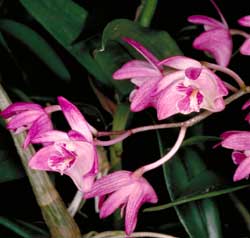
In my glasshouse I have a little collection of Australian Dendrobium hybrids and I am watching their buds expand at the moment.   There are a lot of different species which basically fall into two groups, those that grow best in the cool and those that prefer warmer temperatures.  Because my glasshouse is unheated and also houses a lot of different kinds of plants I have restricted myself to cool growing forms, which tend to be smaller flowering but more robust.  They are often forms of D. kingianum, an eastern Australia native, usually found growing on rocks and known to locals as the Pink Rock Orchid. It is generally a small plant which produces stems of light pink to dark purple flowers held on long inflorescences above the plant. There are white varieties and a few spotted and variegated varieties, and some bicoloured forms too.  My plants are growing in orchid mix in quite small pots, and they are flourishing, but I absolutely drool when I see the large clumps that I see in the annual show – huge plants with hundreds of flower stems holding shimmering butterflies of flowers.
These attractive little flowers do not take a lot of care – they cannot if I can look after them.  They are watered every couple of days and given the occasional feed of dilute fertiliser in spring and summer, but apart from that get no special treatment.  They do not need to be grown in a glasshouse either – they will flourish in any cool frost-protected area, such as a porch or a patio as long as they get enough dappled light.

Sunday, September 25, 2011

Scents and sensibility


The Head Gardener and I took advantage of the warm weather at the top end of the weekend to go for a stroll down to the Kuripuni village for lunch.  It was very pleasant walking along in the sun, looking at the gardens and noticing how much spring has moved along in the past few weeks.  At one garden we stopped to look at a shrub growing over the fence line with wonderful racemes of chartreuse-yellow flowers.  The Head Gardener looked at me and said “That’s it, that’s it!”
I must have looked a little puzzled, as she gently reminded me that I had failed to identify a plant she had come home and asked about.  A work colleague had been given a bouquet which featured what she had described to me as “Lily of the Valley flowers, but from a shrub”. I knew she would not have meant the shrub usually called the Lily of the Valley, the Pieris as we have a couple of them in the garden.
At the time I just could not picture what she was walking about, but I really ought to have thought of this lovely shrub.  It is Stachyurus praecox, a deciduous plant so it has gone out offavour a little but it has a lot going for it, with a charming display of flowers in the spring before the glossy coppery-brown leaves unfurl.  At this time of the year it is very valuable for picking, the colour seeming to go with most colours, especially the golden colour we associate with daffodils and Forsythias.
There was another attraction in a garden a few houses down the road and I could not quite work out what it was at first.  A beautiful scent was drifting over the footpath – heady and sweet and fruity all at the same time.  I thought it was perhaps Daphne, but then I thought it was a bit sharper than that. When I had a closer look through the shrubbery I was astonished to see that it was a mix of at least three different scents, all within the same small garden.
Against the wall was a trimmed specimen of that charming semi-deciduous charmer, the hybrid Viburnum x burkwoodi. It is undoubtedly the most popular of the scented Viburnums in New Zealand, with tight clusters of pure white flowers at this time of the year, carrying a soft fragrance that I have seen described as being like that of baby powder – certainly less heady than Daphne. It has nice green foliage in the spring but grows a little sparsely and can look a little straggly until it is mature.  Clipping will help that but you need to be careful as if you clip it too hard you will knock the flowering back as well.
The semi-deciduous behaviour it shows is understandable as it is a hybrid between the evergreen V. utile and V. carlesii.  The former is a rare species in New Zealand, and I have never seen it offered, probably because it is not very attractive, but V. carlesii is usually findable and is a very fine deciduous shrub. It grows to about two metres and at this time of the year is covered with the most delightful pink-budded flowers, opening to white, and scented even better than V. x burkwoodii in my opinion.  You will find this in garden centres at this time of the year and it is well worth seeking out.  It always reminds me of my old gardening friend Henry Carle, who used to write this column when I was first interested in gardening, and who encouraged me over the years.