Saturday, June 30, 2012


In the time I have been involved in gardening, tastes have changed dramatically.   Roses, which were once the staple standby of almost every garden, have suffered a sad reverse in popularity, as have many flowering plants.  The days of rows of gladioli lined up, all clearly labelled and staked have long passed, as have the rows of glorious gerberas stashed into dry areas under windows, their glorious, and sometimes gaudy flowers, flaunting themselves summer long.
But some plants have somehow managed to sustain their favourite status, albeit in a reduced state, and perhaps those decadently-scented evergreen shrubs, the various members of the Daphne family, have managed it better than most.
I was walking past a garden centre the other day and they had a barrow of Daphnes, “pink and white” lined up for sale, all looking healthy and happy, with deep green glossy leaves.  They were all forms of the most popular of Daphnes in New Zealand, the almost-hardy D. odora.

This has been a favourite of New Zealand gardeners for many generations, with its clusters of extremely fragrant flowers in early spring earning it a deserved place in most gardens.  Only the most curmudgeonly of gardeners could fail to be impressed with its heady scent.  They could legitimately complain about their longevity however – these are notoriously short-lived in the garden.
Things have actually got better in the past few years, as the removal of debilitating viruses and the subsequent production of plants from disease-free stock using tissue culture has definitely helped keep these beauties a lot hardier.

There are a few little tricks you can do to help keep your plant healthier and happier – and hopefully, keep it thriving longer in the garden.
Firstly, it is important to remember that they are very fussy about where their feet are.  They do not like being in very moist conditions and they are very particular about having their roots disturbed –they hate their feet being touched, dug into or uncovered.  They will do far better in a shrubbery where they are able to be left untouched than in a traditional mixed bed, with cultivation of the soil around their roots.

You need to be a bit canny about feeding them too. Firstly, they prefer a slightly acidic soil – they will not grow in areas that are limey, so forget about planting them with lavenders, irises and rock roses.  And they do not like too much nitrogenous fertiliser either – too much N in the NPK fertiliser rating and they will bid your garden farewell.  All they really need is the occasional touch up with a low dose of acidic plant food – something like Azalea food would suit them fine, or perhaps a few prills of a slow release fertiliser like Osmocote.  If you think they are growing a little unwell due to acidity not being right, you could try a touch of Epsom salts – it seems to help often.

It has to be said that some Daphnes are not the tidiest of growers – they tend to get a bit twiggy as they age.  It is a good idea to keep them slightly trimmed as they grow – do not try and give them a hard pruning or cut them back hard – they simply will not take it.  Instead, only lightly prune after flowering.  Picking the flowers is a great way to do this!

If we are having a cold winter the plants can sometimes be a bit slow to come into flower – do not worry about this as it is entirely natural and the plant will not be suffering any long term damage.  Similarly,  sometimes when plants are laden with flower buds, the leaves can turn yellow and drop off. Again, do not get too stressed about this – the plant is just dropping some leaves to put its energy into producing flowers, and new leaves will soon enough grow where the old ones were. 
There are a few choices when it comes to D. odora. The most commonly grown is probably the longer-leaved and more robust ‘Leucanthe’, which has ruddy flowers.  Among the type species, with shorter leaves and more compact growth, there are white and pink forms as well as one marked as apricot and called ‘Cameo’.  I have to say whoever named this variety was looking through apricot coloured glasses!
Regular readers will know I am no fan of variegated plants usually, but the form known as ‘Aureomarginata’ as a delight, with a delicate band of gold around the edge of each leaf.  Mine has proven to be short-lived but I will replace it if I can find another plant.


Sunday, June 24, 2012


I was quietly tilling the soil in the vegetable garden during a slightly fine break at the weekend, preparing it for a mid-winter planting, when it dawned on me that I was getting ready for one of my favourite genera (that is a flash way of saying my favourite group of plants).  This is a group of plants that forms a significant part of my vegetable crop rotation, is also found in my little herb garden, and yet is also one of my favourite flowering plants as well.
In case you had not already worked it out I am talking about the wide Allium genus, home to onions, garlics, leeks, spring onions, shallots, and chives as well as innumerable glorious flowering bulbs as well.
At this time of the year it is the garlic and shallots that are occupying my mind, as mid-winter is the traditional time for planting them.
Shallots are small perennial onions I guess – usually sweeter and less pungent than true onion, and usually grown from divisions of an extant bulb rather than from seed.  I grew a good crop of these last year and have kept some of the bulbs aside to use for planting this year.  I found that each bulb I planted grew about five or six new bulbs, and as they are very much a “no fuss“crop they are ideal for the new gardener.
It is best to fertilise you soil well, with a general fertiliser – make sure it is not too nitrogen rich as that will lead to soft growth and potential disease problems later one.  I worked the soil up to a fine tilth and then planted the shallot bulbs about 1-2 cm below the surface.  Some people say it helps start growth if you soak the bulbs in some cool water for about 15 minutes before planting, but I figure that is unneeded as they are going to be soaked soon enough!
The theory is that the plants will have grown to maturity by mid-summer, but I found last year they needed a little longer in the ground.  We had a terrible summer of course, so that may have been the problem.  Anyway, it is the usual onion trick of waiting until the tops start to fall over, then twisting the tops to let the bulbs dry out naturally.  The bulbs store well without sprouting and can be used right through the winter for extra flavour.
Garlic grows in a very similar manner, although a garlic bulb has more divisions (“cloves” as cooks call them, although they neither taste not look like the spice cloves.)  Garlic is very tough and hardy and remarkably easy to grow for the home gardener, although it must be stressed that it does best in good soil.  If grown in poorer or damp soils it tends to be more reluctant to fatten up very much.
Again, plant the cloves with the blunt end down, and just push gently into the soil, which you will have pre-fertilised. They will take a little while to pop into life, but soon enough they will be racing away.  If you have grown your own previously, you can just keep some cloves for planting out, but it probably pays to buy in some fresh stock every few years, just to make sure you have vigorous plants.
If you have a bit of room to play with, and lots of cloves to play with, you could grow some “garlic greens” by planting a clump of cloves quite closely in fertile soil and harvesting them through the spring and summer, leaves and all, and using them in stir fires.

Sunday, June 17, 2012

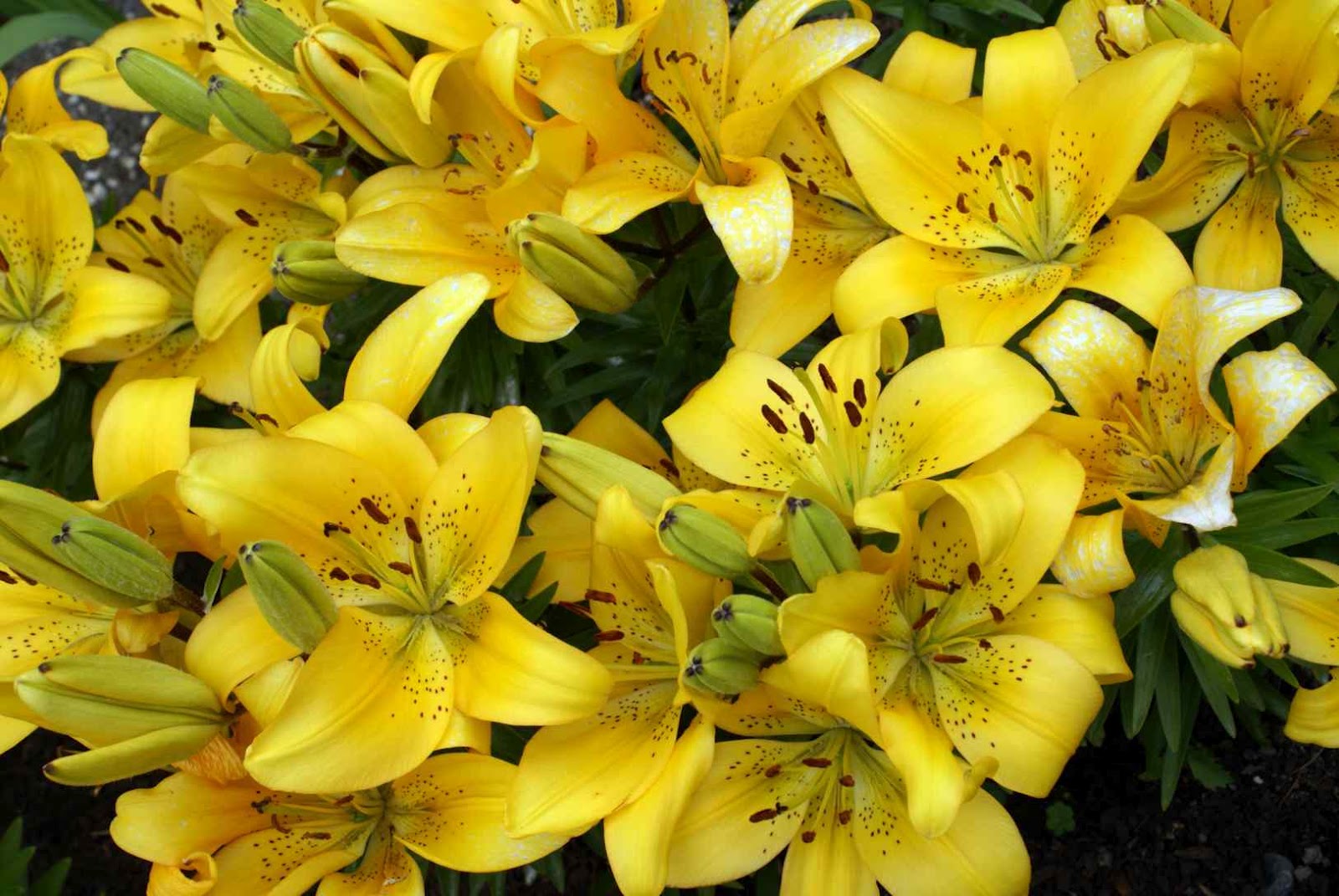
Lilies


The last week has seen the arrival of real winter, with snow piled up on the peaks of the Tararuas, and a succession of cold days – really cold days – that remind us that Matariki is here.  The traditional Maori New Year is a goodtime for taking stock, and celebrating the turning of the year back towards summer time.
Although that is true in a literal sense, it is also (unfortunately) a little fallacious.  Due to the effect of the sea warming and cooling more efficiently than the land, we have a drag between the “real” mid-winter, which is today, and the coldest days, which are ahead of us still – July is usually the coldest month.
A bit of time out in the garden this weekend was enough to drive the message home – it was bitterly cold and I was more than happy to get back inside.  I had been tidying up a patch in the vegetable garden to plant some garlic and shallots (more about that next week) but I also had a prowl around the garden, looking at how things were progressing.  I had the tedious chore of picking up the large leaves from the Magnolia ‘Sweetheart’ which is a feature of our back garden – and stands in the middle of an iris trial bed.  The leaves have to be removed as they make a terrible mess as they rot down, and they are wet and cold at this time of the year.  But the recompense is in the buds - beautiful silver-coloured buds to give a subtle reminder of what will be in store in a few months.
I feel the same way about the lilies that are scattered throughout the garden.  Some of them leave ugly stems in early winter, and they have to be carefully removed, while one other species, a Lilium martagon seedling tries to flower out of season in the early winter.  The frost usually gets the flowers.
I am a relatively late convert to the beauty of the lily – it was not until we came to this garden about 15 years ago that I grew anything other than the Christmas Lily, Lilium regale.  This heavily scented treasure, such a traditional favourite for some families, did not feature much in our family, but the Head Gardener’s mother and grandmother were both huge devotees, and we now have two or three clumps around here.  It is always a welcome component of the Christmas house decoration, although one allergy-prone son does not appreciate it so much.
My own mother was a keen gardener who tried to get by without spending too much on the garden – she had no money to spare – so we were always aware of her special purchases.  I have fond memories of the special attention she paid to her favourite highly scented lily – the golden ray lily from Japan,  Lilium auratum.  You would probably be hard pressed to find the species in New Zealand now, but its blood runs through the Oriental Hybrids that are in the garden centres at the moment.
They can be slightly tricky growers - they are gross feeders for a start, and need good humus enriched soil.  You could use organic matter as light mulch, and then fertilise in the spring and just before flowering.  They must not be allowed to dry out but you must also have excellent drainage as they cannot tolerate wet feet.  I have them is raised beds, the ground covered with other plants.  In really hot gardens they would probably benefit from light shade.
I have a couple of glorious plants which I have to pass when I go for my evening swim in the hot nights of February, and their heady, almost decadent, scent is at its best at that time of the night – I luxuriate in the cool water and soak up the fragrance.
They are available in shade of white and pink, through to almost red.  The flowers can be single-coloured, but some of the best have golden or red bars on the petals.

Sunday, June 10, 2012

Outrageous good fortune


Some years ago I got myself caught in the middle of an argument with a plant breeder from a scientific institute from the South Island, by suggesting that sometimes scientists might not be the best people to be breeding plants for the commercial horticulture business, and further saying I thought they may have other scientific ideals that got in the way.
One scientist responded, and we corresponded for quite a while, swapping notes about the various plants we shared a common interest in.  He was particularly interested in native plants, and was excited about a cross between a manuka (Leptospermum scoparium) and a kanuka (Kunzea sinclairii), found on an offshore island, which was duly registered and made available to the plant trade, under the less-than-sexy name of Kunzspermum hirakimata ‘Karo Hobson Choice’.   And since then it has disappeared without trace.
Meanwhile, nurserymen have been fiddling with manukas for years, since the first pink flowered forms were found in the wild, then the red forms were also discovered and the double flowered forms were crossed with the coloured ones and a range of coloured and doubled forms were introduced – from California and Australia mainly.
Interestingly, the manuka, a quintessential New Zealand plant you would think, is actually quite a new migrant from Australia, where there are over 80 species.  Both manuka and kanuka are thought to have arrived within geologically recent times, their spread throughout much of the country having been aided by human intervention in the form of fires.  There are many different forms, and some variation in flower colour.  In Wairarapa the upright white flowered form is most commonly seen, but anyone who looks at these plants in the wild will have noticed there are some bushes which seem to have aberrant flowering seasons.
The most interesting array of wild plants I have ever found was on the heads of the Hokianga harbour, where light pink flowered plants in a variety of forms abound.
Australian nurserymen seem to have become  a lot more interested in raising some hybrid Leptospermums from species other than our native one recently – I am not sure that you could call them manukas as they are not indigenous, so perhaps we’ll call them hybrid tea trees, after the name Captain Cook originated when he made an infusion from their leaves.
One I noticed in garden centres this weekend is ‘Outrageous’ – and I mean that is its name.  It is one of a number of colourful cultivars developed at Bywong Nursery at Bungendore, New South Wales, a cross between two Australian species.  It is a medium shrub which grows to about two metres high with drooping branches and narrow leaves about 15 mm long, with a more green tinge than our manukas usually possess. 
The five petalled, deep red flowers are larger than usual for a manuka, being about 20 mm diameter, and have a have a green centre which contrasts well with the red petals.  Its parent species are said to be hardy so this could be an interesting addition to the range of Leptospermum varieties available in this country.
One of its parents has mauve flowers, so if ‘Outrageous’ was crossed with New Zealand forms we might be able to extend the range of colours found in the cultivars already on offer.

Sunday, May 27, 2012

Where have all the flowers gone?


Over the weekend the Head Gardener and I had some time in that most dreaded of environments for a middle-aged man – a big city shopping mall filled with bright lights, trawling teenage girls and shops filled with garish colour. Seeking some respite, I went into a bookstore and had a look at the gardening books.  I was astonished to see that about 80% of them were about edible gardening – fruits, vegetables and herbs.  There were a few books devoted to design – mainly of the “Making your edible garden look good" kind – but there were precious few about growing flowers, and apart from one on roses, the only books on  specific plants were one each about Cycads and bromeliads!
I am as keen as anyone on the resurgence of interest in cultivating edible plants, but I am greatly saddened by the demise of flower gardening.  When I was growing up it seemed to me that most people had a favourite flower they cultivated assiduously  – various family members were fans of irises, roses, camellias, fuchsias and orchids, while organisations devoted to gerberas, carnations, dahlias and cacti all flourished. 
Famous New Zealanders were passionate flower growers. Prime Minister Robert Muldoon was famed for his lilies, but few know that NZRFU president Ces Blazey, best known now as the name who guided the 1981 Springbok tour of New Zealand, used to devote his spare hours in summer to growing exhibition quality Gladioli.
This was brought home even stronger to me when I left the bookstore, drawn to a florist’s shop by the heady scent of some greenhouse lilies, and came across vases filled with spider chrysanthemums, in unnatural chartreuse shades.
At one time Chrysanthemums were ubiquitous garden flowers, treasured for their late flowering season, and appreciated especially for the autumnal shades they are often found in.  Apart from the potted plant version, popular with florists and supermarkets, they are seldom met with now, but can there be any plant with so much flower power at this time of the year?
I suspect that the few chrysanthemum plants that are grown in the home garden today are actually potted plants that have been planted outside when they finish flowering.  As long as a bit of care is taken with have a long life in the garden, but expect some changes!  In the nursery your potted mums will have been given a dose of growth retardant, and once they are out in the garden they will grow a lot more exuberantly – they will probably be about 1.5 metres high when they flower rather than the 60cm they managed in their pot. 
They will also tend to be a bit straggly growing – nothing terrible but a bit floppy, so it pays to grow them near a fence of some other support. You can pinch them out as they start to grow, and then once again as they have grown a little, which will result in more branching and more heads of flowers, although the individual flowers will be smaller.

Sunday, May 20, 2012

Sports day


I was cleaning up my office the other day, as a consequence of our recent refurbishment of much of the house, and I came across a photograph I put aside a while ago to form the basis of a column about the way new plants are produced and introduced to horticulture.
It is one I took in the Queen Elizabeth Park rose beds some years ago, when I stumbled across a chimera flower – one where the signals to determine flower colour had somehow got their wires partly crossed, the result being a strange bloom that could not quite make up its mind whether it wanted to be red or yellow.  The decision was obviously so difficult the flower simply gave up on trying to resolve it – one half of the flower stayed the same red as all the other flowers on the bush (and indeed in the bed) while one half decided to go yellow.
This sort of flower genetic shift or change, albeit normally associated with the whole flower or habit  changing colour, is more common that you might imagine at first, and has led to some interesting new varieties, especially among those that are grown by the millions, such as roses.  
Sometimes the shrub-sized plant ends up a climbing shoot, which remains stable and can be reproduced.  Perhaps the best examples of that are the climbing forms of ‘Iceberg’ and ‘Peace’.  Sometimes the sport can be a change of colour – ‘Peace’ rose, that doyen of big flowered hybrid tea roses, has given rise to a number of sports, including the wonderful ‘Kronenburg’.  There is a bed of this at the new Queen Elizabeth Park rose garden, and it has its gigantic flowers that are an interesting take on the pale cream and pink shades of ‘Peace’.  It has two main colours - the petals are claret red with straw yellow reverse. It is impossible to ignore and ostentatiously beautiful.  And, although I have never seen it, it has also re-sported, by sending up a climbing shoot, which is available on overseas websites.  And I know of at least one re-sporting of this in Masterton.  A lady came to see me once about a gardening matter, and mentioned in passing how disappointed she was with her ‘Kronenburg’, saying she had cut a whole branch off because the flowers had all turned deep gold! 
Perhaps the most common of all ‘sports’ are those that give rise to different coloured foliage, with variegations of various sorts, and sometimes even changes in shades of the entire leaf.  Some plants seem particularly prone to his habit.  Anyone who has owned a large Cupressus macracarpa will probably have seen tips of old branches with golden foliage.  The vast majority of the many golden forms of conifer you see will have originated this way.  The surprising thing is that some plants seem very prone to doing this, while other, such as the ubiquitous Pinus radiata seem very reluctant to do so. Apart from one or two golden forms, which I think were actually seed sports and thus slightly different, there are not too many ornamental forms of the Monterey Pine around.

Sunday, May 06, 2012

Maples in autumn


May is a funny month in the garden.  Summer is well and truly past, and autumn is approaching its peak in some ways, but in other ways the winter has already arrived.  

Parts of the garden look a mess - the perennial beds look very ragged, with ugly foliage on peonies and hostas requiring looking after, and less than happy-looking daylilies also need a clean-up.
The vegetable garden loos decrepit as well - tomatoes have long since stopped growing, and basil and eggplants need removing.  The last of the unripened tomatoes have to be gathered for placement on a sunny shelf, and the empty space where the summer vegetables once grew needs turning over and mulching.
And then there are the autumn leaves.
There seem to be polar opposite views on the question of autumn leaves.  Some people seem to find them an abomination, and need to clear them daily - if not more often - while others take a much more relaxed attitude to them, perhaps even harvesting them for children to play in, or regarding them simply as a good source of roughage for the compost.
I firmly belong to the latter school, although I must say I nearly changed my mind when the large and resilient leaves from the large flowered Magnolia hybrid fell among the grass-like leaves of my Pacific Coast Iris seedlings.
We do not have a lot of autumn coloured trees and shrubs in the garden - the Head Gardener does not entirely approve of deciduousness - but there are one or two I would not be without.  
We have a mature Japanese weeping maple at the edge of one of our shrubberies, and I wonder if there is a small tree which gives as many different highlights during the year.  In the winter it has a slightly gaunt aspect, devoid of leaves as it is, but it also has wonderful architectural shape, the gently tumbling branch habit catching the eye.  In spring our form, which is the plain green Acer palmatum ‘Dissectum Viridis’, pops out the most amazingly bright green leaves, accompanied by very delicate little flowers, like very miniature ballerinas.  They need to be seen up close the be noticed, but they are stunning.  Later the leaves mature to a more sombre green, which the hold nicely over summer, but as winter approaches again, they kick in with a lovely display of yellow, orange and red. Even when that is all over, and you think there is nothing more to come, there is a little encore performance from the ‘helicopter’ seeds, which are light brown against the dark brown of the old leaves.  
These little beauties, which are reasonably expensive, add so much to the garden that they should be on almost everyone’s list of top shrubs.  There is quite a range of them available nowadays - more than when we bought our one, when there was basically one green and one red form around, with a number of different red (or purple) varieties to choose from.  ‘Crimson Princess’  has red stems and foliage right through spring and summer, but as autumn approaches it turns bronze then bright scarlet. ‘Crimson Queen’ is slightly more subdued, but has similar habits, while the old variety ‘Inabe Shidare’ has lacy purple foliage that is tougher than most, enabling it to cope with more sun than most other varieties.
If you want a totally different form try the new ‘Orangeola’.  This has orange tinted leaves when it first opens, but the leaves then turn deep rusty brown before becoming green for the main growing season.  But the show does not end there, as a supply of new orange leaves is produced over the summer, the new foliage looking like flowers. In the autumn all the leaves turn dark red before finishing off back again as orange.  A superb weeping variety that is quickly becoming popular overseas.


Sunday, April 29, 2012


We were in Melbourne recently, and I had promised the Head Gardener that I would take her to the most interesting garden she had ever seen – bearing in mind the Head Gardener is a Kindergarten teacher.  Accordingly, on Monday we made our way by tram out to the Royal Botanic Garden, entering at the opposite end to the entrancing garden I had promised to show her, and for the next few hours we meandered through the beautifully landscaped gardens, looking at the trees and shrubs (and the few plants that were in flower) and enjoying the sights and sounds of the Australian avifauna.
As we made our way up the literal highpoint of the garden, I promised her that the allegorical highpoint, the marvellous Ian Potter Children’s Garden, was not far away.  And sure enough, after tours of cactus gardens, cannas gardens, fern gardens, herbs gardens, and even New Zealand gardens, we found ourselves outside the Ian Potter garden – which is closed on Mondays and Tuesdays!
Wednesday morning saw us catching a different tram and making our way directly to the Ian Potter Garden, which was indeed open, and in full use.  The garden is a great example of what can happen when a child-centred garden is created, with lots of opportunity for exploration and discovery.  Most of the plantings are of Australian natives, but interestingly, some clipped creatures in the front of the garden are made from the New Zealand native Muehlenbeckia complexa, under planted with the New Zealand sedge Carex comans.
One of the first things you find inside the garden is a wonderful plant tunnel, evocative of the Australian scrub country, which leads to a pond and a series of little streams, constructed to enable children to get their feet wet.  Further into the garden is a jungle-style garden, with stone structures and thickets of bamboo, and a playhouse, brown by planting willow stakes and allowing them to grow.  The horticultural highlight to an old man was the red flowering gum, Eucalyptus ficifolia ‘Summertime’, but the many children in the garden were far more entranced by being able to run around in the spaces created.
To one side, but integral to this garden, is a child-scaled kitchen garden, which was being visited by a succession of school parties while we were there.  The kids were entranced by the wide variety of plants growing there, and there were signs that some school parties had been allowed to make a contribution – a row of recently geminated peas was labeled with a suburban school’s name. 
The range of plants growing (bear in mind this was in mid-April) was a little strange to our eyes.  Freshly planted lettuces were cheek by jowl with a shrubby chili, laden with curious small bell-shaped fruit.  In one bed a lovely crop of leeks was growing alongside some maturing capsicums, while just over the pathway a large bed of tropical fruit included pepinos and sugar cane.  It was interesting top overhear the lessons being carried out in the garden, and to realize how few of the children knew many of the fruit and vegetables on display in the elevated beds.  They did enjoy playing in the sand pit that was also part of the garden!
Interestingly, the adventure part of the garden was mainly peopled by younger pupils, largely at play, while slightly older children were being instructed in the kitchen garden.  

Sunday, April 08, 2012


Narcissus 'Thalia' 

As much as those of us who love and grow bulbs may want it to be otherwise, for the majority of people spring flowering bulbs means one thing – daffodils.  My guess is that the daffodil probably accounts for nearly half of total bulb sales in the autumn. 
For us in the Wairarapa the daffodil has another special meaning as it is the floral symbol of Carterton, derived from the wonderful ‘Middle Run’ open days, dating back to the 1930s.  There the late Alfred Booth bred daffodils and spread his resulting seedlings and many other varieties he purchased through the paddocks at the front of his farm, creating a five hectare wonderland of yellow and white in the spring. 
Most of us are not privileged with that amount of land to dedicate to naturalising daffodils and have to settle for some clumps in parts of the garden.  If you have an extensive backyard, with perhaps a small orchard, you could consider establishing your own little naturalised area – just grab some bulbs of the hardiest varieties (usually sold as “farmers’ mix” or something similar) and broadcast them by hand, planting them where they land.
For myself, I have a bit of as thing for the smaller varieties, growing some in pots and containers so I can appreciate their subtle beauty, as well as scattering them about the garden – almost anywhere there is room.
One of my favourites is the pretty little ‘Jetfire’, often found in supermarkets in the middle of winter as it one that responds well to being forced into flower. The happy little flowers betray their origins in the cyclamen shaped Narcissus cyclamineus with their bright yellow backwards curving petals and a long orange cup.  The cup becomes deeper as the flower ages. This is a very reliable little plant and has steadily increased in our garden.
Another with reflexing petals is the prettily named ‘Tete-a-tete’ , a tiny variety with one to three very small delicately scented with long yellow cup and reflexed petals.  As the French name suggests, the flowers are borne in pairs facing each other.  This is another very reliable variety, being more elegant than ‘Jetfire’.
‘Rise and Shine’ is another pert little scented flower, with backwards curving white petals and small cups.  They open slightly orange then fade to yellow – another great garden plant.
My favourite of these little flowers is the wonderful white ‘Thalia’, a very old hybrid of the delightful Narcissus triandrus , the Spanish species sometimes called ‘Angel’s Tears.’  The flowers in the species (and this hybrid) hang down, softly suggesting sadness.  ‘Thalia’, nearly four hundred years old, is surely one of the loveliest of its hybrids with its pure white, pendulous flowers, two or three flowers on each stem.  I grow mine in a pot and delight in bringing them up onto the back porch where I can catch their wonderful sight and subtle scent each morning.


Sunday, March 18, 2012


I have been planting out some birthday presents this week.  It seems I am officially so old now that I am reduced to selecting my own presents, and also so old that the most exciting things I can think of to brighten up my life are some new plants for the garden.   Having an autumn birthday means I often get bulbs as a presents (and welcome they are, always) but this year I decided I wanted to jazz up my perennial border for autumn so I picked out a few things to brighten and better colour coordinate it.
The first of these was a pretty coloured Verbascum called ‘Sierra Sunset’.  Verbascums are commonly called “mulleins” and some species have made a bit of a nuisance of themselves by seeding alongside roadways and through riverbeds.  The most common of these, but not the only one, is the world-wide weed V. thapsus, the woolly mullein.  This has very woolly silver leaves and sends up large spikes of yellow flowers.  It is not normally too much of a problem in crops or in the garden as it really prefers very disturbed soil (roadside gravel seems to suit it well, as does a gravelly river bed).
There is quite a range of garden hybrids available now, mainly in earthy tones of peach and apricot, although there are also a lot of purple coloured forms.  Verbascums are lovely plants, with spikes of flowers that look like refined hollyhocks, although they generally only grow about 150 cm high.   They also tend not to be very perennial, and often die out after a year or so (some species are biennial) but they also self seed slightly.  The resulting seedlings  are generally pretty close to the original plant in colour.
‘Sierra Sunset’ is more compact than many forms, growing less than 100 cm high,  and has large peachy orange flowers borne on sturdy stems, which pop up from rosettes of soft green leaves from early to midsummer.  I am especially keen on using its soft orange colour to combine with the more orange Crocosmia ‘Lucifer’ which is growing nearby.
I also fell for another subtly flowered plant, a “yellow” Shasta daisy.  Leucanthemum  ‘Banana Cream’.  I am not a great fan of white daisies – apart from those in the lawn I do not have any in the garden – and there is no shortage of yellow daisies in flower through the summer, but this is something slightly different.  It has large, soft lemon daisy blooms stand on top of sturdy stems above dark green foliage.  The flowers definitely fade as the age, and they end up being pretty close to white, but the soft cream is a very attractive colour, and like most Shasta Daisies, this will pick well for the house.
My mother always had clumps of pure white Shasta Daisies in her garden, and they did very well for her, so I am hoping this recent introduction will prove as hardy as and generous with new growth.  It will flower through most of the summer if the flowers are kept picked, and flowers at about 45 cm high – perfect for the front of the border.


Sunday, March 04, 2012


I normally like March.  It is usually the start of the slow slide into autumn, where February’s treacherously high temperatures are starting to be tempered a little and, usually later in the month, we can expect a little rain to help break the drought.  This year, though, March came clattering in with a hiss and a roar, a trans-Tasman weather bomb bringing wind and rain in equal measure.  Trees were downed, bridges closed and even the Martinborough Fair, a 35-year veteran of coping with the vagaries of autumnal vicissitudes, decided a little discretion was called for and the bi-annual craftarama was abandoned.
When I had seen the bad weather was on its way I made a point of harvesting all I could from the vegetable garden, and what a mixed harvest it was, with a surfeit of smelly alliums (onions, garlic and shallots) providing armfuls of pungency, while the rich bounty from the tomato vines gave some compensatory sweetness. 
It was the tomatoes I was primarily worried about.  There are very full of fruit despite the slightly lousy growing season, and it is all on the turn and I thought the fruit would get bruised, and it was even possible some of the vines might get toppled by the winds.
As it turns out, I need not have worried. The fruit has escaped without too much blemish and all the vines are upright and looking well.  Despite only having half a dozen vines, we are unable to keep up with the ripening fruit, and have been in the lovely position of giving some away.  Even the strawberries have keep on fruiting well this year, and we have been able to have some on the breakfast cereal in the morning.  It feels like the height of decadence.
The Head Gardener is most excited about another fruit though – the passionfruit vine she planted a couple of years ago has got hundreds of fruit, and they are starting to colour up. If you can find a nice north facing wall this is a relatively easy climber to grow, but it does need to be given some sort of frost protection in all but the warmest spots in Wairarapa.  The Head Gardener had been on at me for a while to plant one for her but I kept telling here we did not have an appropriate site.  In the end she bought one and told me she was going to plant it along the edge of our back patio.
I have to say I was a little dubious (I should have known better really) and told her I did not think it was a suitable position.  There is no surfeit on the patio roof, and the soil in that area is very poor.  She was undaunted, and got me to dig out some of the stony soil and replace it with lots of compost.  She then planted her precious climber in the fresh soil, applied some slow release fertiliser, and carefully tied the vine to the patio trellising.
I looked on indulgently, thinking that the effort would all be in vain, and opinion I was able to express as the plant very slowly tried to gain a foothold in the dry soil at the patio’s edge.  My amusement was short-lived – the passionfruit grew, slowly at first, but then with the vigour and enthusiasm that climbing plants often display. It is now in full triffid mode, snaking its way through the trellis, sneaking past the corner and eyeing up the drainpipe to see if it can make it to the roof.
It has also made an impressive number of fruit - one of the little visitors to the garden counted them the other day, and if her maths is to be believed there are over 100 fruit on board.  The first of them are starting to lose their green lustre and are turning dusky purple.  

Sunday, February 19, 2012

Hibiscus


It is one of the unwritten rules of life (and of gardening) that the grass is always greener on the other side of the fence.  That maxim manifests itself in some very uncomfortable ways in our private lives, but it also causes pain in the garden.  I am sure Aucklanders, who can grow an incredible range of plants, are upset that many cold-requiring plants will not flourish there.  I have seen the saddest flowering cherries and hardy Rhododendrons sulking away in Auckland gardens, when far more appropriate plants would grow much better.
In reverse, those who garden in the far south would love to be able to grow many of the subtropical plants that Aucklanders take for granted, willingly swapping their swedes and turnips for some bougainvilleas and orchids growing in the garden.
We are sort of stuck in the middle here.  Some plants will not grow because our climate is not cold enough – I despair of ever successfully flowering that doyen of Fritillaries, Fritillaria imperialis despite many attempts – and our frosts mean we have to be very careful about providing any tender plants with special shelter.
For my own part, there is one group of plants I would love to be able to grow with the ease that those further north can – the shrubby Hibiscus.  Whenever we go on a summer break to northern climes I rush around with my camera, snapping the glorious silken flowers these flamboyant plants bear each year, insanely jealous, recognising that growing them around my place is just a pipedream.  They are very frost tender and in Wairarapa they need to be placed against a north-facing wall, preferably in full sun, and in well-drained soil.  None of the many varieties can cope with poor drainage, so clay soils are out too.  If you are stuck with sticky soil, and you have a warm spot for one of these beauties, I think it probably pays to invest in a nice big pot and some free-draining potting mix.
We took this step about ten years ago, when one of the boys became interested in growing some ‘indoor’ Hibiscus – they are sold that way but they will be temporary Hibiscus if grown inside for very long.   We bought a couple of these small flowered hybrids and potted them into large earthenware containers on the patio in an east-facing spot.  They did very well for the first few years, but their performance has fallen away – the yellow one is very spindly and the red one has gone to the great garden in the sky.
To grow Hibiscus successfully in pots you need to start feeding them as once they are established, as Hibiscus are hungry feeders.  The easiest way to provide them with nourishment is a good application of some slow release tree and shrub fertiliser in early summer. Hibiscus only flower on new wood so it is good to clean out the old branches each winter and let the plant renew itself.  You can be tough with the pruning – if the plants are starting to get a bit leggy and woody you can cut them back very hard.  Within a year they will have bounced back with a new framework of growth of and more crops of flowers.  Most varieties branch near to ground level and make attractively thick growth.  If you have a mind to, Hibiscus can be trained to make wonderful espaliered shrubs, an  especially good way to grow them in our climate as they are well suited to growing up under the eaves of a north-facing wall.

Sunday, February 12, 2012


Lapageria up close

This crazy weather has been driving us all mad – even the usually reliable kick start to hotter weather – the return of children to school – has not brought any relief from the dull and cool weather of this so-called summer. Plants are confused too.  I have two types of spring flowering irises that seem to think spring has returned and have put out a few flowers, and Magnolias and Michelias have also been fooled into throwing a few blooms.
Thankfully, a few plants have been able to thrive over the season and have provided their usual generous display of flowers.  One that has impressed me this year is the neighbour’s brightly coloured Bouganvillea, which is clambering over a north facing wall of her house, in a very warm and dry spot. 
These South American plants come from really warm climates – more tropical than subtropical – and need as warm a spot as possible in our climate, away from any frosts, but at the same time sheltered from the worst of the winds.  Ideally, a north-facing wall under the eaves of the house would be the right place.
They are not fussy as to soil, but will not thrive if the drainage is poor.  Remember that soil alongside houses can be quite dry and also thin, so a good application of some humus as a soil conditioner is a good idea.  Newly planted Bougainvilleas need careful watering, with care taken to ensure they do not dry out, but once they have got their feet well and truly into the bed, they will happily thrive with next to no water.
You need to be a bit careful with feeding these beauties though – they do not mind some occasionally, but make sure you do not use any formulation high in nitrogen as that will stimulate leaf growth at the expense of flowers.  It can also cause the plant to go crazy, with long whippy growths that will need careful pruning.
In Wairarapa we are a little restricted to the types we can grow.  The bright crimson ‘Scarlet O’Hara’ and the slightly lurid purple ‘Magnifica Traillii’ are the most vigorous and hardiest varieties for our climate, and are certainly the ones I have seen growing best around here. The more subtly coloured Hawaiian varieties are nowhere near as hardy.  There are also some dwarf varieties, suggested as being suitable for containers, but I have not seem them in any local gardens.
As Bougainvilleas can make a lot of growth over the season, and because they are actually clambering shrubs rather than true climbers, they need to be pruned carefully.  They flower on new wood and can be pruned back quite hard during winter and will bounce back to bloom again the following summer. As a general guide, you can cut back the stems that have flowered to within 5cm of the older wood.   Over the summer just keep an eye on any watery shoots appearing near the base of the plant and remove them.  When doing any pruning, don’t forget these plants do not twine to hold onto the plants they grow over, they grab them with the harsh thorns that line the stems, thorns that are just as happy to grab at the gardener.
If you are looking for a colourful climber, but do not have a hot north facing wall but rather a cool south facing wall, another South American could be the one you are looking for – the luxuriant Chilean Bellflower, Lapageria rosea.
These are evergreen climbers from the cool temperate forests of Chile, and like most climbers, they prefer a situation where their heads are in the sun but their feet are in the cool of the forest floor litter.  Being forest dwellers, they will take colder temperatures but they cannot stand any frost. They have a flush of flowers any time from now until later in autumn, but they have flowers most of the time. And what flowers they are!  Large bell-shaped flowers that have such a heavy texture as to appear almost wax-like, they take weeks to fully open, and then stay on the plant for many more. 
They are generally a rosy red, as you will have worked out, but the flowers usually have a subtle checkered pattern over them, so they look even more intriguing up close.  There are white forms too, which seem to have an even thicker texture.
These are hard to find at the garden centre but I know some local nurseries stock them.  They are never cheap because they are a nurseryman’s nightmare.  They are difficult to grow from seed, as you need two different clones for the flowers to set seed, then they take many years before they are sellable as they are very slow to get under way.  As if that was not enough, snails love them and seem to be able to sniff out a new shoot from a mile away, and quickly (at least as quickly as a snail can) get over to eat them.
I have a couple of plants growing along a south facing wall – a red and a white.  I hand pollinate them each year and get seed about one year in three, and then lose about a third of plants in the glasshouse.  I am not trying to pout you off growing one of these – I think they are one of the choicest of all climbing plants, and if you have got a south facing wall with a cool root run, you should try and hunt one out.  They are very long lived, and apart from the snails do not seem to get any pests.  And even better – they do not seem to be badly affected by a bad string of summer weather.

Monday, February 06, 2012


We have interesting discussions in our family about the role ‘nature’ and ‘nurture’ play in shaping our personalities.  On the one had we have the geneticist son, on the other the teacher Mum, each arguing their corner, until finally agreeing that both have a part to play even if they do not agree on the ratio.
This argument is especially interesting at the moment as our younger son has re-developed an interest in gardening now he is established in his Wellington flat.  He had gardens in the nursery, filled with miniature roses, and a small garden here which is nominally his although he has never done any work on it.  Now he is settled in a flat his innate (or nurtured, depending on where you sit on that debate) love of gardening has come to the fore and he has made his first real gardens.
Interestingly, he has planted lots of colourful annuals, including bedding dahlias, petunias, Livingstone daisies and marigolds, despite saying he saw far too many of them as he grew up helping in the bedding plant nursery we owned.
But he has also got interested in succulents, which I guess is only to be expected as it where so many of us find our interest in gardening first stimulated.  I still have a pot of a small Aloe species that came to my from my grandparent’s sunroom, via my parents patio.  I think it is Aloe aristata, a species that was once very common as a pot plant, mainly because it was so easy to keep going.  Just pop it in a well lit area and it will flourish, eventually sending up a 30 cm tall stalk of pinkish-red tubular flowers.  Over time the mother plant will form little offspring around her bas and will eventually develop a nice clump of dark green, tight leaved rosettes. 
There are so many different succulent plants, with an almost infinite number of different hybrids that it may pay us to define exactly what we mean.  Generally speaking, succulents are regarded as being plants that in the wild grow in arid regions, and have developed water retention tricks to help survive sustained dry periods.  They usually store water in their leaves, although some do so in their stems, and a few have evolved to do it in their roots.  Many of them have also developed silver foliage as a way of combating excessive heat.
Many can be grown as pot plants, and they are good plants for beginner gardeners to start with as they will forgive the errant waterer.  On the other hand, of course they do not like too much water, so will quickly die of kept damp.  In the garden they can provide a very useful counterpoint to other foliage colours, and they are well adapted to growing in those difficult warm and dry spots near houses or on banks.
The most common of these are the Echeveria species and hybrids, part of a group of over 150 species native to the Americas, from Texas to Argentina.  The leaves, which are usually silver, form symmetrical rosettes either sitting on the ground or at the end of long stems. Some types make multi-stemmed shrubs growing to a metre tall.  They can withstand long periods of drought and will grow in a variety of garden situation, but for or really intense colour they prefer to be in a well drained position with plenty of sun and air movement and regular water.  The most commonly-grown forms are the smaller growing silver leaves species that are used for edging in dry conditions. They generally flower with a spike of orange/yellow flowers in early summer.

Sunday, January 29, 2012

A sticky end


One of the delights of gardening is its very seasonality, the way as gardeners we become attuned to the ebb and flow of the year.  In spring we relish the emergence of the daffodils, and we plan for the upcoming planting season for the vegetable garden.  In summer we glory in the harvest of our sub-tropical crops (capsicums, tomatoes, cucumbers), while in autumn we marvel at the glory of the changing colours of the leaves.   In winter … well, in winter we hibernate, pull out our plant catalogues and plan another growing season.
But there are other regular patterns too, ones that garden writers come to experience.  One of these concerns an unusual and interesting plant that seems to puzzle people about every seven years or so.  Late last year the enquiries started about it again.
People get in touch to ask about a strange plant they have in their garden that looks a bit like a flax on a stem, or perhaps some kind of Agave (if they know what that is!) that has grown a trunk, and then flowered with an enormous and odd looking inflorescence.  This flowering stem, with pale white flowers, then does another unusual trick – instead of setting seed it produces small bulbils that can easily be detached and will thrive if potted up. 
And when they get in touch I know that it is a flowering season for Furcraea parmentieri (formerly F bedinghausii) – and that might cause heartache for the gardeners who get in touch, but more about that in a second.
Furcraea parmentieri is a wonderfully dramatic plant with great architectural value, its handsome blue-grey foliage making it a popular garden plant in many parts of the temperate regions of the world. Although it comes from the arid regions of central southern Mexico at altitudes of 2500m-3000m and thrives in dry, free-draining poor soils it is hardy.  I have seen clumps of this plant used to great effect in the Dunedin Botanic Gardens.
But there is heartbreak for those who love this plant – like many of its relatives it is monocarpic – it flowers just once, in an amazingly dramatic fashion with a spike that can reach up to three metres, then goes into a rapid decline and dies.
The odd thing is that many of the plants in the region seem to die together.  I assume they have come been planted at the same time and whatever climatic trigger causes one plant to flower affects others raised at the same time.  A recent Times-Age photograph showed three plants along the front of a house, no doubt planted for their architectural value, now in full flower and about to die!
The last time we had a mass flowering of these plants I collected up some bulbils, and grew them on in the glasshouse, intending to plant them out.  I never actually got to put them in the garden, and gave most of them away, but I have two growing in large pots and they look very attractive.

Friday, January 27, 2012

In my newly replanted perennial garden a funny thing has happened.  Some of you might remember me writing this last year when I was writing about removing a lot of plants from this garden: “Another clump to go was a big patch of Crocosmia ‘Lucifer’, a plant that I have failed with - incredibly enough bearing in mind it is simply an improved Montbretia, one of the weediest of the South African bulbs.  The catalogue assured me it had wonderful foliage and ‘amazing heads of flame-red blooms’ but it has never flourished with us, perhaps being too crowded, but the flowers seem to fall to botrytis and the foliage gets very diseased looking, so out it came.”

Turns out I did not get rid of it all, and also that the clean out must have allowed better air circulation around it as it has been stunning this season, the foliage being nice and clean and the flowers, which are opening now, showing no sign of any disease. It looks just superb, although slightly at odds with the rest of the garden, as I planted a lot of light pink and blue flowers around it.

Other funny things have been happening too – lots and lots of white Gladiolus flowers have been appearing. It is one of the prime tenets of garden writing that Gladiolus most emphatically do not revert to white, despite many gardeners thinking they do.  Well, I have to say I have never planted any white Gladiolus in this (or any other) garden, so they are either reversions from other varieties, or they are very vigorous seedlings.  The stems on the (non-reverted) Gladiolus are most impressive – they reach up to two metres and when the flowers at the tip open, there is a little branch of new flowers appearing at the base of the stem as a little bonus.
It may be that strictly speaking these have not reverted to white, but they could have been seedlings from a non-white plant.  Either way, I have a patch of white Gladiolus where I once had coloured varieties.

Tigers for the summer


Mid to late summer can be a tricky time in the flower garden, with many perennials having had their main burst of flowering and now concentrating on growing a little to store some more fat to ensure a good flowering next season.  Thank God for those long term flowering plants like Dahlias and day lilies that seem to just keep on giving more months on end, and of course, for those annuals that have prolonged flowering periods.
Fortunately there are also some that flower at this time of the year, including a few very attractive bulbs with spectacular flowers.  I have a great love of the exuberant Central and South American show offs, the Jockeys Caps, or Tigridias to give them their proper name.  These are members of the vast Iris family (immediately noticeable by their arrangement for floral parts in threes) and are mainly forms of the one species, T. pavonia, although there are other species in cultivation, sometimes to be found on the lists of bulb specialists.  I have grown a number of these rarer species, but they are quite tender and it is difficult to over winter the bulbs.  They rot in the soil and are attacked by aphids if stored dry.
 The hardier garden hybrids are a different kettle of fish. As long as they are grown in well drained soil and in a sunny aspect, they will thrive in Wairarapa conditions and multiply nicely, without ever getting to be a nuisance.  The most commonly grown form is probably the bright red form, although a quick look around plant catalogues shows the pink form is the one most offered.  I like the red form, as it is a bright cherry red unseen in any true irises, but I think my favourite colour is probably yellow. 
You would think that with a name like Tigridia, these bulbs would have been named after tigers, and would accordingly have striped flowers.  Not so – they are solid coloured across the main part of the petals, but the central area of each flower is spotted and splotched with a co0ntrasting colour, usually deep red.  In the red flowered forms the central portion is yellow based, with red /maroon spots.  The most spectacularly different form I have grown is the species T. duranguense, a Mexican species with mauve flowers that are prominently mottled all over the flower.  There are many other species, mostly unavailable in New Zealand, to tempt the keen bulb collector.
These cheery flowers only last a day each, but they are carried in a long succession, with flowering lasting for over a month usually.  I find it pays to grow the different colours in different parts of the garden as the plants set seed very easily, and the red strain seems to swamp the other colours.  Tigridias are very easily raised from seed, and a range of colours would soon give rise to some interesting forms for the person interested in starting out plant breeding, as they flower from seed within two years.
There might be another reason for growing these plants – they are apparently delicious to eat! Luther Burbank, the great American plant fiddler and creator of the Burbank plum, the Plumcot and the Shasta Daisy, discovered that these lovely bulbs were edible.  He said: “When cooked like potatoes, or made into a stew, they constitute a really delicious vegetable.  To my taste the bulb of the tiger plant is at least the equal of any vegetable under cultivation. It is also highly nutritious. I am not sure that it has an equal among the vegetables of our gardens in its combination of nutritiousness and appetising flavour.

Sunday, January 08, 2012

Penstemons


The stars of the Christmas bouquet this year were the stems of luscious Penstemons, which I have scattered in various beds around the back yard, and with which I am totally enamoured. They are largely North American plants, and for our gardening purposes split into two different groups.  There are a number of more or less dwarf species which are very valuable for edging a border, or for an old fashioned rock garden. 
However, the more commonly found forms are the border perennials that are sometimes called the “queens of the summer border” much loved for the prolonged flowering season and their hardy reliability. They are very easy plants, at home in any soil as long as it is not too damp, and will thrive during the hotter summer months.  Many species are to be found in arid areas of North America, and Americans tend to think of them as wild flowers, which perhaps explains why the hybrids are more popular in Europe than they are in their own country.
One of the reasons I like these guys is that you can easily bulk them up yourself – they are very easily grown from autumn cuttings, grown under cover over winter and planted out in spring.  That allows you to be generous with the planting size you can go for, and believe me, a bed of ten or more of one variety looks absolutely stunning.
There are many, many varieties on the market, and I am not sure that they are all correctly named.  I have some catalogues where the owners are proudly stating they have the “true” form of a named variety, alongside that of other nurseries, where the same claim is made, and the plants are quite different.  It might be that the best thing is to see them in flower in your local garden centre and decide on that basis.
‘Blackbird’ is one variety there is some discussion about.  As I understand it, this has relatively small deep maroon flowers, held delicately on dark stems, making it a great cut flower.  It grows to just over a metre high, and will spread almost that wide after a few years.  But there is another ‘Blackbird’ being sold in New Zealand, and the “true” form, with flowers that are nearly as deep but are much fatter and are borne on a plant that is much stumpier in growth.
Another with slightly wiry stems is the glorious ‘Drinkstone’ which has rich reddish-pink bells drooping gently with large stems filled with colour.  When at its best, the large stems are covered with flower making this a great variety for picking.
One of the older varieties which have stood the test of time is the subtly coloured ‘Hidcote Pink’, named after the lovely English garden. It has medium sized flowers, pink with dark pink veins in the throat. It clothes its stems well with bloom and is a hardy reliable doer in the garden.
If you were picking a few Penstemon to grow with an eye for picking for the house you would make sure you had ‘Snow Storm’. It has pure white bells in heavy panicles on strong stems and is a fabulous addition to the border and is probably one of the best white flowering perennials for summer.  It is medium seized at about 80 cm, and has a bushy growth habit.
If showy plants are more you style, and you are a fan of falsetto singing or disco music you will not be able to resist ‘Maurice Gibbs’, with his cerise pink to red flowers with a bright white throat.  On the other hand, if you are feeling more sombre and sober you might want to go for the darkest Penstemon you can find.  In that case you will be looking out for ‘Raven’. As well as being one the darkest of all the varieties, it is also one of the showiest, with dusky, purple flowers that flare just enough to let you see a white striping on the throat.  It is not one of the huskiest growing of the Penstemon, but it is surely one of the prettiest.

Monday, January 02, 2012

Leeks


The start of a new year is a good time to replenish the vegetable garden, although to most of us the thought of too much strenuous work in the days after Christmas is rather daunting. This season,  weather broke a few days after Christmas though, and those who had made the effort to replant were repaid with a few days’ showers to help water the new plants in.
I was not so well organised.  My gardening over the break consisted of harvesting various components of our festive fare, and helping my son and his partner exert a modicum of control over the wilderness that comprises their Wellington garden.
Still, the New Year’s weather might have dampened down enthusiasm for midnight frolics but it certainly left the garden spoil in great condition, and I was keen to get some leeks planted for the winter harvest.  I had some free ground from the small area where we had grown a token crop of Christmas potatoes, and although it is not really ideal soil for growing leeks, I managed to turn it over and went out seeking some leek plants.
I am usually keen to buy some, nice punnet-grown plants for the garden, but I think members of the broad onion family do better if planted from open-ground grown seedlings, so instead of popping along to my garden centre I shuffled into the supermarket and got a bundle of field grown leeks –they were bigger and huskier than anything I have ever seen grown in a punnet.
The first step in growing leeks is to carefully choose where to plant them.  They are not overly fussy about soil types but they do best on light soil that had been well manured for a previous crop, probably best a green leaved crop such as lettuce or cabbage.  They are best not grown in a patch that has previously grown a crop of new potatoes, as the soil will be too loose and friable – leeks do far better on quite firm soil – so I made sure I trampled over the soil to firm it up before I planted out.
If you like long white stems on your leeks you are probably going to have to try a trick or two at planting time. Using a thick dibber or trowel, make some holes about 15 cm deep and about 20cm apart, making sure the holes are vertical.  You then need to move the dibber or trowel from side to side so that the holes are slightly larger at the top and about 5 cm wide.
To prepare the plants, trim the roots until they are 2.5 cm long and also cut the tips off the leaves. The leeks should now be gently dropped into the holes, filling the holes with water.  The water will wash enough soil over the base of the plant to allow it to become established. When you are cultivating the soil around the plants later you will slowly fill the holes up.
You will need to keep a close eye on the young plants once they are placed out as they need to be kept well watered for the first few weeks. Once they have settled in you could give a side dressing of general fertiliser, or perhaps a weak liquid fertiliser. You well need to keep the weeds down, of course, and keep the soil well aerated to allow any natural water to seep in, plus to make better use of the irrigation you apply.
Once the plants are growing well you can start to build up soils around the base of the plants, aiding the blanching that will return a larger proportion of the vegetable as the sweet and subtle flavoured part of the leek, rather than the coarser and stronger green portion.
When you harvest them is up to your taste.  I am rather partial to baby leeks (I have a great recipe for fish fillet, herbs and baby leek casserole) so I pick some when they are still quite young.  I will let some grow larger but I think they are probably best when about 3cm through, perhaps a little more.  I am certainly no fan of those monsters you sometimes see at the vegetable shows, with stems about the thickness of a pick handle!

Monday, December 26, 2011

Poinsettias


It was an interesting Christmas this year – the raspberries were a little bit behind and we did not have very many for Christmas dinner, although the young visitors still managed to find a basin each for themselves!  The Christmas lilies managed to splutter open on Boxing Day – about a week later than normal, meaning we missed what is an important element of Christmas for the Head Gardener’s family.
Still, the other important components were there – freshly dug potatoes, oodles of chocolate and champagne, and most of the family members needed to make it a great day.
One of those was the Head Gardener’s brother and his wife – they work and live in Switzerland and had been looking forward to a warm Christmas so they flew in on Christmas Eve.  He has a management job with an international seed and agricultural products company.  When we had a chance to have a chat about business he casually let drop the information that his company is one of the world’s major suppliers of Poinsettias.
Poinsettias are a common Christmas gift, their bright red leaves (not really leaves but we will come to that soon) seemingly heralding the festive season.  The traditional explanation is that shortly after the Spaniards colonised Mexico a small girl gathered flowers from the countryside to decorate the altar to celebrate Jesus’ birthday, and the tradition quickly spread.
These members of the Euphorbia family usually colour up in the middle of winter, thus they are a natural for celebrating the season in the northern hemisphere, but they have to be tricked into performing in this country.  The coloured bracts (which surround the true flowers) are produced in reaction to diminished light levels, so clever pot plant growers manipulate the light levels in their glasshouses to produce them for this time of the year.
If you were lucky enough to have one for Christmas and you would like to prolong the flowering season there are a few simple things to remember. Firstly, they need to have a good amount of light but it is important to keep them out of direct sunlight. It is probably best to keep them in a warm and well-lit room, near a sunny window. Make sure you keep them away from cool breezes, as they can be sensitive to the cold.
It is important to get the watering down properly, as Poinsettias like to be kept damp but resent being kept over wet. To check (until you can tell just by looking) put your finger in the mix and if it comes back damp then the plant does not need watering. On the other hand, if your finger is dry you should water the soil until the water runs freely from the bottom of the pot. IT is important that the plant never sits in water though, so sit your heavily watered pot in the sink until the water stops coming out the bottom, then place it back on its saucer.
There is no fixed regime for watering, and you will need to check every couple of days to see whether your plant needs any extra liquids.  One thing you will not have to worry about is feeding the plant – it will have had all the nutriment it needs supplied when it was planted in potting mix.