Monday, February 26, 2007

A wedding and a wonderful weekend in Wanganui


On a recent sunny weekend, the Head Gardener and I travelled to Wanganui to attend a friend’s wedding, and to catch up with some of my family, the River City being my father’s ancestral homeland.
More years ago than either of us care to remember I took my then new girlfriend, now the Head Gardener, to Wanganui for a day trip. We looked around the art gallery and the museum then made out way up to Virginia Lake. High on the hill above the lake stands a glasshouse proudly called the “Winter Garden.” I managed to convince my beloved that this garden was a gift by my family to the good people of Wanganui, a deception neither of us have forgotten, and one of us has not forgiven.
So this weekend, on our way to the wedding on St Johns Hill, we went back to the lake and the gardens. I have been a few times in recent years and have been a bit disappointed in the plantings but this time around we were very impressed with the garden – but not with the lake. We had been warned that the city had been experiencing a paucity of precipitation (borne out by the very dry looking gardens and lawns) and that the lake was suffering. It was cowpat green and giving off a most unpleasant odour. We didn’t get too close to the lake at all.
The first thing I was taken with was a bedding display in the large lawns in front of the “Winter Gardens.” It was a grand circular bed filled with two different French marigolds. These marigolds were past their best and many had seeded. As a result of the seeding a multitude of sparrows and other seed-eating birds had colonized the flower bed and were busy scoffing the autumnal harvest.
The real highlight of the bed though was the large planting of the bright red perennial lobelia, L. cardinalis, that was providing a convenient roost for the many small birds.
This is a Mexican species with beetroot red foliage - in fact, it is well worth growing this plant for the foliage alone -but its crowing glory is the brightest scarlet red flowers that top the deep foliage in summer.
Despite coming from Mexico, this flamboyant dark-skinned beauty prefers slightly damp soils, in full sun. It will grow perfectly well in normal garden soil but can also grow in the margins of the pool. The dark red foliage dies almost completely away over the winter so do not go thinking that the plant has died – it is just taking a well-deserved rest. It can be divided at this stage and replanted, but it also grows easily from its fine seed.
The most common form of L. cardinalis is the one called ‘Queen Victoria’ with slightly deeper red foliage. There are green leaved forms but to me it seems pointless to grow these when the red leaves are half the point of the flower. I think it looks best when planted with light green foliage or flowers (the lime-green Nicotiana looks stunning with it) or grey foliage and/or white flowers.
There are a number of hybrids available in the market, largely derived by crossing L. cardinalis (so named from the cardinal red flowers) with the North American L. siphlitica (I’ll leave you to work out what medicinal use gave this species its name). This is a blue flowered species with green foliage, although there is a lovely white flowered form around too, just called ‘Alba.’
There are now varieties in most shades from white through pink and mauve, to red, blue and purple. Among these is the very popular ‘Cinnabar Rose’, with rose pink flowers.
After photographing the Lobelias, and scaring the sparrows, we made our way up into the “Winter Gardens” themselves, a complex of a large display glasshouse and an attached “Beach to Bush” garden.
Scattered through both the interior and exterior gardens are lots of statuary and garden ornaments. I am a plant lover and such ornamentation usually leaves me unmoved, but on this occasion I was pleasantly surprised as the decoration blended in well – except, I have to say, for a large red and gold concoction, looking like an over-sized Christmas bauble.
The first thing to take everyone’s eyes as they entered the glasshouse was the stupendous display of enormous tuberous begonias. These are largely named varieties (they are labelled discretely but it is easy to see what varieties they are) and they are all grown in large bucket-sized pots. They are staked and supported and the floral display has to be seen to be believed.
At the wedding reception I was talking to a friend I hadn’t seen for a couple of years, and asked after her parents. She pulled out her digital camera and showed me a photograph she had taken earlier that day. It showed her father looking resplendent among the begonia display!
The tuberous begonias and their associated pot plants like bromeliads, impatiens and orchids are obviously thriving in the constant warmth and relatively high humidity in the glasshouse. I loved a Japanese influenced garden, complete with white impatiens to replace the traditional azaleas, bamboos and statues.
I strolled through the sandy part of the ‘Beach to Bush’ garden too, having a wry smile at the beach-like atmosphere created, complete with half-buried torsos and beach chairs.
The bush part of the area is a blue-shaded lathe house – a sort of shade house with thin slats of wood creating the shade. It was filled with native plants – ferns, perennials and some lovely creeping fuchsias – but I was very surprised to see that the bush was underplanted with bright red begonias!
At first I was a bit taken aback, but I am sure the gardeners and designers were making a point about how we should be using our native plants to create gardens, not replicas of native forest, and how a little humour in the garden can provide a lightened effect.
And for the lady gardeners the really important news. The bride was exceptionally beautiful, and the bridegroom made the most entertaining and romantic speech at the reception. All the ladies at our table were ooo-ing and ahh-ing.

Thursday, February 22, 2007

The little darlings - dahlias

Taratahi Lilac

As the summer heat comes to its apex (in theory at least) our choice of bedding plants for garden display is going to come under severe pressure. Those of us who planted petunias will probably not be too happy this year as they have not really thrived. Most of the “warm” annuals, such as geraniums and zinnias, have struggled with the intermittent weather and the cool evenings.
Some bedding plants relish this sort of weather though, and I have noticed that some types seem to have flourished – the Impatiens in some local body gardens seem to be doing very well for example.
One planting that I have been taken with is on a sloping bed in a local park. There is a mixed planting of yellow and red bedding dahlias, backed by some bush Nasturtiums. The dahlias have been planted in separate blocks of yellow and red, and they look marvellous.
I am a great fan of dahlias for the summer garden as I believe they provide a long period of flowers for both the garden and the house. The bedding sorts have been so improved over the past few years as to be almost unrecognisable. In the past they were not uniform as to size, and the colours were at best variable. They were only available in open pollinated varieties and there were some awful colours in the mix.
That has all changed with the introduction of the F1 hybrids like ‘Sunny’, first brought into New Zealand by their Japanese breeders in the early 1990s. There have since been a number of new strains, including what is probably the best dwarf form, ‘Figaro.’ This is an improved form of the old ‘Rigoletto’, being both more reliably double and also smaller.
The wholesale buyers of seed will be able to buy this in single colours, but I don’t think any local seed companies offer it in this manner. Early in the planting season you will probably find that some of the larger bedding plant suppliers have grown punnets of single colours for your bedding schemes.
I have noticed that the yellow form seems to be a lot more consistent that the red and orange forms, with the reds in particular showing a few rogue types with shades that tend more or less towards orange.
Many of you will remember the old ‘Redskin’ variety, with, of course, purple foliage. There is an attractive update on that form too, with the ‘Diablo’ range. The dark foliage works particularly well with lighter coloured flowers – yellow, orange, white and light pink in particular – but the darker red forms do not work so well.
Over the past few years I have been growing a few of Keith Hammett’s new garden dahlia introductions in my ‘dark bed’. This is a bed that has a lot of dark foliaged plants in it so Hammett’s new series with its near-black fern-like foliage fits in brilliantly. I especially like ‘Knockout,’ which has bright yellow flowers most of the summer, making a wonderful contrast. I think my next favourite is the startling ‘Scarlet Fern,’ as bright a red as the name suggests. In the next little while two further varieties will come available – I’ve had a sneak preview and they look great. ‘Best Bett” has lovely soft apricot flowers while ‘New Horizons’ has red flowers with bright yellow highlights. Another new one was released late last year.
Despite my best efforts I failed to make it to the Ellerslie Flower Show last year but friends who made it to the show all tell me they were most taken with Hammett’s latest introduction ‘Kapow.’ This is another in the dark foliaged series but in this case has white, or perhaps light pink, flowers that have a strong magenta stripe down each petal. The effect is every bit as stunning as the name suggests.
It is not going to be an easy task to find this variety but keep your eye out for it – it may be more available next year – as it is going to be a star of the garden in the future.
It is not well known but some of the world’s most popular dahlias have been bred in Masterton, where the Fraters have a successful breeding programme. They have been responsible for a number of varieties that have done very well in Australia – three of their ‘Taratahi’ varieties are in the top 100 varieties as judged by the members of the American Dahlia Society. The most popular of these is a lovely lilac pink cactus variety, ‘Taratahi Lilac.’ I must say that flowers in this range are not really my go, so I prefer the scarlet ‘Taratahi Ruby’ or the beautifully subtle yellow and orange blended ‘Taratahi Sunrise.’ The latter two are both of water lily form.
There are also an increasing number of very dwarf forms grown nowadays and they are perfect for growing in containers or in very small gardens. These varieties only grow about 40 cm high and are available in a wide range of colours. I like the ‘Dahl’ series, with a number of different named forms around, all with the second name ‘Dahl.’ These are all semi-double to double forms and are reliable flowering types.
The ‘Little Dahlings’ range is slightly smaller and has single flowers.
I grow a number of small forms, and have noticed that they drop seedlings. Being ever the optimistic gardener that I am I generally leave them to grow on and flower. At first they were dwarf varieties, mainly in the red/orange range, but this year one has sprung up to be about two metres tall, with moderate flowers on very elongated stems. The flower is nothing to write home about so I think it is probably time I started taking the seedlings out, and bought some new dahlia varieties for next summer.

Monday, February 05, 2007

Flashy Aussies

Eucalytpus ficifolia
Some years ago a friend told me a story involving a case of misleading advertising. He told me he had seen a house advertised for sale in the columns of his local newspaper. One of the strong selling points was that the property was covered with “near native trees”. He was intrigued about this so he went to view the property. And what were the “near native trees?”
They were Eucalypts. The house was sited in the middle of a huge plantation of gum trees.
We both had a big laugh at the sheer audacity of the real estate agent, while acknowledging that, while there was a case for calling plants of our nearest large neighbour “near natives”, it was a bit cheeky.
Turns out, though, that the realtor knew more than we did – either that, or they fluked a lucky guess. Palaeontologists have kicked in behind the real estate industry by reporting that at one time, there were indeed species of Eucalyptus flourishing in New Zealand, albeit about 50 million years ago.
They died out, of course. Perhaps out climate was just too wet for them and they could not find too much room in our ecosystem. Their cousins, the ratas and pohutukawas, certainly managed to fill niches throughout most of New Zealand so maybe they blocked the Aussie imports.
When pakeha settled New Zealand it did not take them long to realise the potential uses for gum trees and they were soon scattered throughout the islands. Their main use, of course, was for shelter and timber, but many species that have made their way into our gardens too.
At the moment there are some wonderful examples of that brightest of all Australian plants, the red flowering gum, Eucalyptus ficifolia. This is the spectacular Western Australian with fig-like leaves and the blazing flowers of red and orange in its best forms.
This makes a wonderfully shaped small tree when mature – often (but not always) single-trunked, but always with a rounded crown of dark green leaves. These leaves are covered with the large bunches of flowers, usually red, for periods in mid-summer. This is not a huge growing tree like a Sydney Blue Gum – it will probably only grow to about seven metres.
This species is usually grown from seed, and is inclined to be a little bit variable, but the flowers are usually from deep red to orange. Pink and white forms sometimes occur in the wild, and garden grown plants sometimes have flowers in this colour range. I do not think they are anywhere as attractive as the brighter forms. In Australia grafted plants of named varieties are available, but I don’t think they are in the trade in New Zealand at the moment.
There is one problem with this spectacular small tree for those of us who garden inland – it is frost tender. Once established it will cope with most frosts in our part of the world so a bit of care during the first couple of winters will be well repaid. Funnily enough, for a plant from Western Australia, this plant actually prefers to grow in a reasonable wet area as it grows in part of the state with naturally high rainfall.
There is another gum with attractively coloured flowers, once often planted but not so popular nowadays with our smaller gardens, the Pink Ironbark, E. sideroxylon ‘Rosea.’ This is much hardier than the foregoing, but it is also much taller and less colourful, and comes from a much drier climate – you just cannot win sometimes.
My grandparents had one of these in their Masterton garden. It grew to at least 15 metres tall (and might get taller in the right place I would think) and it made a great feature for that part of the garden. Their form had lovely deep pink flowers, but again this can be variable. The flowering time is from late autumn through to late spring, so a generous flowering can be expected over winter. This has the delightful effect of providing nectar for homey-eating birds, including of course the tui.
The foliage on this species is nowhere near as dark as the red flowering gum, and the tree is more branched and lighter foliaged. My grandparents grew plants at the base of their tree – you would struggle to do that with a mature E. ficifolia – so it can be an attractive option for the larger garden.
If you are keen to help bring birds into the garden, there are other Australian options. The winter-flowering Banksia intergrifolia is often used as a shelter tree, largely because it is very wind tolerant, even withstanding salt-lade sea winds. The leaves are dark green above but silvery underneath, so they are very pretty when they shift in the wind.
The flowers are bottlebrush shaped and an attractive shade of greenish-yellow.
This is quite hardy and will cope with quite a few degrees of frost. It is not the most stunning of plants but if you have a bit of room, it is worth planting for the sake of the birds.
There is another summer flowering tree that will also provide food for the birds, the stunning silk tree, Albizia julibrisin ‘Rosea.’ This Oriental favourite – it grows wild from Japan through to Iran – has a lot to recommend it. The light foliage makes this an easy tree to grow other plants (including lawn) underneath and its spreading habit of growth means it is still appealing when it has lost its leaves fort winter.
At this time of the year, the branches are covered with silky carmine-red flowers.
I think this is the perfect tree for the backyard as it provides a nice light shade over summer but is clear for the winter. It will grow in any well-drained soil and needs no special care.


Thursday, February 01, 2007

A summer journey up Taratahi


Pimelia longifolia


I try to have a little challenge for each summer. This is never anything that anyone is ever going to make a reality TV programme about, such as herding cattle in Mongolia, battling hurricanes in the Florida Keys or digging deep under the jungles of Central America looking for remains of ancient civilisations. My summer expeditions are more localised and gentle than that.
This year my aim was to get back up to the top of the Tararua Range that overlooks the valley I live in – in particular the summit of Taratahi, Mount Holdsworth.
Maori have a method of describing how they fit into the world when formally introducing themselves – they give their mihi, a formalised introduction that says what waka their ancestors arrived in Aotearoa on, which iwi and hapu they belong to, who their parents were and what their name is. They also say which mountain and river they belong to.
Taratahi (“one peak”) stands proud on the skyline from Masterton and is the visible termination of many streetscapes – and it is the mountain I belong to. Ruamahanga is my river.
It was a windy day when I climbed the flanks of Taratahi recently. Down on the plains the air was still, and there was scant high cloud, but as I drove toward the mountain I could see that misty clouds were being driven over the top of the range and being sucked down, covering almost all the alpine zone.
Normally my intent in climbing is to get to the very top of the mountain (I am a man after all) but this time I was only interested in reached the transition zone between the beech-clad (New Zealand beech, Nothofagus, not northern beech) forest and the shrub and tussock dominate higher areas. Mid to late January is a good time for photographing flowers in this area, and I was keen to add one or two photographs to my little collection of alpine flora.
I was also hoping to get a better photograph of the blue swamp orchid, Thelymitra cyanea. I had found one of these in flower in the swamp that lies in Pig Flats when I made the journey in late December 2005 but my auto-focus camera had been unable to focus on the individual plants and I had come down from the mountain with about five fuzzy photographs of an indeterminate shaped blue object against a sharply defined moss bed.
I was a little surprised to find a flower in the manuka (Leptospermum scoparium) growing on the edge of the track at the exposed site called Rocky Lookout, about a quarter of the way up the mountain. I photographed the plant here though, feeling a bit pleased with myself that I had found the solitary plant in flower.
Half an hour later I crossed Pig Flat and saw hundreds of blue swamp orchids in flower!
Further up the mountain, as I popped my head out of the deeper forest into the sub-alpine zone, I found a number of native shrubs in flower, including the charming Pimelia longifolia. Why this alpine charmer is not grown in gardens I do not know.
The tops were shrouded in mist so I only ventured as far as Powell Hut, which was hidden from the valley by clouds.
I stayed for a quick lunch, grabbed a few photographs and then made my way back down the hill, meeting dozens of others making their way up.
Coming back down the hill I noticed, among the trampers, a number of red-bodied dragonflies skitting about, but when I tried to photograph them they simply flew away. Lower down on the flanks of the hill I spotted a large kapokapowai Uropetala carovei sitting on the branch of a dead manuka tree. Growing up to 85 mm long, this is the largest of New Zealand’s 11 dragonflies. It is a slow-flying, slightly lumbering species, long-lived, normally living near water. The nymphs take four years to mature.
I came home well satisfied. I had the photographs I wanted, and the bonus of a photograph of a dragonfly to show my athropodophilac son.
Now I just need another challenge for the rest of summer.

Monday, January 29, 2007

Sweet pea bushes


As summer moves on, and the raspberries finally stop fruiting it is time to clean out the bed they grow in, to remove the old spent canes and to tie up the new canes. Most raspberries, of course, fruit on wood they made the previous year, so it is important to remember to keep the supply of new wood replenished, and to remove the old wood.
I do try to keep an eye on the canes during the earlier part of the growing season as the job of training the new stems is a lot easier while they are still pliable.
While I was down in the raspberry patch, I had a wander along the back of the shrubbery that I wrote of last week. It is about three meters wide, with a number of large natives, and a few deciduous shrubs, including a couple of the more unusual Hydrangea species and a giant mock-orange, Philadelphus. I have been cogitating about how I am going to change this garden, more or less deciding on replacing the under storey with some native ferns, so I was taking a mental stock take of the existing planting when I came across a Polygala growing against the fence. I was a bit puzzled at first as I did not recall planting it, then I remembered that it was already here when we arrived, planted by the previous owners. I have not noticed it for a while, as it is so shaded that it does not flower very well now.
I had a chuckle because a work mate, Paul, was talking about Polygalas the other day, saying how valuable they were as a no-fuss shrub – and he is absolutely right, they are very useful shrubs. I told him I did not have any in my garden.
There are many, many species of Polygala, found scattered over most of the earth except our little corner of the world. The only one commonly grown in gardens is the South African species, P. myrtifolia. This has bright green leaves, and has tidy growth habits meaning it has become deservedly popular in New Zealand gardens. The usual form you will find is “Grandiflora”, which has larger flowers that the type species.
These flowers are reddish-purple and pea shaped, although the plant is not actually a legume. The flowers are held in clusters at the end of the branches, with a pronounced flush in the late winter/early spring, but also intermittently throughout the year.
There are other forms around too, with “Dazzler” being perhaps the best known. It has more compact growth and slightly more glaucous leaves. There is a smaller form again, “Liddle Dwarf,” grown by Liddle Wonder nurseries in Waikanae. It is said to only grow to 80 cm so it should be a great addition to the very small flowering shrubs available, especially with its extended flowering season.
There is a bit of a drawback to these plants – the colour of the flowers. The purple shade is strident and it is hard to find flowers that will tone in with them. Perhaps the best bet is plants that flower in a similar colour range, or perhaps in very light shades.
Plants do not get as popular as these have without a reason, and the main reason is the ease with which these shrubs grow. They will flourish in any good soil in full sun, and will even do well in poor soils, provided they are well-drained.
They benefit from as light pruning when planted and an annual trimming will keep them looking nicely shaped.
Most of you will have probably grown one or another of these, but few will realise that some forms of this species have become a pest in the north, in yet another example of a foreign plant succeeding altogether too well in its new environment. It seems that the problem stems from seedlings establishing themselves sin coastal areas of western Auckland. The forms that most nurseries offer are sterile and, as such, will not cause a problem out in the wild.
This plant is often known as the sweet pea shrub – Paul calls it that – but to my mind that name belongs to another shrub Podalyria calyptara. This is another South African shrub but this one has altogether different growth habits. To start with, it has the most amazing silky grey foliage. The leaves themselves are greyish green but they are covered with tiny white hairs, giving a silvery sheen.
The flowers are equally surprising – pale pinkish mauve flowers about the size of sweet peas, very nicely scented and carried with abundance in the spring and summer. These are very useful cut flowers, lasting for weeks if properly cared for. They probably need slightly warmer conditions than the Polygala varieties, and I suspect that they cannot cope with such strong frosts.
This is also a lot easier to mix in the garden as the subtle shades can be more easily accommodated. It grows to about two metres when happy.
Another Podalyria, the satin bush P. sericea, is also available in New Zealand. This also has silver leaves but is a lot smaller than the sweet pea bush, only reaching about 80 cm. the flowers are correspondingly smaller. The flowers are lilac rose and carried in large numbers in spring. They are followed by silvery seedpods.
And yes, they have escaped from the garden and are on watch lists in the north, so plant with caution, especially in coastal areas.
Another plant is sometimes called the sweet pea bush – the bright blue Psoralea pinnata, more commonly called blue broom. This has needle-like foliage and mainly flowers in spring. Commonly found in coastal areas, it is not so usually found inland as it will only cope with moderate frosts.
And, as I am sure you will have guessed, it has become a weed, this time on Great Barrier Island! Not so sweet after all.

Monday, January 22, 2007

That big bad bed in my backyard


Cosmos in flower among the Pervoskia
We have been in our “new” garden for nearly ten years now. In some ways it is barely recognizable from the property we bought. Over the years, we have added many garden beds and extended others –some of the changes have worked well while others have been less successful.
I think that the biggest disappointment has been the large island bed I dug in the rear of our section. This part of the garden has a sleep out and a pool, and it is an area we spend a lot of time in summer. When we arrived there was a tiny strip alongside the perimeter fence so I greatly widened that (from about 30 cm to over three metres) and completely barked the whole area. There were a few native trees in the area - a lemonwood, a golden akeake and a silver matipo – but there was adequate light for most plants to thrive.
That has changed over the years. The natives are now tall and cast a deep shade over the bed and to I need to shift many of the perennials I planted when I first made the bed.
One idea in particular had been a bit of a flop.
I wanted a summery feel to the edge of the border so I planted a row of day lilies, Hemerocallis varieties. I bought ten different varieties from one of New Zealand’s top nurseries, but the garden was, even at the time of planting, marginal for such sun lovers, and as the shade has increased, they have done worse and worse each year. It is time for me to shift them to a sunnier place.
I made the large island bed to give us somewhere to grow the sun-loving perennials and bulbs we both love so much. I took all the turn of a large area then put trailer load after trailer load of chicken manure and compost onto the soil before digging it all in. At the time, I made the bed I remember thinking that the soil felt dry but I thought the addition of all the humus would do the trick and I would have great soil. We garden in thin, well-drained soil, and it usually gobbles up humus, but does give wonderful soils if treated properly.
The new bed soon proved to be a sticky mess. It seems most likely that the spoil from the pool was spread into this area, and the soil we have worked on have proven to be far from the free-draining humus rich soil I had envisioned. Bearded irises, an important flower for us, have proven to be hopeless in this bed – they sulk and they do not flower. We even have a devil of a job getting Montbretias to flower!
Most of us are aware of the weedy Montbretias that often line stream-sides and damp places in New Zealand gardens, but few know or grow some of the vastly better Crocosmia varieties. These have flowers that are three of four times the size of the weedy species and have a fabulous colour range from soft apricot, through the usual oranges, to almost red. I grow ‘Star of the East’, which has large flowers of soft apricot-yellow – only I hardly ever see any flowers. It has grown well enough and has formed a respectable clump, but just does not flower very well at all.
Other plants have flourished in the soil. The Hellebores that are a feature of one end of the bed do fine and provide lovely flowers in late winter, and some Dahlias have done very well too. One has even seeded, the white cactus-flowered form, giving rise to a lovely pink decorative.
Another surprising success has been the sun-loving Perovskia atriplicifolia ‘Blue Spire – and no, it does not seem to have a common name. This is a Himalayan shrub with the amazing combination of grey leaves, white stems and lavender-blue flowers. The form usually grown in New Zealand, “Blue Spire’ is an award-winning variety raised in Britain. The flowers are larger and bluer than the type species. It is not a tidy grower – it tends to sprawl and flip about a bit so make sure it has a little bit of room. The books all say it needs great drainage to succeed, so quite why it is doing so well in this garden I do not know.
The plants that have done well tend to be those derived from meadow-growing species. A couple of Siberican irises have flourished, as have some self-seeded Delphiniums. At the moment the highlight of the garden is the bergamot, Monarda ‘Raspberry Wine.’
The bergamots have hooded tubular flowers atop strong stems – this variety grows about 1.2 metres high- and this bright raspberry-wine coloured form is lovely. There are other varieties in the purple-red-pink range.
The other plants that I am sure will flourish in this bed are the “queens of the summer border”, the Penstemons. These are brilliant value as they flower for months on end and are very hardy. The colour range is great too, and it would be possible to find Penstemon varieties to suit most garden situations.
We have a number of varieties in different beds but I have decided that I will plant up a number of these into this problem bed. I have already purchased a couple of forms that are happily bedded in. ‘Purple Passion’ has tiers of deep grape purple flowers that fit in perfectly with the other colours in this range in the bed, as does ‘Sour Grapes.’ I think I will plant the relatively new ‘Alice Hindley’ around the Perovskia, as her large pale bluish-lilac flowers will combine beautifully with ‘Blue Spires’.
It is surely one of the delights of gardening that gardens change with time and as they change, they allow different spaces for new plants. Meanwhile, I am looking for another new bed to plant those sun-lovers.

Monday, January 15, 2007

The lily of the Nile


Over the past year one of the noble institutions of the great New Zealand horticultural summer has come under attack, a plant that, although not a native, is almost as much an iconic plant of our summer as the pohutukawa. I am referring, of course, to the bluest of blue summer flowers, the ubiquitous agapanthus.
Last year BioSecurity New Zealand announced that they wanted to add agapanthus to the list of plants on the National Pest Plant Accord, saying that the free-seeding habits of some of the larger forms of this popular garden plant poses a threat to the environment, especially in more northern areas. It seems to have been fired up by a group at the Auckland Regional Council who were saying that up to 287,000ha of their region could potentially be infested with agapanthus.
Such claims were fought vigorously by the nursery industry and agapanthus is now registered as being of concern only in the Auckland area, and even then only for research purposes – there are no restrictions on the sale and distribution of agapanthus plants.
That hasn’t sopped a lot of people from forming the view that the plants are banned and sales have plummeted. One of New Zealand’s largest propagation nurseries reports that their s sales have dropped from 30,000 to 5,000 – and they are not happy.
It seems the very things that gardeners love about agapanthus make it a nuisance in the environment. The larger forms especially, have strong fleshy roots that will let the plant grab hold of any ground they find themselves in - the drier the better – and will soon establish themselves, even under evergreen trees or out in the hottest sun on a Napier beachside.
They can cope with the strongest north-easterlies straight off the sea, the harshest southerly whipping off Cook Strait, or the driest, hottest north-westerly. They will even bounce back from being walked over or driven over. They will find spots in nooks and crannies of banks and cliffs, and will reliably flower each summer, bright blue flowers shimmering over pest-free leaves.
They will not want cosseting. You will not have to water these plants each second day, and you will not have to get the organic insect spray out either- they seem immune to attack from any creepy crawlies, and their dark green leaves always seem to be nice-looking.
These are all good things for the gardener wanting a reliable plant that will thrive in the poorest of conditions, but they are also why agapanthus can be a problem in areas where they are not wanted. Thos beautiful blue (and sometimes white) flower heads are followed by attractive seed heads, and then by light seeds that readily disperse in the wind.
These seeds germinate readily. I recall they we grew some in the nursery, saving some seed from a plant down the road. I think every one of them came up. Similarly, I have some new seedlings in a garden along the side of our driveway, a garden made of large bark sitting atop compacted fill – about the worst kind of growing conditions you could imagine. It is narrow and difficult to water, so anything that can grow in it is allowed to, including a cluster of seedlings from my neighbour’s agapanthus plants, which sent their flowers sunwards over our drive, and drop their seeds into the bark.
The resulting seedlings show a great range of colour, from very pale blue through to much deeper shades of purple.
It is easy enough to remove unwanted agapanthus seedlings if you find them when they are young, but once they are established their strong root system makes them very difficult to eradicate. Many weed killers do not work either. You can spray Roundup over the foliage of these persistent growers and they will lap it up and keep on their merry way - useful for weeding between agapanthus and a problem if they are growing in an unwanted area.
I think agapanthus are very useful plants, and do not think they need banning from our gardens. The usual reason given for banning them is that they will invade the bush. It is true that they will grow in shady areas, and very nice the dark green foliage looks too, but they are very reluctant to flower under those conditions – they seem to need light to initiate flowering.
The biggest varieties are a bit of a handful in small gardens, though and I wouldn’t plant them in any garden of mine unless I had a large area I wanted to blank out. They look fabulous in country gardens and along the beachfront where they can be allowed to grow naturally.
There is a wonderful range of dwarf varieties though, and these are fabulous for the smaller garden. They do not seem to be quite so tenacious and do not seed with the same vigour so they present less of a threat to the environment too.
Which variety to choose, when there are so many to pick from?‘Peter Pan’ is an older variety but it is still one of the most popular of all the dwarf forms. It is sterile, so sets no seed, and is light blue highlighted with dark blue contrast. This is popular for bulk plantings or edgings.
‘Kinston Blue’ is a very dark blue form – probably the darkest among the dwarf blues – and is a very compact growing plant. It is deciduous.
‘Gayes Lilac’ is a New Zealand-bred form, with flowers that tend toward lilac, although they are not true lilac buy any stretch of the imagination. It is very nice though, especially among similarly lighter-toned flowers.
‘Streamline’ is another very popular sky blue form, while ‘Snowstorm’ and ‘Snowball’ are probably the best of the dwarf white forms.
‘Tinkerbell’ is a variegated sport of ‘Peter Pan,’ with deep green foliage banded white. It is a shy flowerer, but always looks tidy in the garden.

Monday, January 08, 2007

Genetics and Fuchsias


This weekend has been an interesting one, as it usually is when my geneticist son David is home. His level of learning is now far in excess of my own, and his PhD research has touched on areas of New Zealand plant and animal life, so a chance to talk plants is always welcome.


We took advantage of his being home to go for a walk through the forest at Pukaha Mouth Bruce, timing our walk to coincide with the kaka feedings. I guess the purists will be a bit upset at the concept of feeding these wild parrots but to amateur naturalists is a great chance to see native parrots up close - and by up close, I mean up very close. As the kakas descend from the surrounding forests to take up their station in the trees they take little notice of the humans gathered to watch, roosting a metre or less from the spectators’ heads. It is an amazing experience to be able to stand that close to a wild bird, and for a photographer it is a dream come true.
One of the things David has been explaining to me is the latest scientific thought on the influence of Gondwanaland on our plants. Gondwanaland is the name scientists have given the giant supercontinent that held all the Southern Hemisphere lands including the land we now call New Zealand. We parted company with Gondwanaland about 80 million years ago.
The theory I was taught was that many of our ancestral plants came with us at that time, and evolved in the interim. It now seems that this is very unlikely. Much of what is now New Zealand was submerged during the Oligocene, about 30 million years ago, and most of our ancient plants seem to have arrived in the period following that. Many of them arrived from Australia, and we have many plants in common with our western neighbour, including tree ferns, manuka and southern beech trees.
But we also have a lot in common with South America, where relatives of many of our plants and trees are also to be found, along with a great many of the most popular flowers, trees, shrubs and vegetables for the garden.
Among the plants that first appeared in New Zealand 30 million years ago, as dated from fossil pollen, is the Fuchsia genus, New Zealand being the extreme edge of its range across the Pacific from South and Central America where it is centred.
The New Zealand species have a number of peculiarities that separate them from their pan-Pacific kin. For a start one species, the ground-covering F. procumbens, has yellow flowers (well partly yellow at least) and they face upwards. This is a coastal species and is not reliably hardy but is well worth making an effort to grow as it is very pretty. The light green leaves are charming, and the flowers, although on the small side, are also very pleasant. The main reason for bringing it into the garden though is the wonderful display of berries once the flowering season is over. The berries are relatively large and are bright red.
I grow species this in hanging baskets on the patio where we can see the flowers at eye level and appreciate them more, and where they will be out of the frosts in winter.


Fuchsia procumbens


The other Fuchsia that New Zealanders should be familiar with is the kotukutuku, the tree Fuchsia that is such a feature of the forest margins. This is a semi-deciduous small tree which bears a large number of small flowers, which again are followed by attractive deeply coloured berries. The berries are called ‘konini’ by Maori and are said to be very useful for jam making – something I have no experience at. Old Maori friends tell me that kereru, wood pigeons, taste lovely when they have been eating konini berries, but again I cannot comment – I’ve never eaten illegal Tegel.
The garden fuchsias we grow are not derived from New Zealand species, although there would be potential for some interesting hybrids if they could be persuaded to produce viable seed.
Our garden plants, with their wide range of flower colours, forms and growth habits, are descendants of early introductions of some of the nearly 100 species to be found in South and Central America. They were extensively hybridized during the first half of the nineteenth century and reached their peak of popularity in Europe in the second half of that century, when they were among the plants cultivated extensively under glass.
In New Zealand, we can grow our fuschias outside, even in frost prone areas such as the Wairarapa. I grow some in pots on the patio, others on a south-facing wall of the house, and still others along an east-facing wall of the glasshouse. These plants get cut back by the winter frosts but I just prune out the ugly dead pieces in the spring and they soon shoot away again. Those in more sheltered areas would hardly even need to do that.


I like mine to grow in a natural fashion, but these plants are very easy to train. If you are looking for a stylish standard just keep one strong central lead growing, removing any side growths as they appear. Weeping varieties can easily be trained to grow in a basket by applying the opposite technique – just remove any leaders, encouraging side growth. This is, of course, easier on the varieties that have natural pendant growth – just keep an eye out when you are in your local garden centre.
These are no-fuss plants, but it does pay to keep an eye for thrips, which can attack the undersides of hanging baskets in particular. Just make sure you water the bottom of the leaves occasionally and they will be fine.
And just think. You’re growing plants that have been in New Zealand for 30 million years!

Wednesday, December 27, 2006

Looking back on a challenging year

Wildflowers in Lavinia's garden

The end of the year is the time we traditionally take stock of the year that has passed, and take time out to reflect on our aspirations for the year ahead.
In a personal sense, this has been a hard year for our family. In late autumn, our daughter Lavinia died in Rotorua Hospital. She had been unwell with an unusual form of reactive arthritis since she was at university, but she learnt to cope with her disability and to fashion as active a life as she could manage.
She lived in a small house on the top of a hill near Te Puke, surrounded by thousands of kiwifruit vines, and acres of avocados. She discovered the joys of gardening and fashioned a small garden of the truly cottage variety – flowers, herbs and vegetables fought each other for space in the lush volcanic soil. The occasional foray into the garden from one of her many dogs didn’t seem to faze her too much, and she appeared to have found her feet a little.
We were all worried when her visit to hospital for a minor infection turned from days into weeks, and distraught when she died of an undiagnosed brain abscess.

Lavinia

It was the start of a long and cold winter. In the depths of winter we had to plan our trips around the snow storms that were closing off all the routes between Masterton and Rotorua. We had one spectacular trip over the desert in between closures, when the whole plateau was clothed in a thick winter coat. We stopped briefly to take photographs of each other in the snow, and of the whipcord hebes bowed down with icy fringes.
The weather seemed to match our mood. An early warm spell held hopes of a bountiful spring. On one trip to Rotorua the Kuirau Park side of Pukeroa, the ridge that the Rotorua Hospital sits atop, was simmering with daffodils. We thought that maybe the worst of the weather was over, and a warm spring was about to arrive.
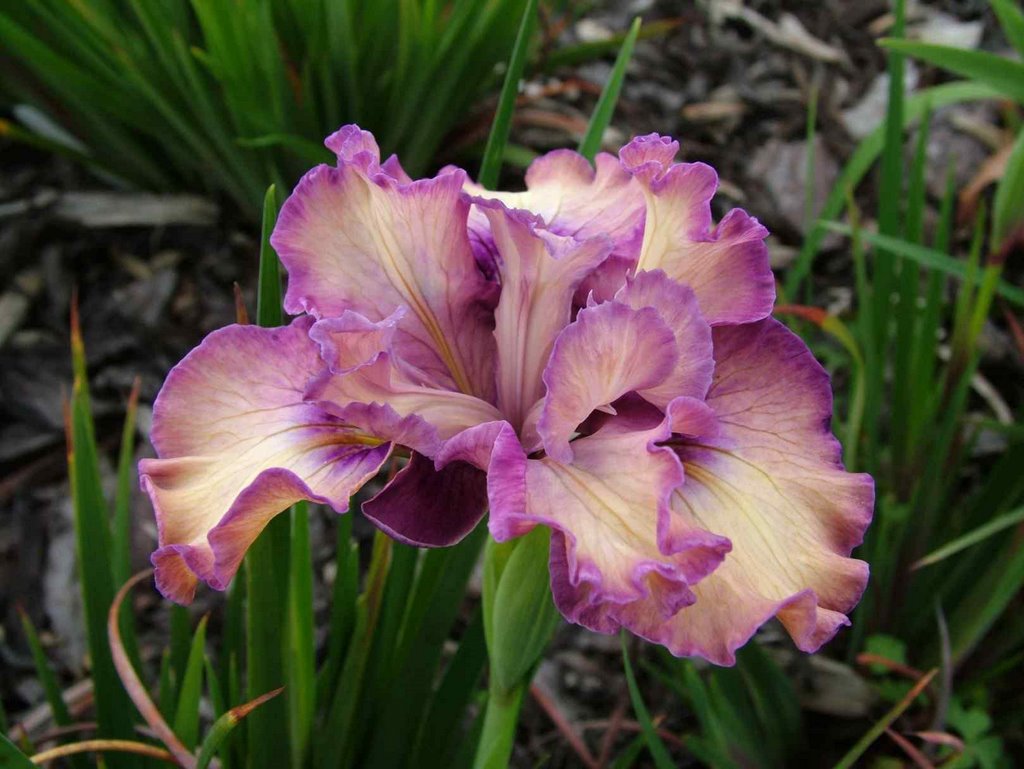
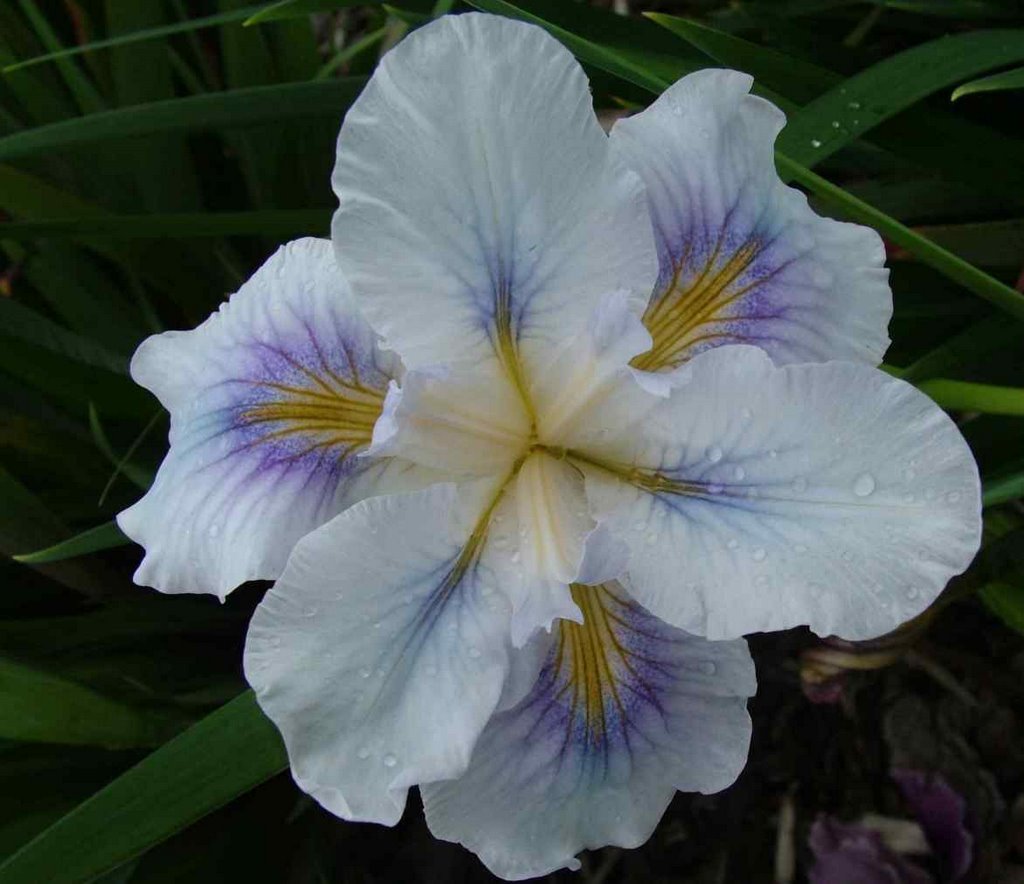
But this turned out to be a vain hope and winter returned with a vengeance. It seemed that week after week the southerly storms found their way north, cooling the ground and keeping spring at bay. My beloved Pacific Coast irises delayed their flowering, and were at their peak a full two weeks later than they usually were.
My tomatoes stayed firmly ensconced in their pots in the glasshouse as I fretted over whether the frosts had passed. In the end, I decided that I had to plant them out in the second week of November as they were getting very spindly under cover. They were in for a few weeks before we had a hard late frost and they were severely damaged, despite being covered. The frost blackened and destroyed many leaves, and burnt out the growing tips completely. They hardly had time to recover before we experienced a sudden burst of hail and they were once again damaged. This time the spotting led to blight. The poor old tomatoes look very sad and we will not have a great crop this year.
The roses suffered similarly early in the season. The cool temperatures and the lack of sunlight meant that many of the buds partly opened and were then either frosted or caught by rain, and they rotted.
In the end, the spring did come, and the iris seedlings, many flowering for the first time, were a reminder about the cycle of life in the garden. Each year there is an autumn, and there is a winter, but equally these times are followed by spring and summer. During these times, we harvest our stores for the leaner times ahead.
The irises held some lovely surprises, and I was looking for one pretty enough to name after Lavinia. Of course, there was none that pretty, so I took out my paintbrush and my labels and I started crossing some of the flowers, thinking that one day there might just be one worth the name. Those crosses that took have huge filled seedpods now and I am watching them carefully to make sure I gather all the seed and sow them for next season.
The vegetable garden has had it troubles aside from the tomatoes. The basil does not like cool soils and it is struggling, and the watermelons given to me by a gardening friend are just a joke. They are sitting there looking like something the dog has played with for a week or two.
But there is an upside of course. The cool and moist weather has meant the whole garden has been damper and, as such, has suffered less stress. Some vegetables have thrived in the cool spring - I do not think we have ever grown such luscious lettuces. As a bonus, the cool weather has stopped them from bolting and they have provided leaves for months. We virtually only grow loose-headed types now and they have loved the season.
The Rhododendrons up at Cross Hills in Kimbolton have loved the season too, and I don’t think I have ever seen that garden looking better than when I visited it in early November. The tulip display at the Wellington Botanical Gardens, which I have never managed to time right before, was breathtaking – not to everyone’s taste in their own garden I would think, but amazing just the same. The roses at Palmerston North, after a slow start, performed very well, and the bed of ‘Paddy Stevens’ that we planted in the new rose beds at Queen Elizabeth Park in Lavinia’s memory is doing well after a slow start.
I sat on the side of Pukeroa a week or two ago. Where the daffodils had had once held sway, knee-high plumes of grass flowers were shifting in the breeze. The grass had been left un-mown to allow the daffodils leaves to make next year's flowers.
And in Lavinia’s garden, the weeds, the flowers, the vegetables and the herbs still fight it out.


Tuesday, December 19, 2006

Christmas season in the south


New Zealand's own Christmas tree, the pohutukawa

Another funny Christmas season is upon us, and we will be sending each other cards and presents covered with the images of a different hemisphere. Jolly red-faced gift bearers will be captured smiling alongside blazing fires while snow mounds can be glimpsed through windows iced with delicate snow patterns. And the floral images will be all out of kilter too. There will be holly trees decorated with bright red berries, and bunches of ivy, and pts and pots of bright red poinsettias. Of course, there will also be mistletoes, but they have a functional purpose at this time of the year.
In our hemisphere things are flipped over. Instead of snow, we have sand, and instead of berry-clad hollies we have the bright red flowers of our own New Zealand Christmas Tree, the pohutukawa. We are able to have bowls of fresh garden flowers rather than drab evergreens, and we have developed our own floral traditions.
Prime amongst those has been the adoption of the Christmas Lily, Lilium regale, as the flower most associated with the season.

Christmas lily, Lilium regale
This highly-scented white beauty is a relatively recent introduction to western horticulture, having been found in China in the 1920s. It is very hardy and quickly became popular the world around, especially in southern climes where its habit of flowering in late December was treasured.
This lily is quite variable as to habit. It can be as low as 60 cm high (most forms are about this size or slightly larger) but can also grow very tall. I have some forms grown from seed that reach over two metres before they bloom. A couple of years ago they were attacked by a virus which sauces them to become a little fascinated, so I thought I’d start them again from seed. The seedlings have flowered this season – a week before the proper date I might add, and before the mother plants have flowered - but they are less than half the height of their parents. It will be interesting to see how they develop in the years ahead.
Christmas lilies are almost ridiculously easy to grow. They will grow in all but the wettest and poorest soils, and will even cope with semi-shaded conditions, although they do tend to grow out towards the light. They are probably at their best in light, well-drained soils with good humus content, in the full sun.
Like most lilies they have parcels of bright golden orange pollen in the centre of the flowers, and also like most lilies, this pollen can stain material so it pays to remove the stamen when picking for the house.
For many people Christmas is just not Christmas without these lilies. The Head Gardener was brought up with this tradition (her grandmother had big clumps in her garden, as did her mother) so we have a number of clumps scattered throughout the garden, and they tend to stagger their flowering, so we usually have some in flower for about thirty days, and also usually have flowers for picking for Christmas.
For New Zealanders, especially those in the north, the quintessential Christmas flower is the pohutukawa.
This coastal relative of the more wide-spread ratas scarcely needs any description, its deep red flowers having been associated with the festive season, and its summer focus, since pakeha settlement.
For those of us restricted to gardening in inland, and thus in frostier conditions, this treasured plant poses a bit of a problem. It can sometimes be persuaded to survive in relatively sheltered places as long as it can be nurtured through the first few years when it is more frost tender, but otherwise is too tender to survive.
Perhaps a tub of the lovely orange flowered form, ‘Tahiti’ might be the answer. This Pacific Islands variety has become very popular, at least partly because of the ease with which it can be grown in containers. It has silvery foliage and bright orange-red flowers that are carried spasmodically throughout the year, with a flush in late winter.
There are other smaller forms around too, mainly forms of the Kermadec Islands pohutukawa, but none are as easily grown as ‘Tahiti’.
I have noticed lots of poinsettias about this year in the shops, their bright red ‘flowers’ (actually bracts that surround the small white flowers) looking seasonally attractive. Many gardeners are tempted to try and plant these shrubs (for that is what they are) in their gardens. Once again, if they are in more northern areas they will probably get away with this but in our lower North Island it is harder to get these plants to thrive. R n
It might be better to try and grow them as house plants, but even then there are problems.
These plants naturally flower in the winter. In the northern hemisphere they are easily manipulated into flowering for Christmas, but down here it is a little more tricky. Fortunately the flowering is initiated by lengthening days, so poinsettias are grown in glasshouses with black shading, and are subjected to day6 shortening from about October.
In the home garden that is difficult but it should be easy to get your Christmas poinsettias to flower next winter. Just keep them moist during the summer, and then start shortening their days in the middle of April. You cannot have any extraneous light on the plant – even a table lamp will provide enough light to stop flower initiation. If you have a spare room that you never use at night that is probably the ideal spot to get your poinsettia alive.

New Zealand mistletoe

As to mistletoe….or should that be Kissletoe?
There are some wonderful native mistletoes, some with bright red flowers. They are rare plants now, threatened by possums, but some years they flower in profusion up at Mount Holdsworth. What better way to walk off Christmas excesses than to take some one you love and go for a walk. Ask the curator where the mistletoes are before you go, but if you don’t find any, you’ll still enjoy the walk!

Monday, December 11, 2006

Jungle beauties


A recent return trip from Rotorua saw me making a slight detour on the way home – I decided to take advantage of having a little extra time to make a trip through to New Plymouth, to visit to the garden of Andrew and Yvonne Brunton. Their fabulous garden Rosedale at Bell Block will be well-known to many of you who travel to the Taranaki Rhododendron Festival as it features a very attractive enclosed garden, formed behind high confer hedges, and a stunning river-side walk lined with Rhododendrons and camellias as well as other precious gems. It is one of Taranaki’s best gardens and always a favourite.
But it wasn’t the gardens I was going out of my way to see - it was the enormous shed on the side of the rose-lined driveway that leads to the garden. Within this growing shed the Bruntons grow over 1000 varieties of jungle cactus, Epihyllum, and it was these cactus I was making my way to New Plymouth to see. I had visited the nursery before, during the lead up to the festival, and was entranced by the display of the thousands of plants growing in the Brunton’s growing shed. I had visited too early in the season to see them at their flowering best though. I knew I should be right this time though as my epiphyllums as my were flowering in the glasshouse at home.
I had an interesting journey through the Forgotten Highway from Taumarunui to Stratford, through some of the most isolated country in the North Island, and some of the most scenic country as well. It was raining when I got to Stratford and the green pastures all the way through the journey made it obvious that Taranaki was not suffering from drought.
When I made it through to Manutahi Road, and up the colourful driveway I was expecting to see a great display of Epiphyllum flowers, but it was not to be. I was met firstly by Andrew, and then by Yvonne, both bemoaning the long cold winter and the cloudy and sunless spring that had left the flowering season many weeks behind. They apologised that the flowers would not be anything like their best for another couple of weeks.
The Bruntons were very disappointed at the weather.
They had started growing their large collection when Yvonne was given some leaf cuttings by an auntie. At that stage they were on a dairy farm near Stratford. Their joint passion for the ever-expanding collection of cacti, New Zealand’s best, led them to relocate to the warmer climate of Bell Block four years ago to concentrate on what is New Zealand’s only commercial Epiphyllum nursery.
In the wild the Epiphyllum species are literally jungle cactus. They are epiphytes that grow in the humus collected in the branches of trees, alongside other plants like orchids and bromeliads. Under these conditions they can get the filtered light they need, as well as a reliable source of moisture. The medium they grow in is very well drained so they are never sitting in water.
These wild plants all have white flowers, and the majority of them are night flowering. I well recall the large specimen of one of these species that my grandparents cared for (albeit spasmodically) in their sunroom. Once a year, for a few nights, the plant would proudly display a succession of stunning white, heavenly-scented, flowers.
When these species were introduced into European horticulture plant breeders soon saw the potential for crossing them with related but more colourful species of cactus, and a huge range of varieties was soon available, all of them day flowering and with colours ranging through most of the rainbow, with the exception of true blue. There is also a lovely range of bi-coloured and bi-toned forms as well as a range of flower size, from relatively small up to 20 cm or more across.
Being jungle plants, these beauties do have some particular requirements before they will perform at their best.
They prefer a well-drained potting mix to start with. The Bruntons use their own formula based on a standard potting mix but with added pumice. They say that some people recommend orchid mix but they feel this is too chippy. They suggest a 50/50 mix of orchid mix and potting mix would work well.
In the wild, Epiphyllums grow in filtered sunlight and prefer the same in the garden. They can be grown outside in areas not prone to frost, but also thrive on patios and in glasshouses as long as they are not exposed to the full rays of the sun.
Watering needs to be handled with care. They do not like to dry out at all, but they equally dislike becoming waterlogged. Either condition is likely to lead to the plant to rot. It is best to keep the potting mix on the dry side of moist.
They can be grown in the same pot for up to five years but do need occasional repotting. At this time make sure you use fresh potting mix and also ensure that you do not “over-pot.” A plant in too big a pot will not flower as well as a plant kept slightly root bound.
Pests are not usually too much of a problem but it pays to keep a watch out for scale insects ands for mealy bugs, as well as for snails and slugs.
These jungle beauties make the most amazing pot plants. Their succulents leaves give no real hint of the startling beauty of the flowers, which can be among the brightest of all flowers. If you are planning a trip to Taranaki anytime soon make sure you look the Bruntons up and call on them and see some of the 1000 different varieties they grow, plus some of their own new hybrids. These stunning flowers are worth a long trip – even one through the Forgotten Highway.


Saturday, November 25, 2006

Michael

The world certainly throws some cruel twists our way. Regular readers will know that my daughter Lavinia died earlier this year, aged 33. She had a long struggle with the effects of reactive arthritis but seemed on the pathway to a better life with a new drug.
Unfortunately the new drug seems to have helped mask a bacterial infection in the jaw which lead ultimately to a cerebral abscess and her death.
When this happened in May we were distraught, and it has been a long hard year for us all, her mother, her partner, her family and friends. This past week has been especially sad as the six-month anniversary of her death coincided with what would have been her thirty-fourth birthday.
Little kindnesses have sustained us - the friend who thinks to bring some fruit or flowers; the friend who realises that the company of children is a blessing and brings youngsters to see us. One special friend brought a prized gem from her garden. She is a galanthophile (lover of snow drops) and she brought one of her prized possessions, a special Greatorex hybrid named "Lavinia," accompanied by a delightful card and soft, comforting words.
She is an internationally known garden writer, and connected by marriage, her later husband being the brother of one of my uncles. She has not had the easiest road through life either, with debilitating illness and the early death of a beloved husband, but somehow manages to always hold fast to the expectation of a new spring rather than dwelling on the coldness of winter.
Her concern was especially poignant as her eldest son also suffers from arthritis, and has had a difficult time coping with the pain and dislocation that the disease carries with it.
This week Michael passed away and I am very sad that my friend will have to suffer that devastating pain of losing a child.
I'll gather some sweet peas and some rose buds from my garden and take them around for her and her aged father.
Tonight give your kids an extra hug and be thankful for all the springs you have.

Sunday, November 12, 2006

Pacific Coast irises season 2006 part 3

A selection of seedlings from Pacific Mist x Eyes Have It have been remarkably uniform – all very dark blue/purple, and very hard to thin out as they are very similar.
The I. munzii hybrids from Lawyer XP 326 have been enchanting plants, with some very imposing late-flowering hybrids. Perhaps the best are the very light blue forms that are still in flower.
Encircle has left some very floriferous plants with subtle flowers, while 2003’s Pretty Boy seedlings have all been in mauve shades, but with Ghio form. The Magic Sea seedlings appeal to many visitors, with their bright clear blue. This year I have crossed some with the I. munzii seedlings


As expected the Pacific Rim seedlings are prettily engaging, with subtle shades and diminutive growth.


In the main the Cross Purpose seedlings were disappointing but one or two were delightful.


The Big Money seedlings were disappointing, many being washed out mauves and creams. We do still not have a good yellow in the garden, but we continue to hope.

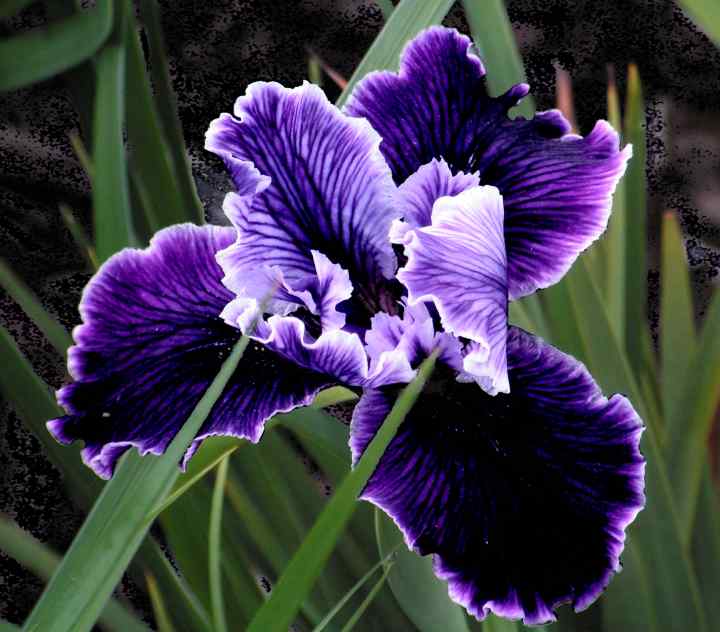
Among the Air Show seedlings, we have two of interest. One is a huge purple veined specimen, while the other is a nice two-toned form.


As always we await the first flowering of the following seasons seed, planted out in March – a few tantalizing hints of interesting things for next season – and there is, of course, another 160 seedlings in the glasshouse – about half our own, and half from the seed pool.

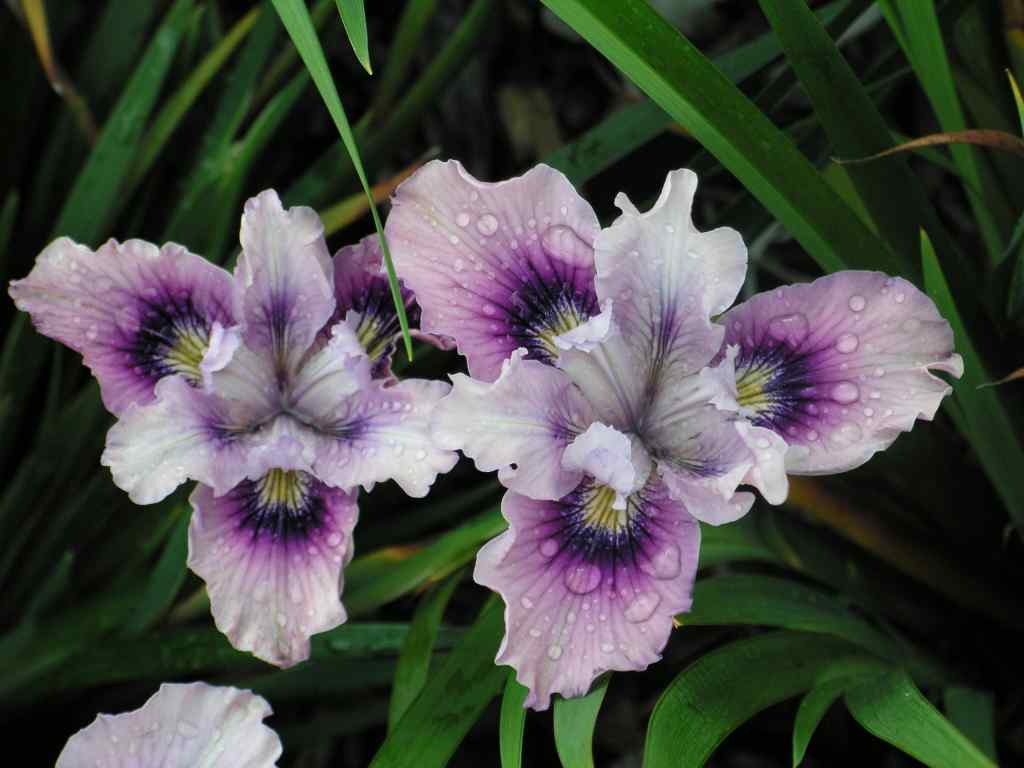
Pacific Coast irises season 2006 part 2


A few more Pretty Boy seedlings.

I have also had some interesting seedlings from a cross from Debby Cole’s garden, from the seed pool in 2000. She offered some Air Show x Marine Magic.
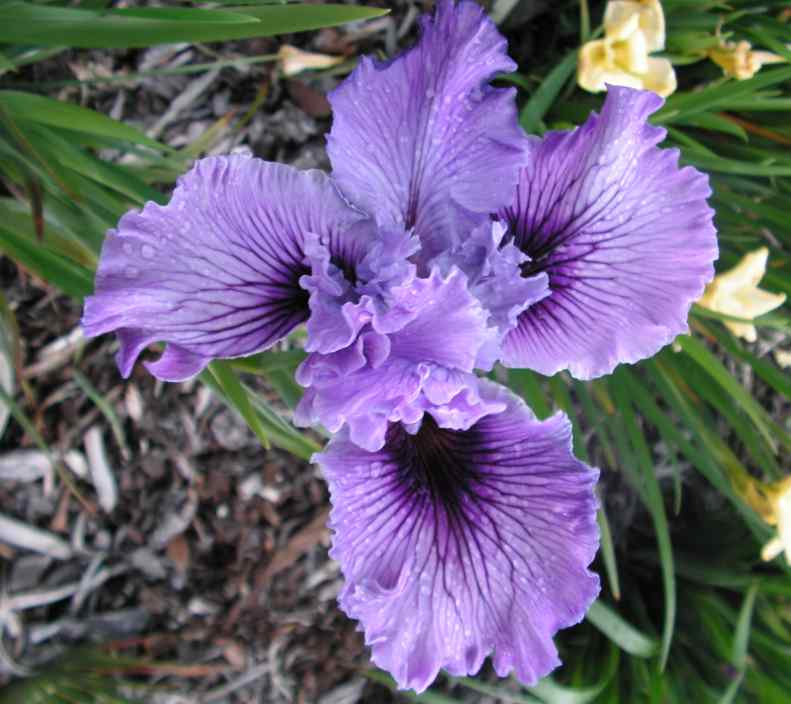
Crossing between two clones of this cross has given rise to a number of interesting seedlings this year, again variations on a theme with lighter standards and deeper falls, prettily veined. The best, not shown, is a pure deep purple/red.


Pacific Coast irises season 2006

It is nearing the middle of November and the PCNI season is almost over. The last of the I. munzii hybrids have nearly finished and now it is simply a matter of waiting to see the seed pods fatten. The first flowers appeared on about 10 September so a two month span is not too bad.
There have been some interesting seedlings this year. A number of seedlings from Stroke of Midnight showed a great deal of variety. There were a few nice reds (none dramatically deep but attractive nonetheless) and a few lovely very pale flowers with light blue through mauve signals. They look much like Stainless Steel to me.


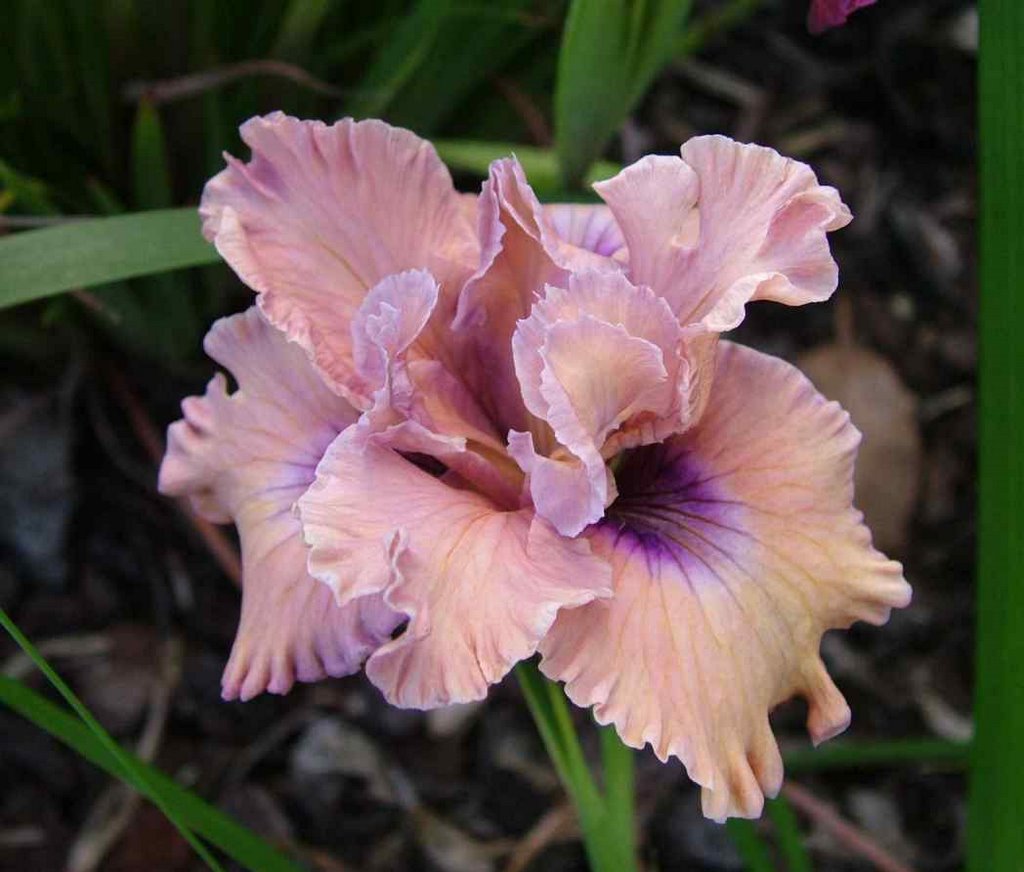
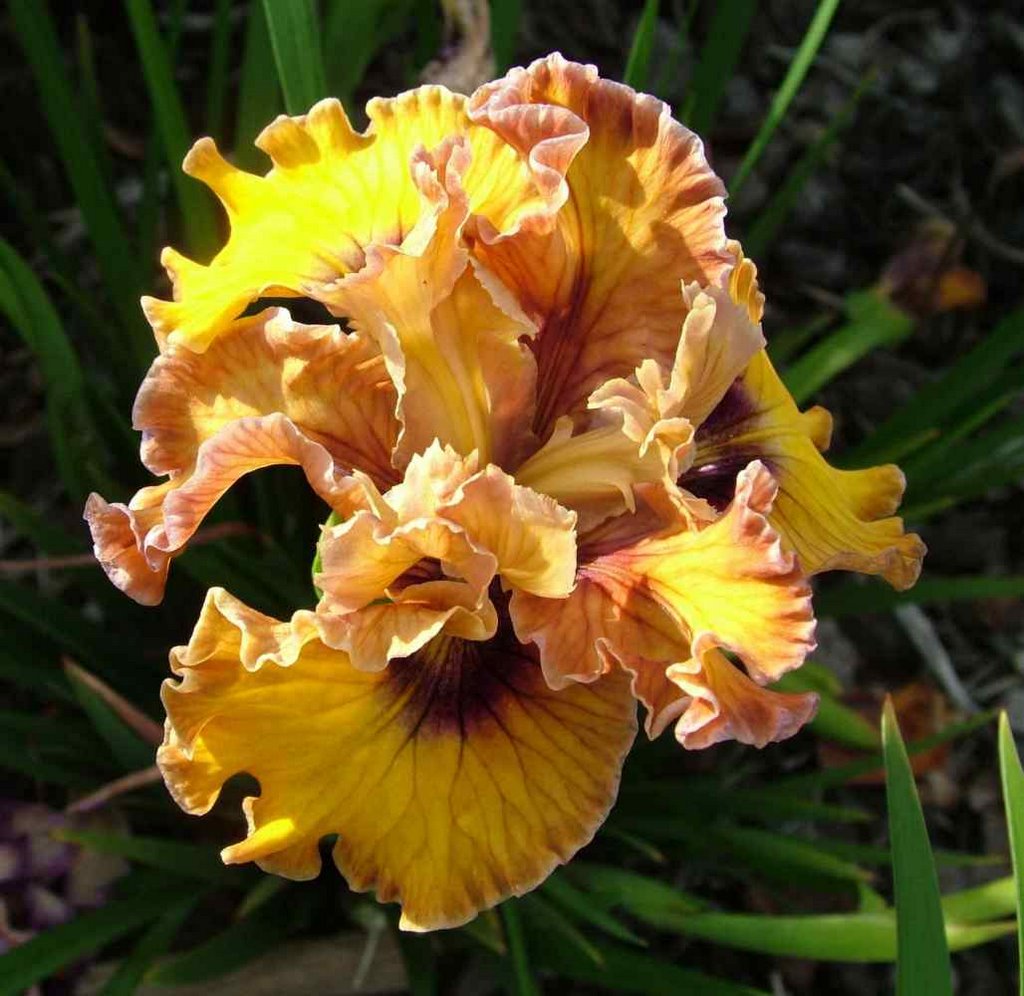
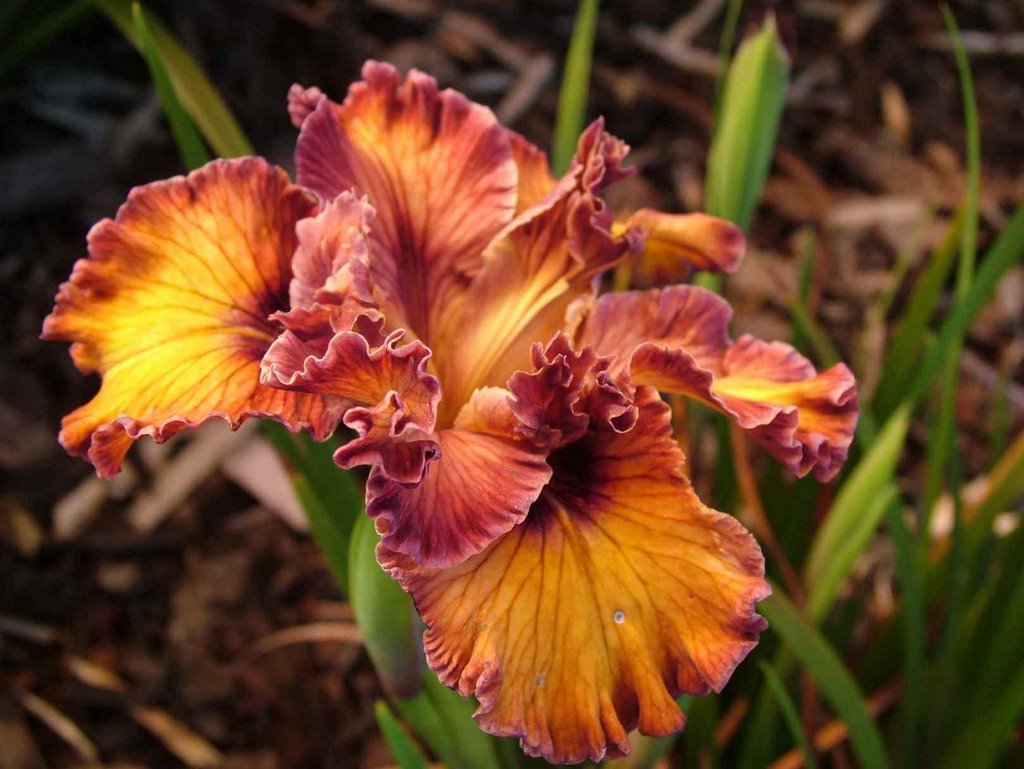
The Pretty Boy seedlings have been very interesting, with quite a variety of form as well as some very interesting colour combinations. They have basically all had yellow through peach to almost burnt caramel ground colours, overlain with varying degrees of colour. It is going to be hard to weed these out, but I have already discarded some of the browner forms as they were very similar.


Monday, October 23, 2006

Tomato time - nearly


This weekend I did the second most popular thing for New Zealanders at Labour Weekend – spending time with family. Although, in this case, I spent a bit of time with someone else’s family - the Summers family, who were having a family re-union. Oddly enough, this family is connected to my wife’s family, as are the Springs, so you can imagine the hilarity at our family get togethers!
The first New Zealand ancestors of the Summers family were William and Louisa. William was a gardener at a number of large sheep and cattle stations in the Wairarapa in the 1890s, where his main job was the production of fruit and vegetables on a large scale. One vegetable that he probably wasn’t growing too many of is the vegetable (strictly speaking a fruit) that has been occupying the thoughts of many New Zealanders over the long weekend – the tomato.
The tomato comes from the highlands of South America and, although it has been grown in the West for many years, it has not been universally popular as a vegetable. For many years it was thought to be poisonous (as are many Solanaceous plants) and was not eaten at all. By the turn of last century it had become more popular although it was still not the staple diet item that it is today.
I have an old catalogue from a Lower Hutt seed firm, dating from 1903. I have just checked and there are 32 varieties of tomato on offer. Interestingly, there are also 32 different melons on offer – rock, water and pie.
Among those many tomato varieties there are few we would recognize today, although, no doubt “Marvel of the Market” was very much like the spherical red-fleshed fruit we favour today. There were purple, yellow and pink skinned types, pear shaped, and, in the case of “The Peach”, even some slightly furry ones. There was one called “Cherry”, according to the catalogue, mainly used for pickling, and “Red Currant,” just proving that some fashions do return.
I did not plant any tomatoes this weekend, as I believe they are best left for a week or two after Labour Weekend. It is a natural human instinct to tie activities with calendar events, but in this case the association does not work well for those of us who garden much south of the Bombay Hills, especially in inland areas. On the coast, you can plant at Labour Weekend, or earlier in fact, but inland it pays to wait awhile.
Before you plant out tomatoes it pays to have everything well prepared. The site selection is important, especially as regards sun. Tomatoes just love growing in full sun – in fact they’ll cope with about as much sun as they can get, in our climate at least.
It pays to add some fertilizer to the soil, and some compost, but be careful with the compost. Tomatoes are very susceptible to damage from hormone sprays and if you have composted anything from a sprayed lawn, you could be in trouble. I would not use any bought compost for tomatoes either, to be honest, as they are sometimes made from garden waste deposited at recycling centres. They are fine for most things, but keep them away from tomatoes, roses, beans and grapes.
Definitely dig in some fertilizer – whatever type you think best. I often use a slow release product, but frequent small applications of quick release will work well too, and you can adjust to a higher potash mix as the plants start to fruit.
The real key to growing tomatoes well is in the watering. The plants grow best with regular watering (compost will help hold the moisture) but is most important for the health of the fruits. Irregular watering, drying out and soaking, will lead to the dreaded blossom-end rot and to cracked fruit.
I think it is a good idea to add some water crystals to the soil before planting, as it will help buffer any dry periods.
Once the soil is prepared the stakes should be driven into the soil. I like to grow mine up strong wooden stakes but you could use a frame or a teepee perhaps. Whatever you use it is important to put the stakes in before the plant as it prevents damage to the roots.
Once the tomatoes are planted it’s a good idea to give them a deep watering – literally soak the soil and then leave the watering for a week or so. If you can do so, it helps to put some kind of mulch down. Remember not to use suspect compost though – perhaps some pea straw or mushroom compost would be good. As well as reducing the need for watering, the mulch will also suppress weeds.
The choice of variety is a very personal one. I like to plant some early varieties – I usually use Early Girl – as they will set fruit at a lower temperature. I also grow some medium sized varieties, as I prefer the stronger flavour of these types. Many of you will prefer to grow the Beefsteak types, with their fleshier fruits. Whichever you choose, it pays to spend a little more and buy an F1 hybrid. It will be sturdier, stronger and will fruit much better than the older open pollinated types.
At the opposite end of the modernity spectrum are the heirloom varieties – some of those old ones from the catalogues of a century ago, and oddball types from around the world. They will tend to fruit later and they will also not have such large crops, but many gardeners enjoy having the slightly eccentric varieties available – the purples, pinks, striped and green forms, in all shapes .
And who knows? They might even find one of the types that Bill Summers was growing, all those years ago, in those huge gardens, attached to the large sheep stations.

Monday, October 09, 2006

Clivias in frosty places


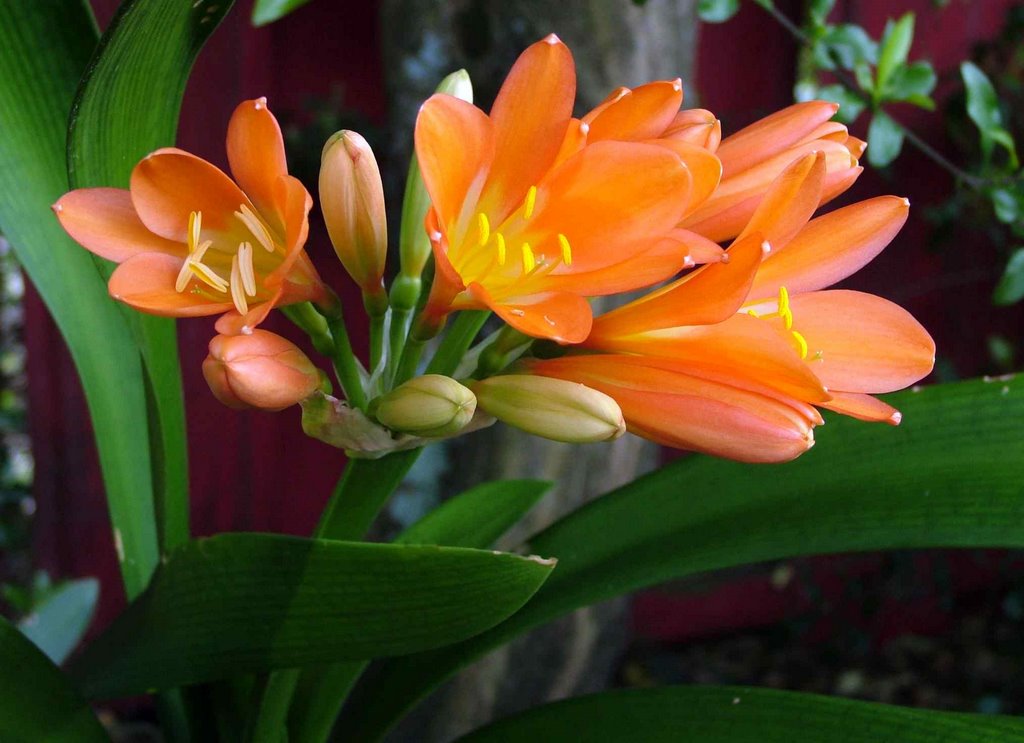
Sometimes in the garden, as in life, it is not the huge things that bring the most satisfaction. In the garden it might be the first flowering of a special plant, or the successful cultivation of a difficult plant. So this week the Head Gardener is one very happy gardener – her Clivia has flowered.
For those in more northern climes this would be no great deal. In warmer areas Clivia present no special difficulties, but in our frost-prone garden it has been an interesting challenge to get one of these South African beauties into flower.
We first planted two large containers with Clivia bulbs about five years ago. The HG is very fond of their elegant beauty and, although I am not a huge fan myself, I do think they are useful and attractive flowers for cool and shady areas.
We planted our plants very carefully, in relatively deep shade underneath a couple of small evergreen trees. Despite the deep shade the occasional frost still manages to sneak in and damage the other frost tender plants that we grow there. Each year the Plumbago manages to make it through until about August before being fried, and the yellow Lantana (also in a container) get similarly blitzed each year. The Clivias usually get their share of damage, and each year the leaves are badly scorched, but this year, perhaps because the winter has been milder, the leaves came into spring virtually untouched, and one on plant a lovely head of flowers has appeared.
Most garden Clivias are bred from the orange species C. miniata. This species has been grown and bred around the world for nearly one hundred years. Until recently the vast majority of the forms available in the trade have been seed-raised orange forms for the garden, with a concentration on large flowers. However, that has not always been the case overseas.
The Clivia is a very popular plant in Japan. In that country, though, the emphasis has been on the raising of new varieties with variegated leaves, and hundreds of forms are known and registered.
In China it is the miniature forms that are most popular, especially when grown as houseplants. In Changchun, Masterton’s Chinese sister city, the plant is so popular that it has been adopted as the official flower of the city
In New Zealand we are lucky in that we can grow them outside (albeit with difficulty in colder areas) but there are some things to keep in mind - the Clivia has some quite specific needs. As explained above, the leaves are frost tender so it is important that the plant should be in a frost free spot. In many areas that means planting in deep shade but that suits these plants fine, as it replicates the conditions they grow under naturally. They perform best under evergreen trees with medium to deep shade, even in warmer areas. The most amazing display of Clivias I have ever seen in a garden was at ‘Ngamamaku’ at Oakura, where a deep, steep-sided gully has been planted out with hundreds of Clivias.
The soil type is relatively important too, as these bulbs prefer very well drained soils. They seem to need high oxygen levels to perform best and will not be happy in wet clay soils.
If you are a fan of these plants you will have noticed that there is an increasing range of plants available now – and they are slowly coming down in price too.
The first of the ‘other’ Clivias to make it out of the specialist societies were the yellow forms. When they first appeared they were hideously expensive and they weren’t the healthiest plants either, some being quite “miffy.”
New Zealand plant breeder Dr Keith Hammett decided that Clivias were worth his time and collected a huge number of forms, corresponding with overseas growers who were breeding new forms. The result of his work is now available in garden centres.
His pale yellow form, ‘Moon Glow’, is a broad leaved, strong growing variety with very wide petalled flowers. The plants are grow from seed so they are a little variable but the all feature hybrid vigour and are a worthwhile addition top any home garden.
Hammett has also turned his attention to the red varieties, also increasingly popular. It must be said that these flowers are not fire-engine red. Remember that they are coming from orange flowers and they will be closer to orange than red, but they are considerably deeper flowered than the old types. Hammett’s varieties are in the trade under the name of ‘Fire Glow.’
Hammett has also unreleased an orange strain called ‘Sunset Glow.’ These are similar to the yellow and red forms in that they have very wide flowers with good colouring, and they are very vigorous.
Tony Barnes at ‘Ngamamaku’ has also been breeding Clivias and had a wonderful range of hybrids for sale at the garden. I visited during the crossing season a couple of years ago and spent some time with Tony as he worked away at his crosses. I can easily see how someone would get excited about breeding these plants as these is a good range of material within the genome to play with. Over the next few years expect to see a great improvement in the form of these flowers, especially on the show bench.
If you are keen on growing any of these plants, it pays to seek out help from the New Zealand Clivia Club. They can be found on-line at http://www.nzclivia.org.nz. Through the website, you will be able to find other New Zealand suppliers of these wonderful plants.
Just do not tell the Head Gardener though. I reckon she’ll be keen to increase the range of Clivias growing around here.

Monday, October 02, 2006

Those stinking aroids

The last weekend of September was a very interesting one for the Head Gardener and I. A spell of fine weather that followed a welcome dose of rain left the soil in wonderful condition so a large part of the weekend was spent with backs bent and rakes, hoes, spades, shovels and dibbers at the ready.
Saturday afternoon, though, we spent a bit of time in the capital city, ostensibly to pick up our son but really to have a bit of time in the Botanical Gardens. It was not a great day weather-wise in the gardens, but the beds were at their early spring best. The display of tulips of contrasting colours had drawn a large number of spectators, happy to brave the cool wind and the drizzle. The tulips were stunning – large healthy well-grown specimens in perfect patterns – not to everyone’s taste but nonetheless a memorable sight.
The sights that will stay in my mind, though, were the newly emerging leaves on the Japanese maples, and the virid light they imparted. There were especially beautiful in some of the sheltered dells where they serve as cover for a wide range of damp-loving species.
One of these species caused us a bit of grief.
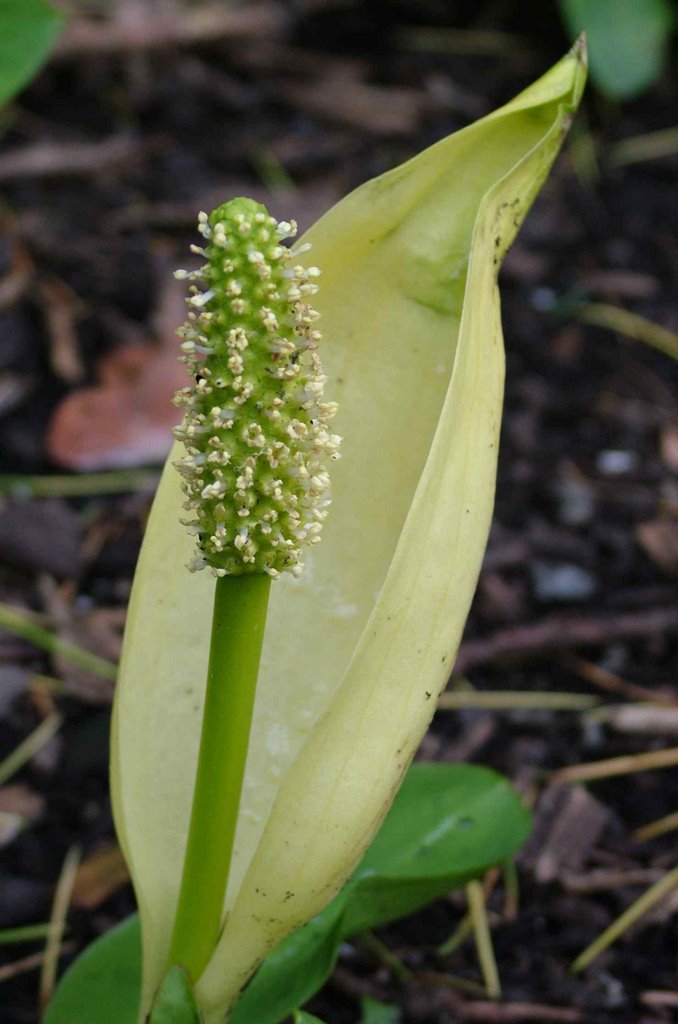
I spotted a clump of the yellow skunk cabbage (and what a name that is!) Lysichiton americanus, in a bed alongside the duck pond. I was so taken with the clump that I stopped to take some photographs. We then continued on our way, looking at the main beds with their tulips, and wandering through the small pine trees, up the ridge and down into the Lady Norwood Rose Gardens.
As we approached the large glasshouse I suddenly realised that I didn’t have the car keys with me, so we carefully, and sullenly I have to say, retraced our footsteps. I had a hunch that I might have put them down when I photographed the skunk cabbage. Fortunately that turned out to be the case, and we found the keys hidden just inside the bed. We were able to move forward again, albeit on a different pathway.
So, the yellow skunk cabbage -it caused us so much grief I have to tell you about the plant.

As you will see from the photograph, it is a member of the large family of plants called the Araceae, most familiar to most people by the common arum lily. Like the arum, the Lysichiton prefers moist soil, with good humus content. It will grow in sun or part shade. It is at its very best, though, in damp areas alongside ponds or streams where, if it is at all happy, it will even seed and establish itself.
As with members of the Araceae what appears to be the flower is in fact a sheath that covers the actual flowers. The sheath appears from the ground in early spring, wrapped around the spadix – the stem that has the small flowers spaced along it.
Unfortunately it shares another common trait of many members of the Araceae - it is fly pollinated, and as such uses a very traditional way of attracting flies to the flowers.
It stinks.
It has a heavy musky scent which unpleasant but it is not as absolutely foul as some of the more lurid members of the family.
Each year or so someone comes to see me with tales of a lily that has just appeared in their garden. They have never seen it before and that it has large flowers like an arum, except they are black. And everyone says the flowers stink.


What they have in their garden is commonly called the “Stink Lily”, “Voodoo Lily” or the “Dragons Flower”, but it is known to botanists as Dranuculus vularis.
Unlike the yellow cabbage yellow this plant comes from Mediterranean Europe and prefers freer draining soil. It has attractive green leaves with white markings, arranged around the snakeskin patterned stem. The flowers, though, are the thing.
And what a thing they are. The spathe pops out fully and tightly closed, greenish brown, with deep markings on the edge. When the spathe opens and the spadix is finally exposed it comes in the most lurid maroon, and can be up to 1.5 metres long. It is sometimes called “amorphophallic” by botanists. When I tell you that “amorpho” means “shaped”, I am sure you can work put how it got its description. As a matter of interest, I see some United States nurseries are now calling this the “Viagra Lily.”
This is an attractive looking plant, and the putrid smell (said to recall rotting meat) doesn’t last for long – maybe just one day. Just the same, don’t plant it by the front door.
I was pleased to see another old favourite in the gardens though, a form of the common “arum,” Zantedeschia aethiopica. The usual form is the common white form so heavily associated with funerals in the United Kingdom, and almost regarded as a weed in New Zealand. There is a very interesting green-flowered form called “Green Goddess”. It is brilliant in the damp conditions where the white flowered form grows, and it is a great flower if you like having different flowers in a vase inside. It was very popular during the time ladies were keen on joining floral art clubs, as it was perfect for many forms of floral display, and it is having a bit of a comeback again now, no doubt influenced by the increasing interest in large foliage and pool gardens.
My favourite among all these arums-like plants is a tiny little one I have in my glasshouse, just for the kids - the mouse plant. Arisarum proboscideum is a shade loving plant that grows about 15 cm high, with funny little flowers that look just like mice, especially when seen from behind. A great one for the kids to scream at!