Sunday, April 13, 2014

Variegated Ginkgos

I was talking plants with a few friends during the week and the topic turned to plants we never expected to see.  You know what I mean – something you stumble upon in a garden that you have never even read about, and you look at it, not quite sure what it is, and then when you work out what it is, you think – “I never would have thought of that!”
I had a moment like that a few months back in the delightful ‘Tupare’ garden in New Plymouth.  The Head Gardener and I were strolling through the garden on a drizzly summer afternoon, having almost the entire garden to ourselves, when we stopped to look at a tree with green leaves, splashed with white lines radiating out from the centre of each leaf.  It took me a minute to realise it was a variegated Ginkgo, but a second’s reflection made it obvious.
There was the same light coloured bark, and there were the same Ginkgo leaves, with their veins spreading out from the leaf stalk, but instead of being the usual dull green, here they were  irregularly splashed with streaks of white.  It is probably more interesting rather than dramatic, but would make a great talking point in a moderately sized garden.
It would be especially interesting at this time of year, when the green colouring would be replaced by gold, giving a butterscotch and ivory sort of look to the trees.
Ginkgos are interesting trees, if a little large for most small gardens. They are ancient conifers, although they look not the least bit like a pine tree.  They have male and female trees, and unless you love the scent of rotten socks, I suggest you hunt out male forms.  The males tend to make a tidier pyramidal shapes, while female forms correspondingly tend to spread more.  And of course, they also bear fruit which contain the famous ginkgo nuts.
If you have never had the pleasure of smelling these fruit, all I can say is that you are very lucky.  It is almost indescribable, but perhaps seven day old socks, mixted with the most pungent blue cheese you can imagine, with an undertone of dog excrement gives you a hint. And I can tell you, having had the misfortune to pick one up, the smell does not go away, even with repeated rinses.  The dried nuts are an Asian treat, but the young nuts smell rather similar to the fruit  although they are said to have a sweet taste with a cheese-like undernote.

Sunday, April 06, 2014

Not much to look at, but ...

A minor star of the native plant world that is showing off at this time of the year is one you might not even notice – the once ubiquitous Golden Ake Ake, Olearia paniculata.  This is a very tough coastal daisy – again a New Zealand native – which was once quite commonly grown as a hedge.  It has light yellow/green leaves which are covered in white hairs on the lower side.  These leaves can be flat but are more usually very wavy, and they are born on orange stems.  If the plants are grown as small trees and are allowed to develop a trunk, the bark has wonderful texture.  One catalogue I looked at described the bark as ‘stringy’, which is hardly a flattering way to talk about delightfully exfoliating bark, although it does tend to come of the tree in strips. 
There is a mature tree near the fernery at Queen Elizabeth Park, which has this delightful bark – it is worth taking a quick detour to look at it.
However, it is this time of the year the Golden Ake Ake lets forth its greatest asset – the totally inconspicuous flowers that you would never even notice, except for one standout feature – they have the most amazing sweet and fruity scent – reminiscent of the Easter orchid. We have a couple of these trees in the backyard.  One is actually growing in the neighbour’s garden, but another has grown as a seedling of that, with much lighter foliage, so I am happy to leave it growing there.  At this time of year the scent is wonderful, especially in the evening.

There are many native olearias, all known by various forms of “daisy” – coastal daisy, mountain daisy, holly daisy.  I am sure you get the idea.  Some of them are primarily grown for their foliage, while others have pretty white daisy-like flowers. Perhaps the prettiest of the New Zealand species known as Streamside Daisy, O. chessmanii, which is smothered in white flowers each spring.

Sunday, March 30, 2014

Parrots, lilies and little ones...

Tulip 'Orange Parrot'
There are quite a number of different forms among tulips, some of which are seldom seen in lour gardens.  Perhaps the most flamboyant of all tulips are the ‘parrot’ varieties, so named because their petals are feathered, curled, twisted, or waved.  Probably the best known of these is the aptly named  ‘Roccoco’, which has swirls of yellow on deep carmine red flowers.  Even brighter is one called ‘Flaming Parrot’, which has bright yellow flowers with a prominent red stripe down the middle of each petal.  Some years ago I saw a bed of ‘Orange Parrot’ – what a stunning sight.
Lily tulips have longer and more slender flowers than most types, with flared ends, suggesting a lily flower.   They look very elegant, but there are not many varieties around in New Zealand.  ‘Pretty Woman’, which has bright red flowers with a small yellow patch at the base, is probably the easiest to find.
There are also the peculiar green tulips, which tend to have a soft coloured flower which features a broad green band up the middle of the petal.  ‘Spring Green’ is probably the best of these.
At the opposite end of the size scale are the rock garden tulips, some of which are very small indeed, but they would need to be sourced from specialist growers.  The varieties available from garden centres will probably grow about 20 cm high, and will have the usual grey-green leaves. Among these ‘Pinocchio’, which is carmine pink with a cream border, and ‘Boutade’, which is bright red, represent good value for the garden.
There is still plenty of time to plant tulips.  Unlike some other bulbs, they prefer quite a chilling over winter, so it will not matter if you don’t get them into the ground for up to a month.  Of course, by then the best selection will have gone, so it pays to get a move on.
Give them a rich, well drained soil, preferably in full sun, and remember to snip the stems when they have finished flowering, as that way they will concentrate of putting down some growth for next year’s flowers.

Sunday, March 16, 2014

Faking it

Gloriosa superba

Perhaps the most mis-used word in gardening is “lily”.  All sorts of plants are described as lilies, even though the majority of them have no botanical connection to the true lilies.  Perhaps in this context, the world “lily” just means “great looking flower that usually comes from a bulb” – or something like that.
Having said that, there are some lovely bulbous flowers out at the moment, including the stunning climbing plant, the “Gloriosa Lily’, Gloriosa superba.  There can be few flowers that are so well named, being both glorious and superb.
This is one that definitely is not related to the true lilies – in fact, it is in the same family as the autumn crocus, colchicums.  Like the colchicums they are toxic if eaten, so a little care needs to be taken with them.  They are a rather curious plant, thriving when well suited – in fact, in frost-free situations in free drain in and dry soils can even become a bit of a nuisance, seeding and establishing  too well.  They grow from a round tuber that turns V-shaped as it ages, eventually growing up to a metre long. 
From these extended tubers a succession of wonderfully coloured flowers will appear, superbly reflexed and in shades of orange-red and yellow.  This little climber (it will grow a bit more than a metre high)  makes a very dramatic addition to the summer and autumn garden, although it does struggle with our colder a little.   Find it a warm spot in the garden, or even in a deep pot, and you should have a glorious and superb flower.
At the moment the pots on our back patio that could be used to grow some Gloriosa are filled with some “Blood Lilies” – Haemanthus coccineus.  In keeping with the theme of this article, these are not actually lilies at all – they are South African members of the Amaryllis family, growing narturally in the summer rainfall areas of southern Africa.
I grow two species of the peculiar flowers.  The first, H. albiflos, is fully evergreen, with strap-like leaves that part in the summer to show flower heads that are basically a giant boss of stamen, with sepals guarding white stamen, tipped with gold.  The second species, H. coccineus is altogether  more dramatic.  Its large strappy leaves die off in the early summer, and the plant just shows the top of the bulbs over summer.  But come the start of March the bulb tips slowly part and a red flush is seen appearing.  Within a few weeks, these have lengthened and the bright scarlet spathe valves open  top shows golden-tipped coloured stamen, bearing  a striking resemblance to a coloured shaving brush.
They can be grown in warm and sheltered sites in the garden but my clump has been happily growing in a pot for the past twenty years and has flourished.

Sunday, March 09, 2014

Rejuvenating the iris beds

Photo courtesy historiciris.blogspot.co.nz 

Regular readers of this column will know I have a fascination for the members of the iris family, in particular the species and cultivars that make up the Pacific Coast Native Irises of North America.  A large area of the garden is devoted to a bed of these plants, from which I selected likely-looking parents for breeding, and into which I plant a couple of hundred seedlings each year.
But even though these are my favourites, I also grow quite a range of other irises, usually just spotted in between other plants in general beds. 
It might come as a bit of a surprise to learn that I have dug out a whole lot of iris plants over the past weeks, and thrown them away.  They were all bearded iris I had been growing for over ten years, and I decided that it time for me to replenish the bearded iris beds, both in terms of soil, but also in terms of replacing the varieties.
Bearded irises area little bit fussy about the conditions they will do best in, although those conditions are easily enough met.  As with most plants, it pays to consider where the plants you want to cultivate occur naturally in the wild.  In the case of the bearded irises, they almost all grow in full sun, in very well-drained soil that is derived from limestone. 
In the garden it pays to replicate those conditions, with an open sunny site, with fertile, free-draining soil with at least a neutral pH.  For my part, I added some extra compost to the beds, but also added general fertiliser and a good dressing of lime.  Most compost is low in pH and if used for lime-loving plants it pays to add some lime.  I used lime flour, which is quick acting, but coarser material, which releases more slowly, is probably better.
When deciding what to replace my old irises with I had a particular purpose – I wanted to grow some of the irises breed by the late Ron Busch, a Christchurch-based iris breeder who had bred some outstanding varieties over the past twenty years, some of which are still being released to the public.  They tend to be very colourful varieties, often with bold colours in contrast, and stitched with extra colour in a pattern that iris lovers call ‘plicata’.
I had to look around a bit but did find an on-line store that stocked a lot of his varieties, and although I could not obtain all the varieties I was interested in, I did manage to find quite a few, and they will arrive any day soon.
When I plant them out I will copy the way they grow in the wild again, placing the rhizomes on the surface of the soil, with the roots tucked in well into the soil, allowing the sun a chance to mature the rhizomes over summer.  Although some will undoubtedly flower next spring, it will be a year before they are at their best – but they will be well worth waiting for.


Sunday, March 02, 2014

Tropical flamboyance


I had an interesting chat with a gardener from just north of Auckland during the week.  She called in at the archive to talk about family history matters and to look at some papers we hold, but talk invariably turned to gardens and gardening. 
She was saying there are lots of plants she wants to grow but just cannot in Auckland – the weather is too warm, or to be more exact, it is not cold enough.  The lack of winter chilling means lots of fruiting plants are useless – her husband complained about not being able to grow currants, gooseberries and cherries – but the plants she clearly wished she could grow successfully were peonies.  When I told her about having half a dozen varieties around the garden she was green with envy.
However, I did say that there was a wide range of plants she could grow that we could not consider, and she said, yes, that was true, but she would happily give up her garden of bromeliads and succulents in order to grow peonies.
For my part, I said I loved tropical hibiscus and yearned to be able to grow them.  She snorted derisively, saying her neighbour had lots of them, as if they were slightly contemptible plants.
And therein lays the rub of gardening.  We yearn to grow the plants our climate will not allow us to, and we take for granted to wonderful range of plants that will flourish for us.  I guess it is an example of the grass always being greener on the other side of the Bombay Hills.
Although a border of tropical hibiscuses is a dream for many of us, there are plenty of places that the shrubs will grow happily enough if given a little shelter.  During my childhood our neighbour across the streets had a large shrub growing up against the chimney on her north facing wall, and each autumn it would be covered with a hundreds of soft pink flowers, each with the prominent stamen that is such a feature of these glorious plants.
Hibiscus flowers are intimately associated with the Pacific Islands, and it is a tourism cliché for a pretty young girl with a hibiscus flower tucked behind her ear to greet a tourist, but it also a reality.  They are native to the islands, among many warm places, and most of the varieties we grow in New Zealand are bred from Fijian or Hawaiian cultivars, or from hybrids between the two types.
Hawaiian hybrids are small-growing and bear the most stunning flowers of all, with bright colours in almost all hues imaginable.  Unfortunately they are also extremely cold-tender and need the warmest sites possible to flourish.  The Fijian hybrids are slightly more cold-hardy and larger growing with smaller, often fully double, flowers, although these ‘double’ flowers are rather messy to my eye.  
The bulk of New Zealand varieties used to be Fijian but Auckland nurseryman Jack Clark worked crossing the two different strains, then reselecting for those that grew well in Auckland, and his hybrids are still very popular, including one named after him, ‘Jack’, which is a bright orange double form.

Sunday, February 23, 2014

All the way from Chile, with bells on ...

Lapageria flowering in the manuka

Last week we were discussing gardening at work and the question came up about the best place to grow a Chilean Bell Flower climber, Lapageria rosea. It is an interesting question because ithe placement of this stunning plant does require careful consideration.
 Like many plants from Chile it is slightly frost tender, and if left outside on a normal fence it would soon succumb to our winters. But on the other hand, again like many of its Chilean kith and kin, it prefers a cool root run, so is not really all that suited to a northerly aspect. 
I have two plants growing intertwined – a white form and the more usual pink one – and they are happily growing up against the wall of our sleepout, on a south wall, along with some Chatham Island Forget-me-nots.  I added lots of compost and sand to the soil, so it is well drained but also has a high level of humus. 
The plants grow to the roofline each year, and each winter the frost nips them back a little.  Over the past few years they have also send some trailing branches out into the adjoining manuka and dwarf Camellia trees, but that is fine as their flowering seasons do not overlap, and it is a nice bonus to have the beautiful bells hanging from a slightly lower height.
I cannot think of a relatively easily grown climber that is as rewarding as the Chilean Bell Flower.  Mine has had intermittent flowers for the past couple of months and is now approaching the height of its season.  The white variety has flowers tinged with pink as it opens, but once fully extended has the most pristine of flowers.  The pink or rose forms, on the other hand, have waxy flowers of varying shades of pink, usually with white mottling on the inside, sometimes visible from the outside.
In the wild of Chile these plants were once harvested for their fruit, but they are now protected and are the national flower.  In the garden they are relatively easily grown, but they are difficult to propagate.  I have found the only reliable way is to grow them from seed, but it is a slow business.  They are not self-fertile, so two different clones are needed, and even then seed set is not reliable.  Once the seed is set it forms a small sausage like pod.  The seed should be sown as soon as it is ripe, as it germinates a lot better fresh than it does if it has been stored for a long time.  It takes a few years before the new plants flower.
If you have a cool spot on a south facing wall and want a special climber, you would do no better than get one of these from the garden centre.  Treat it carefully for the first year or so – slugs and snails love the fresh shoots in the spring and can quickly make a big mess of a small plant.


Sunday, February 16, 2014

Wind flowers need rain


Late summer and early autumn is a great time for us bulb lovers.  The very first of the spring flowering bulbs have started arriving in the garden centres – the anemones and freesias usually – and catalogues start arriving filled with new daffodil varieties and a range of the rare and exotic for the connoisseur. 
But this time of the year is also exiting because a number of other bulbs start to come into their own – the summer deciduous ones.
We generally associate the trait of losing leaves over harsh growing times with deciduous shrubs and trees, the majority of which defoliate for the winter.  This is because they would otherwise be in water deficit – the cold soil means the trees cannot take up much water, while they would continue to lose water through transpiration if they still had leaves.
There are a few trees from hotter climates that do exactly the opposite – they drop all their leaves over the dry and hot summer, when again they would lose more water than they could take up.  Plants from the hotter areas of Africa tend to do this.
Bulbs are, in effect, deciduous too, except instead of dying back to a perennial or woody system, they defoliate entirely and survive in the form of swollen roots.  Most bulbs do this by growing over winter and early spring, flowering and setting seed in early summer, then dying down until the autumn rains arrive, when they start the process over again.
Others, though, do this differently, and they prefer to like dormant over spring and summer, then burst forth with their flowers in autumn, grow until the spring, then die down again for the summer.
My mother had a warm north-facing bed underneath her bedroom window which was filled with bulbs – lots of old fashioned freesias and muscari, but also big patches of three of these autumn flowering beauties.
The first of these was the clear white rain lily, Zephyranthes candida, also erroneously called an autumn crocus.  This is probably the hardiest member of its family, and is a reliable late summer flowering bulb, that reputedly flowers with the first of the autumn rains.  I am not so sure that the trigger is the arrival of rain, as I have grown this in one of the beds at the back of the section, and it has reliably flowered in late February/early March each year, despite receiving regular watering as I keep the rest of the bed alive.
The leaves are deep green and similar to thin daffodil leaves.  The flowers pop out of papery sheaths and are pure glistening white, about the size of a garden crocus.  It is a good garden plant without being extremely special.
Last year I noticed someone advertising some of the rare species and hybrids from the family on TradeMe, and took the chance to increase my meagre stock of these.  The four or five varieties I purchased are all tenderer than my garden stock so I grew them in pots in the glasshouse, thinking that I could also better control the water supply that way.
This week the first of them came out, and what a glorious surprise it was.  I have read about Z. grandiflora for years, and seen photographs of it in various books, but I had no concept of just how much bigger it was than Z. candida.
The 100mm flowers, which are a luscious pink, similar to the colour of belladonna lilies (to which they are quire closely related) are more open than Z. candida, and are held atop 100mm long scapes.  They are certainly more exuberant than their white-flowered counterparts, and a clump of them makes a fabulous sight.
There is now a range of hybrids that bulb fanciers can sometimes get access to, with yellow, orange and salmon forms all to be found, although none is readily available.  The related genus of Habranthus can also be found from specialist growers.  
By the way - you might actually call these rain lilies the true wind flowers, as that is what there botanical name means - Zephyr= wind, Anthes= flowers.

Sunday, February 09, 2014

Springing the leeks


The long and unspectacular summer has spluttered on through the past week, with showers and almost wintry conditions prevailing for much of the time.  I went to a barbecue the other evening, and we almost managed to get through the meal before it started to rain lightly.  Fortunately we were underneath  sun umbrellas  - hardly needed for sun though – and were able to stay outside for a while.
At one stage the conversation turned to planting winter vegetables and someone suggested leeks would be good to pop in now. I was a bit surprised as I always think leeks should  be planted before Christmas, especially if you are keen to grow the large leeks we are accustomed to.
My friend, though,  said she always planted later, and that she didn’t mind if they were a bit smaller than usual, as she likes the small sweet leeks that come from a later planting.  That made me think a bit, not least because I had not planted any leeks in the early summer.  So this weekend I got a bundle of field grown leeks and popped them into the garden.
Ideally leeks should go into ground that has previously been used for a fruit crop (tomatoes, capsicums, egg plants) but I am a bit short on space at the moment and I had to plant them in land I had just harvested my crop of Elephant Garlic.  I refertilised the soil because leeks and Elephant Garlic (larger and milder than usual garlic) are actually variants of the same species and I probably should have chosen a different site – except this is perfect for leeks.
I did the usual stuff for leeks – creating a small hole for the seedlings – about 20cm deep – and carefully planting the leeks into the holes.  They were well watered in, and as time goes on the hole will naturally fill itself in, ensuring the bottom portion of the leek will be white when it is harvested.
You can make a ridge about the same height, and then plant the seedlings in a trough along the top of the ridge, gradually filling it in as the plants start to grow, and that will have the same effect.
The good thing about leeks is that they are pretty much fool proof, and as such are great for the new gardener, who is probably a little unsure about what to do with the garden over winter.  We have never had any disease problems with leeks, and as long as you make sure you keep on feeding them they will grow for a few months yet.  Make sure you harvest them before the spring of course, as they will develop a woody stem as they start to put up their flower heads.

Sunday, February 02, 2014

Whipping the hebes

Among the many native plants I am fond of, the vast collection of flowering shrubs that make up the genus Hebe come top of the list.  This remarkably diverse group of nearly exclusively New Zealand shrubby equivalents of the Northern Hemisphere veronicas has evolved into a wide range of plants in Aotearoa, and fills many ecological niches in our environment.  Through in the works of hundreds of years of plant breeding and you have a valuable range of plants suitable for most gardens in one way or another.
In the heights of the mountains a particularly odd-looking group of hebes grow, with leaves almost completely absent.  These are the whipcord hebes, now known by botanists as  Leonohebe but for our purposes they can remain hebes.  Perhaps the best k own of these is the South Island species known as H. cupressioides.   Those of you familiar with Latin will know that this means “like a Cypress”, and there could hardly be a more apt description.
In a case of similar adaption to the same environmental conditions, this hebe has evolved the same tiny, adpressed leaves that conifers that live in the sub-alpine conditions that these plants live, and has ended up looking just like them rather than the closely related hebes that grow nearby.
The very small leaves – almost scale-like- grow tightly around the stems until the casual observer would not think the plant had any leaves.  This is, of course, the same adaption that the conifers have made to avoid losing too much moisture in the dessicating winds that blow almost incessantly in the mountains.
Unlike the conifers though, these plants have a wonderful show of flowers when the conditions are right. The white or light blue flowers are held at the end of the upright stems and when the season is right, can completely smother the tops of the shrubs in a haze of colour.  It seems to me that these flowers are carried with more abandon in cooler areas, and the plant does not often flower abundantly this far north, but this is still a plant well worth growing.

Sunday, January 26, 2014

On the straight and yarrow


In the past few weeks I have been reconstructing parts on my garden, and reconsidering others.  Two large plantings of Alstroemerias have been cleaned out – they were both about fifteen years old and become just a little overgrown in their beds.   I will have to think about their replacements as I have nothing in mind yet.

I have been using another area to grow-on plants as I decide whether I want them in the garden, and I think I will clean that out, plant the ones I like into other places in the garden, and set about planting a little summer flowering garden, based on the North American prairies.

As a general rule I am reluctant to get too intellectual about gardening – it is primarily a fun activity for me and I am not interested in building a garden that has a complicated set of rules about what plants should or should not be included.  I love New Zealand plants, and have many of them in the garden (some to the Head Gardeners dismay I have to say) but I would never think of planting a New Zealand-only garden, and so the same rule will apply to the prairie garden – I want to create a garden with the feel of a wilderness dryland garden rather than a botanical replication of the prairie.

There is a group of plants that will be essential for this garden – the vast daisy family, which has many representatives that revel in these sort of conditions.   Among the first of these daisies will be the relatives of the common weed yarrow, the white (usually) flowered plant found growing in wastelands on the side of the road, as well as invading lawns.  There are many beautifully coloured cousins and hybrids in this family that add a sort of wild elegance to the border at this time of the year.

Perhaps the most dramatic of these is the stately Achillea filipendulina 'Gold Plate', with the finely dissected fern-like foliage typical of the family, but with bright golden heads of flower carried about 1.5 metres tall. In this variety the foliage is grey-green, giving another contrast for the border even when it is not in flower.  This plant would be ideal as the central highlight in my garden.

Around it I would like to have one or two other varieties as well. A few years ago there was a lovely strain of seed grown plants available and I think some nurseries must have kept cutting-grown varieties from these as there are some named forms found nowhere else but New Zealand.


There are some pink and lavender forms around, but as this garden will be in the yellow/orange/red range of colours I will avoid those, and plump for ‘Terracotta’, which has flat flower heads of rich terracotta that fades to a soft yellow.  ‘Fanal’ is a good red flowered variety that will perform better if the flower heads are removed after flowering.

Sunday, August 25, 2013

Give peas a chance


Although it is just the very start of spring at the moment, it is the time to start thinking about the Christmas day meal, and to start preparing the vegetable garden for the fresh vegetables that form such an essential part of our season festivities.
As much as I love Brussels Sprouts, the iconic staple of the English Christmas feast, I certainly would not want to swap a plate filled to overflowing with potatoes dug freshly from the garden once the presents have been opened, and recently harvested and podded peas.
We do not grow peas every year, as we are now constrained as to the size of our garden, and wit only two of us at home we concentrate on other vegetables, but if you have young children anywhere in the vicinity,  you probably should grow some.  They are a great vegetable for encouraging young gardeners, as they are relatively easy, normally free from diseases, and can be seen growing by impatient youngsters.  And of course, and freshly picked and podded peas taste so much better than any bought produce.
In Wairarapa, early September is a good time to get sowing, provided you have a nice well-drained site that is not too cold.  Peas generally need to be grown through the cooler months as they are very prone to mildew, and once the warmth and humidity of summer kicks in, they will just get disease and fail to thrive.  If your soil is not already supplied with plenty of organic matter, it pays to add some well rotted compost  to it,  As well as adding extra nutriment it will also improve the soil texture, making it better for the plants to grow.  As you work the compost into the soil, make sure it is cultivated to about a spade’s depth, and worked to a fine tilth.
Peas are probably best sown rather than planted out from seed trays – they are certainly a lot cheaper if you sow directly as pea seed is relatively inexpensive – but there are some pea varieties that will transplant alright, and if you just want a few plants of sugar snap peas or snow peas to grow in a container (they do very well grown that way) it might be just as easy to get the head start that nursery-grown plants offer.  The kids will love having pots of peas near the house too.
If sowing, just make shallow rows in the well prepared soil, the rows about 45 cm apart, and each seed about 5 cm away from its neighbours in the row.  If you want to give their germination a kick start you can soak the seeds in warm-ish water for an hour or two before sowing, but this is not essential.
Newly germinated seeds are like magnets for birds, and to a lesser extent, slugs, so it pays to be careful and ready for the onslaught.  I like to use a roll of chicken wire, rolled over to form a tunnel, as this can be easily removed as the plants grow up and can be used as cover for other young seedlings.  You can also just keep the chicken wire in place and use it as a base for further support by adding bamboo stakes, or even just garden twigs.  Plenty of people just start off with twigs, and that system works well too.  Make sure to put some form of slug prevention down as the plants are just popping through the soil.
It pays to make sure the peas are not too crowded in by other tall growing vegetables as that will taken some of the sun off them and will also prevent good air circulation which is the best defence against mildew.  You should have few other pests, but aphids are sometimes a small concern – just use some organic neem oil and them and that should keep them under control.  I am not sure that aphids do too much damage to the growing plants on their own but they can help spread virus diseases and you do not really want that in the garden.

Sunday, August 18, 2013

A wet spring weekend

Magnolia 'Sweetheart'
A wet weekend at this time of the year seems like a bit of a waste for the home gardener.  The imminent arrival of spring means all sorts of things are starting to move, and there are a few chores that need to be carried out.
I have been aware that the shepherds purse – Capsella bursa-pastoris to give it its Latin name – has been flowering in my iris beds, and this little member of the brassica family has many, many seeds, all of which will lie dormant in the soul to smother next early spring’s growth, so I knew I needed to get in and weed them.  They grow so quickly that leaving them for a week or two was simply not an option, so I grabbed the chance in between showers on Saturday afternoon, and got onto them. 
I was distracted in the work though, as our Magnolia ‘Sweetheart’  is just starting to flower.  It has been heavily budded for a while but the recent warm weather has made it rush out into flower and it looks outstanding on our back boundary.  I love the tree magnolias in general, and the pink shaded ones most of all. This variety has deep pink flowers, upright facing, with lusciously creamy interiors.  The flowers are medium sized (some varieties have very large flowers) and fit this tree perfectly.
I was also distracted by a planting of some new bulbs.  This year I spent my birthday goodwill on a selection of new bulbs, and they are just coming out now.  Two in particular have really impressed me, a soft pink hyacinth and a bright yellow lachenalia.
I have come to like hyacinths late in my life – I think I always regarded them a slightly fussy, overly formal plants, and associated them with the precise bedding the Dutch are so fond of, or the potted specimens you see in the supermarket.  One of my boys, after giving his mother a potted blue specimen for Mother’s Day, told her it reminded him of Dame Edna’s wig, and that image stuck with me, I suspect.
But we were given a handful of bulbs by my sister-in-law a few years ago, a mid-pink variety of great vigour that has slowly expanded and taken over a sizable container at our back door.  It looks fabulous at this time of the year with a succession of pink spires of flower giving great colour.
Over the past few years I have planted more varieties around the garden, and have a lovely yellow form (more like cream to be perfectly honest) called ‘Yellow Queen’ in the back border but this year I planted the softest pink flowered form called ‘China Pink’ and what a beauty it has been, with flowers of porcelain-like beauty of the softest cool pink, all with a lovely fragrance. 
Just across the pathway, in a bed filled with South African bulbs, is a new planting of the “Cape Hyacinth” (they are not actually that closely related), one of the new African Beauty lachenalias, ‘Romaud’.  This is a new hybrid and has flowers similar to the old fashioned ‘Pearsonii’ which has been grown for many years in New Zealand, with yellow tubular flowers, with a waxy texture, hanging from a strong stalk.  The difference is in the size – ‘Romaud’ is slightly taller but also much stockier, meaning you get a much better floral effect from the plant.

I also grew the blue form called ‘Rupert’, and I have to say that neither of these new forms are as hardy as the old types, so do not expect them to increase quickly in the garden, and give the mass effect that the old red form ‘Pendula’ gives in the garden, but they are stunning plants.

Sunday, August 11, 2013

Scentational scene

Osmanthus 'Pearly Gates'

Many trees and shrubs that flower in the late winter (or early spring) have pale flowers, often highly scented.  Flowers use scent to attract pollinators, usually bees and butterflies in the day time, so in a sense brightly coloured flowers offer no advantage.
This week I saw, or rather smelt, two new white-flowering, highly scented shrubs.  The first of these was on the ledge at the workstation of a colleague.  She had picked some flowers off her Camellia transnokoensis and brought them into work.  In the warm work environment the few sprigs of flower were enough to scent a small room, with their spicy, heady scent.  To my nose it smelt slightly reminiscent of the once common winter-flowering, shrubby honeysuckle, Lonicera fragrantissimum.
This camellia species from Mount Noko in Taiwan is sometimes given the colloquial name of ‘transnok’, and has with dainty leaves, perhaps willowy, with a graceful upright habit. The pure white flowers open from tight buds marked with deep pink. This shrub is ideal for screening or hedges, and over the past few years has become very popular.  It will grow to about three metres ultimately but is easily kept much smaller by clipping.  Like most camellias it thrives in moist, humus-rich soils with a neutral pH.
The other new plant (to me at least) was one that was recommended by an old friend (the friendship is old, not the friend!) who had seen it growing in a local garden – the slightly scarily named Osmanthus variety, ‘Pearly Gates’. 
I have grown some Osmanthus shrubs in the past – larger, autumn flowered forms mainly, with overly heady scents, but I had not seen this lovely form of the smaller growing species O. delavayii.  This is of the most fragrant of all flowering shrubs, its usually insignificant flowers having ta rich heady, fruit-filled scent. Plant hybridisers have been at work on this species and in the past few years a couple of new varieties have been released, with much larger flowers, while retaining the exuberant scent.
The better of them, ‘Pearly Gates’ has not yet become grown widespread but when gardeners learn about its good points it will soon become a firm favourite, as it has a lot of things going for it.  It is a very hardy evergreen shrub, providing good clean texture, and the white tubular flowers give a great display at the time of the year when there is not much out in the garden.  It is quite slow growing and makes a perfect hedge as it is very suitable for trimming – one Masterton gardener has planted it along a contained area between a wall and a glass swimming pool fence and it looks stunning.
This is not too fussy as to soil conditions – it will cope even with quite poor soils – and looks at its best when clumped into reasonable sized groupings.  With the addition of the scented flowers, it makes a great basal planting for near a house.  Left to its own devices it might grow to two metres, but its compact growth habit, and its ready acceptance of trimming, make it easily kept to a much smaller size.

Sunday, August 04, 2013

The camellia blight problem


At this time of the year – late winter but warming up towards spring – there is one shrub that should be coming into its own, a shrub that has been relied on to supply colour for the garden and flowers for the house for generations, that wonderful evergreen shrub, the camellia.
But over the past few years things have changed and gardeners need to be a bit more careful about how they plant and use this once ubiquitous shrub.  The arrival of the dreadful flower blight has changed everything.  This horribly disfiguring disease is caused by a very virulent fungus and effectively destroys the beauty of the blooms by browning them almost as soon as they open.  There is no sign of any effective chemical control yet, and those who passion is growing camellias must be throwing their hands up in frustration.  I know the New Zealand Camellia Society has been funding research into control of this nuisance, and overseas societies have also been throwing a lot of money at solving the problem of this scourge of camellias.
This fungous, Ciborinia camellia, lies dormant in the soil where it can live for up to five years, becoming active when a cool period is followed by warmer temperatures and moisture – does that sound like a Wairarapa spring?  It has been known in the United States for over sixty years, and has gradually spread through almost all growing areas.  It has not been in this country so long, being first reported in Wellington in 1993, but once it arrived it spread very quickly. In theory it mainly spreads incrementally, their spores moving only short distances in the wind, but I have friends who garden in very isolated places, and they all report that they have problems with this disease, so I think it is most places in New Zealand – certainly everywhere in the North Island.
There is talk about the way gardeners can be careful with hygiene among the fallen flowers, carefully picking up all infected flowers, even to the extent of taking the flowers that have fallen among the branches of a tree away, and burning them.   I am sorry, but this is wildly optimistic, and will never work in reality, as the flowers are so numerous and flower for months, and many gardeners have more than one variety.  I am no specialist in camellias, but I grow six varieties – too many to harvest the flowers.
There is also some talk of using neem oil to help control its spread, but I think even the most enthusiastic supporter of this wonderful organic spray would agree that it has not proven to be any use against this disease.
So what do we gardeners do?
There is some talk of being able to breed our way out of this conundrum, by finding resistant varieties and breeding from them.  Some recent work at Massey University suggests this might be feasible, but it looks like it will be a long way away before it is commonly available.
At the moment the only tactic to keep the pest at bay seems to be to grow varieties that flower before the disease really gets under way at this time of the year.  This will not please everyone, as some of the most delightful varieties flower in the middle of the season, or later, and the reality is that they are going to carry the horrid brown patches that typify this infection.
One obvious answer it to grow more sasanqua camellias.  These autumn flowering varieties look quite different to the more familiar C. japonica and allied species we are more familiar with.  They have a more open growth habit with narrower leaves and willowy growth in many cases.   They make wonderful wall shrubs, when allowed to splay out in one dimension, but some of the denser growing forms also make very good hedges.

Sunday, July 21, 2013

A thought for my peonies


'Coral Charm'

Last weekend, when the weather was at its worst, and it was windy and raining heartily, I went down to my local garden centre to choose some peonies.  Not unsurprisingly, it was very quiet and I was able to take my time and look through the racks of packets on the shelves.  I was excited to see what a good range of varieties is available nowadays, but I did catch my breath a little at the prize of some of the newer forms – they were over $30 a packet.
I am used to looking through catalogues from various bulb growing firms and I am quite accustomed to seeing daffodils and irises reaching these sorts of prices, but their value quickly diminishes and a variety that was selling for $50 one year will be down to $5 within a decade.
Not so for these peonies – although the types I was looking at were certainly relatively recently introduced, they were also all at least twenty years old.
At first I was a little taken aback, but then I thought of how long-lived peonies are, and quickly came to the decision that I would still buy a few varieties as part of a revamp of a couple of flower beds out in the back garden.
The site I had in mind is absolutely perfect for peonies as it is both sunny and well drained in a bed that was originally part of a vegetable garden, then used for lining out bearded irises.  Over the years it had had a lot of compost added to it, and thus it is deep and fertile soil, soil that is ideal for peonies.   Although it seems counter-intuitive, peonies can still do quite well in relatively infertile soils, as long as it never becomes water-logged.
It is quite important to make sure peonies do not have too much competition from nearby trees and shrubs, as they do not cope with that at all.  In fact, they can even throw in the towel if they are under a lot of overhead foliage.  I suspect the flowers might also be a bit troubled by botrytis in that situation too.
When you buy plants at this time of the year you are getting divisions from larger plants, and will usually get some roots that look very much like the rhizomes of a bearded iris, with large buds about 3 cm long, and coloured bright pink.  It is quite important to plant these correctly as they can fail if planted too deeply or shallowly.  Unlike bearded irises which need to be planted on the surface of the soil so they can creep along in the sun, these plants actually need the rots to be slightly buried.  But they should not be planted too deeply – if they are planted too deeply the buds will be insulated from the winter chills which induce new growths.  The ideal depth is for the bottom of the new buds to be about 5cm below the surface. 
You do not need to add any fertiliser when planting – in fact it can be counterproductive as it may damage the new buds – and, despite their long-lived reputation for needing super-fertile soil, they are not gross feeders, and probably do not need a lot of supplementary feeding.  We have a large specimen of the pale pink, late-flowering form ‘Sarah Bernhardt’ which is grown in a mixed perennial border and has done fine for the past fifteen years without any extra feeding, and has slowly increased in size.

Some people think peony is slightly coarse, but I have no problem with my plants – I just plant other summer flowering plants around them, and their admittedly unexciting greenery is hidden for the summer.  It is important that you do not cut the foliage down straight after flowering, in the way you might with daffodils for example (you shouldn't really do it with daffodils either!) as it will stop any plant growth.  Instead, wait until the autumn, when it will slowly turn yellow and die off naturally.  I always cut the old, dead foliage at that stage and compost it.  If you wanted to, you could give the plants a quick spray with fungicide at that stage but I have never felt the need.

Sunday, July 14, 2013

Cyclamen surprise


Cyclamen coum


There are plenty of plants that have lots of variety, with multicoloured forms and a variety of different plant shapes, but sometimes it is the singularly unchanging plants that capture out attention.  At this time of the year it is the humble cyclamen that grabs me, despite the inescapable fact that all cyclamen species follow the same basic shape, and they are really only available in white and pink, with a little variety thrown in with modern hybrids – purple and other shades that are not found in the wild being added.
And at that point I suppose we had better start making a distinction.  In most gardeners’ minds there is only one type of cyclamen, or perhaps two at most, and they are the florists’ cyclamen, early winter flowering plants that are very popular around Mothers’ Day.  In fact, when we owned the bedding plant nursery we grew these plants by the thousand, both traditional large-flowered forms, and the more recent miniature varieties.
In the wild there are about twenty species of cyclamen, although you would probably have to be a botanist to differentiate between them.  Just one species, C. persicum, has provided the basis of the florists’ cyclamen, but in the hundreds of years of selective breeding within this species, a wide range of forms has been selected, and the cyclamen now represents great value as a winter pot plant, providing many months of colour for a relatively cheap price.  For a price of about $10 you can have flowers in the house for months on end.
There are just a few tips to growing these plants as potted plants.  The first is that they need good drainage, but at the same time they like moist soil, so it is important to make sure they are in moisture retentive soil but not sitting in a saucer filled to the brim with water. When watering, make sure you water the soil and not the corm, and also ensure you let the water free drain. It also pays to water early in the day for two reasons; firstly, to allow the water to soak through the plant, and secondly, to let the corm dry out again before the evening.  If these steps are not followed the plants are a little prone to mildew.
When growing potted plants inside it also pays to be a bit canny about light levels as, cyclamen do best in bright indirect or curtain filtered sunlight – if they are exposed to direct, hot sunlight they will probably develop burns on their leaves.

Like most potted plants, it pays to give the pots a little feed every now and then especially if you are looking to retain them for more than one season.  The easiest thing to do is to apply a liquid fertiliser on a regular basis – perhaps once a fortnight. Remember to put this on in the early part of the day, and try and avoid the corm.

Once the plant has finished flowering there is no reason to discard it -  you can either plant it in the garden in a shady spot that is protected from frost, or you can put it in a cool spot for the summer months, reducing the watering, and then re pot it in fresh potting mix next autumn for winter.

Smaller and certainly less well-known are the dwarf species, found throughout the Mediterranean area. The best known of these is the diminutive ivy-leaved species, C. hederifloium, which is sometimes seem naturalised in extensive swathes in large gardens, its carpet of shining white and soft pink flowers always looking stunning in later summer and early autumn. I have grown this in pots in the glasshouse, along with its slightly less hardy cousin, C. africanum, which has marginally longer stems in my experience.
Among the other forms I have grown is the lovely winter flowering C. coum, with rounded leaves, usually deep green, but sometimes marbled with silver, and in some special strains, pewter coloured. The flowers, which are slighter stumpier than other species, are usually pink, of varying shades, with a deep maroon blotch at the bottom of each petals. 

This species is quite hardy – it is naturalised in parts of Great Britain, so should be perfectly fine in New Zealand.  It is also reasonable able to look after itself in the garden.  I grow moist of my small cyclamen in the glasshouse, not because they are not hardy, but because that way I can get too see them easier, and can appreciate their beauty better. Like all cyclamen species, they set deed readily, contained within a capsule that sits just above soil level, but is spring loaded.  When the seed is ready the seeds are rapidly dispersed, and germinate where they land, meaning I have pots that end up with more than one species.

Over summer my iris seedlings are grown underneath the glasshouse benches, each 100mm pot holding a separate seedling.  Imagine my surprise and my perplexed expression when I discovered some C. coum growing in the iris beds this winter.  I can only assume they must have been dropped into the seedling pots before they were planted out, and have germinated in the potting soil when it was placed into the iris beds.   

Sunday, July 07, 2013

Hebes out front


The combination of the week’s mild weather (despite it being the middle of winter) and a bit of time at home, led me to have a wander around, looking at what is happening in the garden.  As it is still very early in the season I was surprised to see a number of spring flowering bulbs out in flower. The tazetta narcissus (that most people call jonquils) are out, but as they can flower very early I was not shocked, but I was very surprised to see the little green and black flowered snake’s head iris, Iris tuberosa, in flower, at least a month early.
A clump of hyacinths I planted in the autumn was in flower too, the pale yellow ’Yellow Queen.’ I suspect that this might be a case of an imported bulb breaking cover early, and that it will revert to its usual flowering period next year.
I also had time to look at a couple of shrubs that I knew needed trimming or removing.  One was a seedling kohuhu, Pittosporum tenuifolium.  It was a lovely small-leaved form, with a shimmering silver colour, but it had grown up through the lower branches of a semi-mature Magnolia grandiflora, and was rapidly growing to be a nuisance, and really had to come out.
The other problem was of a smaller nature – a dwarf dark-coloured Coprosma, whose growth ambitions outgrew the space I had allocated for it. It was also very free with a crop of berries each season, and as such also had a crop of seedlings each year.  I am not normally too worried about seedlings appearing among my plants (it’s a natural consequence of using lots of mulch among shrubs) and often keep and propagate the seedlings I find, but not in this case.
I was very keen to add another hebe to the number growing in this bed, as they have proven to be very reliable in what is a difficult site.  The previous owners had altered the front of the house, and had added truckloads of soil.  Unfortunately it is of very poor quality – very much clay-based and sticky in the winter.  On the summer it dries out badly, and forms great crevasse-like cracks, and most shrubs struggle to grow in it.  However, hebes, of various stripes, have managed to cope with the soil, and in the main they have thrived.
 I planted a scattering of cuttings from the strongly coloured ‘Wiri Prince’ a few years ago, and they have flourished.  This is one of Jack Hobbs’ Auckland-bred hebes, but seems very hardy here and quickly forms an upright, evergreen shrub reaching at least 1.5 metres high. The rich violet-purple flowers are mainly carried in summer to autumn, but the shrubs seem to have a flower or two at most times.
We also have a plant or two of the deep rose pink flowered ‘Wiri Charm’, which is a very tidy growing form (tidier than ‘Wiri Prince which needs to be trimmed annually) and grows to about a metre high, forming a dense shrub.  ‘Wiri Cloud’ is smaller, with crisp green leaves and pale pink flowers.  This one makes an interesting alternative to a box hedge.
We also have a number of the grey-leaved species, as I love the foliage contrast they offer.  Perhaps the best of these are the form of Hebe albicans known as ‘Red Edge’, and the stunning (and very well-named) ‘Quicksilver.’ ‘Red Edge’ is descended from a species mainly found in the mountains of Nelson province, and is very hardy.   It has a compact growth habit with a grey leaf of its parent species, but its point of difference is the pinky-red edge around the leaf. In summer the foliage colour intensifies giving the shrub a pinky hue. 
‘Quicksilver’ is a form of H. pimelioides, with an open arching habit. The small grey leaves, each with a red edge, contrast well with the dark branches. The flowers are small and light blue-mauve, carried in the early summer, and although they are attractive, it is the foliage that is the winner with this plant.

Sunday, June 30, 2013

Mid-winter ramblings


For the past couple of weeks I have been on annual leave, having what I believe young people call a ‘staycation’, when you are on leave but remain at home.  Mid-winter is certainly an interesting time of year to be on leave, and the days have alternated between cloudy and cold, and frosty and fine – and cold.
On one of the finer days I swept the dust off my old golf clubs, packed them in the back of the car and went out east, to gently hack my way around the Castlepoint Golf Club at Whakataki. It was an interesting round, where I was accompanied by the sounds of yarding from a neighbouring farm, with the usual sound effects from a mob of sheep, a pack of barking dogs, and the whistles and shouts of the farmer.
On the side of nature, I was also delighted to have the company of a large troop of tui as I moved from hole to hole.  Over the years the golf club must have thought of winter feed for honey gatherers as they planted out the fairways and byways of the course, and the tui were greedily sipping from the red flowered gum trees that were scattered throughout the course.
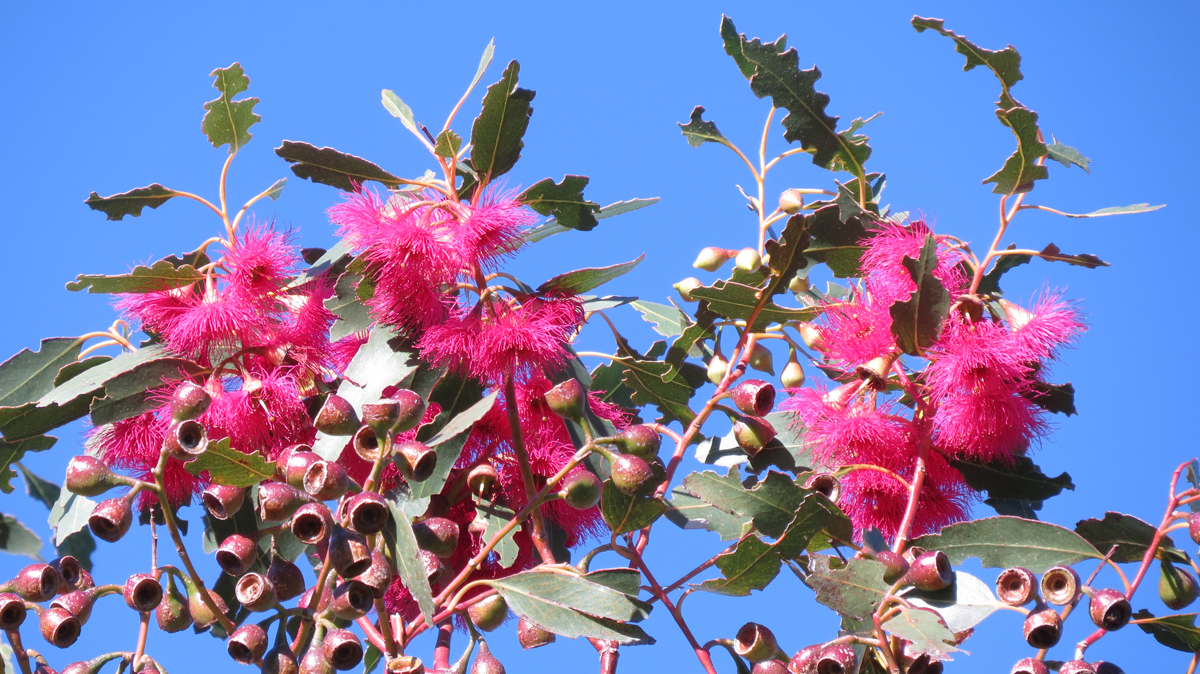
The most common of the red flowering gums, and by far the prettiest, is the Western Australian native E. ficifolia, now called Corymbia ficifolia by botanists, if not by gardeners.  This is a small but densely-growing tree with large racemes of tightly growing flowers, and at its best in the summer, is a vibrantly dramatic tree, sometimes confused with pohutukawa.
It is slightly frost tender, but will grow in inland Wairarapa as long as it is given some protection in the first few years of its life – there is a spectacular tree in Opaki Road, nest to the Mormon church. In warmer areas, such as on hills or nearer the coast, it makes a wonderful small tree, and is frequently planted as a street tree in towns further north.
It is easily raised from seed, but is very hard to graft, and therein lies a slight problem. This tree does not come true from seed, so there is a risk in planting out a seedling – it may not give the wonderful orange/red colour the gardener looks for.  The flowers can be paler, right through to soft pinks, and even pure white.  A few years ago I ran along an avenue of these trees on the other coast, and there was no unanimity at all – no two trees seemed the same colour.
The winter flowering species, which is so useful at supplying feed for honey-eating birds, glories in the names of Eucalyptus leucoxylon ‘Rosea’, and is a form of a South Australian species, known as Yellow Gum in its homeland, although it also has a number of other common names.   It grows in a more open manner than E. ficifolia, displaying its light coloured bark.  Although the species is variable as to flower colour, the bright red form commonly grown for ornamental purposes is generally fairly true to colour.  Having said that, I have to say that it is not uncommon for pink forms to appear when these trees are grown from seed.

This tree is slightly bigger than E. ficifolia, especially when grown in a position sheltered from the worst of the wind – conditions which do not apply to the Castlepoint Golf Club I have to say.  That size, and the propensity of gum trees to shed branches, probably means that this tree is not really suitable for growing in smaller sections, but larger gardens can easily cope with one of these.
And the golf?  Well, I enjoyed a walk in the country, and sounds of a working farm coupled with then bird song in the bright clear skies made for an enjoyable morning. The less said about the golf, the better.

Sunday, June 23, 2013

Schlumbergia - what?


Among our favourite plants there are many with such ugly names that we prefer to call them by their old ones.  The fabulous winter flowering iris is known by most people as Iris stylosa, surely a much classier name than the now correct, Iris unguicularis.  Similarly, the winter flowering cactus that I always knew as Zygocactus has now been renamed with the un-euphonious Schlumbergia. I think I’ll stick with the old name, or perhaps use a common name.
In the Northern Hemisphere these plants are known as Christmas Cactus, rather obviously because they flower in the middle of winter.  Here in New Zealand they are sometimes called Crab Cactus, from their unusual flower shape, or more commonly, chain cactus (although there are other cactus known by that name) or inch cactus, from the fact that the leaflets grow an inch at a time. 
As a matter of botanical interest, these “leaflets” are actually the flattened branches of the plant – it does not actually make any leaves, but carries out photosynthesis through the branches.
These wonderful plants, given their “new” name in the 1890s to commemorate Frederic Schlumberger, a French collector of cacti, but it never became popular, and to be honest, most modern nurseries do not use it now either. 
Although these are true cactus plants, they are not desert plants as you might expect - they originate from the jungles of Brazil, where they grow as epiphytes on the trunks of large trees.
 I am sure that most people will be familiar with these cute little winter flowering plants, usually from ones that have been handed around among the family, as they are so easy to propagate.  Once they have finished flowering, the “leaflets” can be detached and popped into potting mix where they will quickly grow new roots and start all over. 
I have a small collection of these in the glasshouse where they can happily sit on a bench until they start to flower.  The most magnificent of these is a lovely light pink flowered form, which I started some years ago as a cutting from a plant that a workmate’s mother brought in to work for us to share the flowering.  I do not know that she thought we would also pinch one or two leaves!
The other plants I have are some I bought a few years ago from a nursery, and they were very modern ones with quite different colours.  These are very popular potted plants in the northern hemisphere, as you can imagine for a plant that flowers at Christmas, and breeders have got to work on them, expanding their range from the older forms which tended to be in the cerise pink range.  I have to say that these new ones, which have orange, bright red and even yellow-ish, have not been as vigorous as the light pink form but they are still very attractive.
As you would expect from an epiphyte (a plant that lives attached to another) these guys need really good drainage.  I think you could probably grow these in an orchid potting mix but I have just used a standard mix with some orchid mix added to it, about 60/40. That does not mean they like to dry out – they do not, and it is important to keep a steady supply of water.  If allowed to become too dry they will quickly withdraw water from the leaves which will shrivel.
 If you want them to do well it pays to give them some food every once in a while – I just sprinkle slow release pellets on the surface and it does the job well.  They prefer semi-shaded conditions, as you would expect from a jungle plant, and the leaves can easily burn if left in full sun.  If you have a really warm spot, you could even try growing them on the branches of a tree.