Sunday, June 30, 2013

Mid-winter ramblings


For the past couple of weeks I have been on annual leave, having what I believe young people call a ‘staycation’, when you are on leave but remain at home.  Mid-winter is certainly an interesting time of year to be on leave, and the days have alternated between cloudy and cold, and frosty and fine – and cold.
On one of the finer days I swept the dust off my old golf clubs, packed them in the back of the car and went out east, to gently hack my way around the Castlepoint Golf Club at Whakataki. It was an interesting round, where I was accompanied by the sounds of yarding from a neighbouring farm, with the usual sound effects from a mob of sheep, a pack of barking dogs, and the whistles and shouts of the farmer.
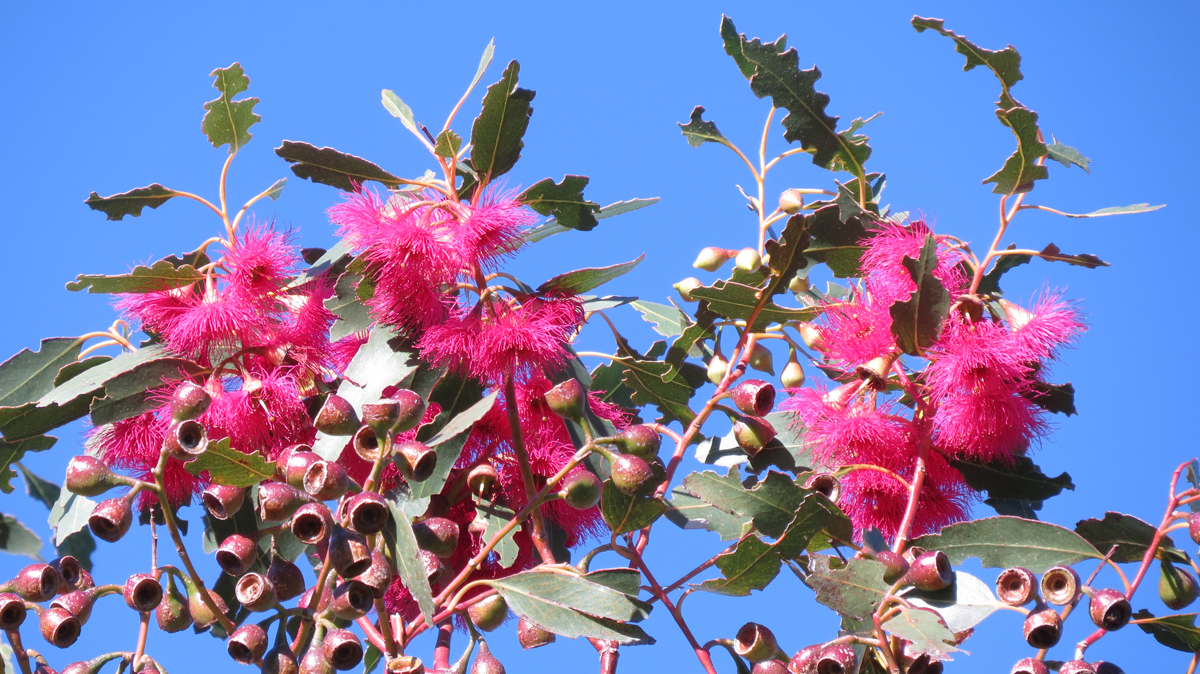
On the side of nature, I was also delighted to have the company of a large troop of tui as I moved from hole to hole.  Over the years the golf club must have thought of winter feed for honey gatherers as they planted out the fairways and byways of the course, and the tui were greedily sipping from the red flowered gum trees that were scattered throughout the course.
The most common of the red flowering gums, and by far the prettiest, is the Western Australian native E. ficifolia, now called Corymbia ficifolia by botanists, if not by gardeners.  This is a small but densely-growing tree with large racemes of tightly growing flowers, and at its best in the summer, is a vibrantly dramatic tree, sometimes confused with pohutukawa.
It is slightly frost tender, but will grow in inland Wairarapa as long as it is given some protection in the first few years of its life – there is a spectacular tree in Opaki Road, nest to the Mormon church. In warmer areas, such as on hills or nearer the coast, it makes a wonderful small tree, and is frequently planted as a street tree in towns further north.
It is easily raised from seed, but is very hard to graft, and therein lies a slight problem. This tree does not come true from seed, so there is a risk in planting out a seedling – it may not give the wonderful orange/red colour the gardener looks for.  The flowers can be paler, right through to soft pinks, and even pure white.  A few years ago I ran along an avenue of these trees on the other coast, and there was no unanimity at all – no two trees seemed the same colour.
The winter flowering species, which is so useful at supplying feed for honey-eating birds, glories in the names of Eucalyptus leucoxylon ‘Rosea’, and is a form of a South Australian species, known as Yellow Gum in its homeland, although it also has a number of other common names.   It grows in a more open manner than E. ficifolia, displaying its light coloured bark.  Although the species is variable as to flower colour, the bright red form commonly grown for ornamental purposes is generally fairly true to colour.  Having said that, I have to say that it is not uncommon for pink forms to appear when these trees are grown from seed.

This tree is slightly bigger than E. ficifolia, especially when grown in a position sheltered from the worst of the wind – conditions which do not apply to the Castlepoint Golf Club I have to say.  That size, and the propensity of gum trees to shed branches, probably means that this tree is not really suitable for growing in smaller sections, but larger gardens can easily cope with one of these.
And the golf?  Well, I enjoyed a walk in the country, and sounds of a working farm coupled with then bird song in the bright clear skies made for an enjoyable morning. The less said about the golf, the better.

Sunday, June 23, 2013

Schlumbergia - what?


Among our favourite plants there are many with such ugly names that we prefer to call them by their old ones.  The fabulous winter flowering iris is known by most people as Iris stylosa, surely a much classier name than the now correct, Iris unguicularis.  Similarly, the winter flowering cactus that I always knew as Zygocactus has now been renamed with the un-euphonious Schlumbergia. I think I’ll stick with the old name, or perhaps use a common name.
In the Northern Hemisphere these plants are known as Christmas Cactus, rather obviously because they flower in the middle of winter.  Here in New Zealand they are sometimes called Crab Cactus, from their unusual flower shape, or more commonly, chain cactus (although there are other cactus known by that name) or inch cactus, from the fact that the leaflets grow an inch at a time. 
As a matter of botanical interest, these “leaflets” are actually the flattened branches of the plant – it does not actually make any leaves, but carries out photosynthesis through the branches.
These wonderful plants, given their “new” name in the 1890s to commemorate Frederic Schlumberger, a French collector of cacti, but it never became popular, and to be honest, most modern nurseries do not use it now either. 
Although these are true cactus plants, they are not desert plants as you might expect - they originate from the jungles of Brazil, where they grow as epiphytes on the trunks of large trees.
 I am sure that most people will be familiar with these cute little winter flowering plants, usually from ones that have been handed around among the family, as they are so easy to propagate.  Once they have finished flowering, the “leaflets” can be detached and popped into potting mix where they will quickly grow new roots and start all over. 
I have a small collection of these in the glasshouse where they can happily sit on a bench until they start to flower.  The most magnificent of these is a lovely light pink flowered form, which I started some years ago as a cutting from a plant that a workmate’s mother brought in to work for us to share the flowering.  I do not know that she thought we would also pinch one or two leaves!
The other plants I have are some I bought a few years ago from a nursery, and they were very modern ones with quite different colours.  These are very popular potted plants in the northern hemisphere, as you can imagine for a plant that flowers at Christmas, and breeders have got to work on them, expanding their range from the older forms which tended to be in the cerise pink range.  I have to say that these new ones, which have orange, bright red and even yellow-ish, have not been as vigorous as the light pink form but they are still very attractive.
As you would expect from an epiphyte (a plant that lives attached to another) these guys need really good drainage.  I think you could probably grow these in an orchid potting mix but I have just used a standard mix with some orchid mix added to it, about 60/40. That does not mean they like to dry out – they do not, and it is important to keep a steady supply of water.  If allowed to become too dry they will quickly withdraw water from the leaves which will shrivel.
 If you want them to do well it pays to give them some food every once in a while – I just sprinkle slow release pellets on the surface and it does the job well.  They prefer semi-shaded conditions, as you would expect from a jungle plant, and the leaves can easily burn if left in full sun.  If you have a really warm spot, you could even try growing them on the branches of a tree.

Sunday, June 09, 2013

Pitching in


Sometimes my two jobs interconnect in interesting ways, and this week gave a great example.  A local landscaper came in to see whether I could tell him about the sort of plants that were in use in the 1920s, as a client wants to re-establish an authentic garden around a beautiful workingman’s cottage from that era.
Interestingly, his client wants to use camellias, natives and evergreen Magnolias to supplement to laurel hedge which has already been planted.  Luckily, we have an old Robinsons catalogue from the 1920s at work, and I was able to show him that the wonderful Magnolia grandiflora¸ with its large bay-like leaves and bowl-shaped scented flowers was a favourite in the 1920s, and that there were a few old Camellia varieties around too, although there were none in the catalogue that were commonly grown now.
It was in the native tree and shrubs area that things have changed the most, with the 1920s catalogue being very sparse on varieties that we would think of as commonplace.  There were no Hebes or Coprosmas, and even very few Pittosporums.
This was a little surprising as Laurie Robinson became well-known a little later on as one of the most ardent garden fans of native ornamentals,  and as the introducer of quite a number of variegated forms of some of the shrubby Pittosporum species, especially tarata or lemonwood,  P. eugenioides  and silver matipo P. tenuifolium.
Robinson’s nursery, no longer in family ownership, continues to grow new forms of these popular native shrubs, and in the past year or so has released two new dwarf forms of P. tenuifolium. Over the past few years a number of different dwarf forms have been released in New Zealand, including a lovely silvery/green leaved form from Clareville Nursery called ‘Elfin’, which we have in the front garden.  They all share a naturally compact growing habit, with the ability to be clipped to be kept under control. 
Perhaps the best known of these is ‘Golf Ball’, a fast-growing dwarf shrub that can easily be kept to about 30 cm high with a similar width.  These are quite often used as a replacement for  box hedging, having a lighter look while being just as easily kept under control.  A few years ago the nursery industry was promoting the use of some Hebe varieties for formal hedges, but this makes a much better choice.
Recently two new coloured forms have become available from Robinsons, and a few other selected nurseries – a golden form and a silver one, called, you will not be surprised to read, ‘Golden Ball’ and ‘Silver Ball’. As you would expect, these varieties have bright glossy foliage, and form naturally rounded shapes, with foliage of golden and silver hues respectively.
I have been intrigued by another relatively new selection, a semi-dwarf form called ‘Reflections’.  This selection I immediately noticed in the nursery stocks as it has a very tidy form with clean high gloss foliage and striking colour. The small leaves are green with a curiously wavy edge, coloured yellow on the central rib and veins.  As if that was not enough, the stems are red and the new growth is right creamy-yellow.  This makes a nice com pact growth, perhaps a little more vigorous than the truly dwarf forms, but also much more compact that the willowy larger forms.
Like all Pittosporums, you need to be a little bit careful about insect infestation, especially the pesky little native psyllid which can pucker the leaves of left unchecked.  A quick spray with an insecticide will soon sort the problem out.

Sunday, June 02, 2013


I had a special treat during the past week.  A regular reader of this column rang me to say she had a special present for me from her late mother’s garden – a big pot filled with oxalis.
I know most of you will be appalled at the idea of such a gift, and anyone who has struggled with any of the few pestiferous members of this widespread family of bulbs will throw their hands up in horror at the thought of a gift of such pernicious, unwanted plants.
But those of you who are fans of small bulbs will have shared my excitement at the offer, especially as it was a pot of the intriguing O. versicolor the creatively coloured little plant with barbers’ pole flowers.  This little charmer has a slightly different habit of growth to most species as it forms a very low-growing sub-shrub with almost woody stems, only growing a few centimetres tall.  At this time of the year their flowers are in evidence, and what funny little flowers they are.  The plant produces crimson striped, funnel shaped buds like tiny striped old fashioned barbers poles.  They open to reveal pretty white cup-shaped flowers with crimson margins.   
We grew this plant years ago in a warm garden in front of one of the glasshouses in the nursery, in a bed where one of our sons grew his miniature roses, and it flourished, which gives a good indication as to the sort of conditions it requires – warm soil, a sunny open site, and a bit of watering over the summer.  It is reportedly half hardy but it coped with anything our climate could throw at it.  And it did not spread at all!
I have a bit of a thing about the whole group of these lovely little bulbs and have a number of pots growing in full sun underneath my office window, many of whom have been in flower over the past few weeks.
I think my favourite of these might be the delightful South African species, O.  massoniana.  This is a strong growing and very free flowering form, ideally suited for growing in containers.   It has the most amazingly coloured flowers – sometimes called ‘bright orange’, but really more of a warm, light terracotta colour with bright golden centres.   Unusually for Oxalis, this species can be propagated from cuttings of the tree-like shoots.  I find this one is not as strongly-growing as some of the other species I grow, but it is startlingly beautiful when in flower in its terracotta pot.
The various forms of O. pupurpea that I grow are now just slightly past their best.  This is wildly variable South American species, and is grown for its attractive winter flowering habit, and their attractive cut foliage.  There are a number of forms available in New Zealand, and an even wider range on sale overseas. 
Among those I grow, the one I like most is a deep purple foliaged variety which I have seen described as ‘Nigrescens’.  Naming of these plants can be confusing as nurseries have confused similar looking types, and it may be possible that it is the same variety grown in the rest of the world as ‘Garnet’. The deeply coloured, clover-shaped leaves are wonderfully offset the glowing pink flowers.  These flowers are very difficult to photograph effectively as they have a shiny gloss and the flowers always appear lighter in photographs than they do in the garden.
I grow two other forms of O. purpurea,  both having (oddly enough) green leaves; one with glowing white flowers, the other with the same shining pink flowers of the dark-leaved variety.  There are yellow and cream forms of this species too, but I have never seen them on offer in New Zealand.

This species increases very well in the pots, and, even though there are plenty of species I would happily plant in the garden,  I think I would be hesitant to plant any of these varieties in light well-drained soil as they might get a little too territorially ambitious and could multiply a little too quickly.

Sunday, May 26, 2013

Pineapple guava or bad medicine?


In a well-known poem devoted to autumn, the English Romantic poet John Keats, whose relatives live in Masterton, called the season a time of “mists and mellow fruitfulness.”  Writing in the early 19th century, Keats would have had apples and pears, medlars and other old world fruits in mind, but here in New Zealand in the early 21st century, an entirely different set of fruits scent our misty season.
Perhaps the most uniquely New Zealand fruit is the Feijoa.  I am not claiming this as a native plant, but New Zealand seems to be the only place in the world that the fruit is grow on a large commercial scale, and the only place where it is a common garden fruit.
Botanically, the feijoa is member of the vast myrtle family, and thus is a distant cousin to our rata and pohutukawa, a kinship that can be appreciated by looking at the flowers.  They occur in the wild in highland parts of different countries in South America, and are now grown as a crop in New Zealand and a few other temperate countries.
They were introduced to New Zealand in the 1920s, and quickly became very popular as a reliable evergreen shrub that could be used as a small feature tree, but was also well-adapted for use as a shelter tree, and was often grown as a tall hedge.  Even under these conditions, the feijoa will crop, and most of us will have eaten these fruit as children, usually from trees that bore so many fruit that the owners could not cope with it all.
Opinion is divided on exactly what the fruit tasteslike.  Some say the flavour is reminiscent of pineapple, guava and strawberry, while other catch hints of mint.  Those who do not like the flavour usually say it tastes like an unpalatable medicine!
When I was first involved in horticulture there was a very restricted range of varieties available, and they were not that much better than the seed grown plants offered for sale for hedging.  That has changed in the past few years and there is now quite a range of different varieties available.  Some are self-fertile (‘Unique’ is the most reliably so) but most will do better if there is another variety growing nearby.
I have grown ‘Unique’, and it is a very reliable cropper, with medium to large fruit which it carries from an early age but there are many others around.   ‘Pounamu’ is a newer smooth skinned type, with fruit that ripens early in the season – they should be edible by the end of March – while ‘Opal Star’ is a later fruiting form with strong flavours.  ‘Gemini’ and ‘Apollo’ are also reliable forms, although both need another variety nearby for pollination.
Feijoas are very easily grown, but they do best in well-drained moist soils, rich in humus.  They will cope quite well with periods of drought but need abundant watering during fruit maturation if full sized fruit are to be enjoyed.  They need little trimming or pruning, but can easily be shaped and trimmed if that is needed.  Give them as much sun as you can, but they will also cope with partial shade.


Sunday, May 19, 2013

Made in Japan


This year’s long and very warm summer has been followed by an equally protracted autumn.  It is nearly the end of May and we have not had a significant frost, and there has been comparatively little wind.   The result of that has been a wonderfully drawn-out autumn display by the many deciduous trees that abound in Wairarapa.  At the weekend we went over to Wellington and the poplars in the Abbotts Creek valley were in full golden glow, while on the other side of the hill the avenue of American oaks opposite the Birchville entrance was glowing rusty red.
We have a fiery purple Japanese maple putting on a show halfway down our drive – or, more correctly, our neighbour does, but the tree comes over the fence and gives at least as good an autumn display for us as it does for them.  I know there are two much-divided schools of thought on autumn leaves.  One hates the very thought of them, and tries to catch them before they land, and sweeps them away to oblivion instantly.  On the other hand, there are those who relish the changing seasons they herald, and delight in crunching through piles of discarded leaves.  I am very much in the latter camp, and am never worried too much about fallen leaves.  It might be different if I had huge London Plane growing outside my front door, but Japanese maple leaves  are airy and ephemeral and any inconvenience of their falling in autumn is more than compensated for by their on-going beauty through the year.
I think Japanese maples are the perfect small deciduous tree for the home garden, with their elegant shape, and their year-round attractions.  In the winter most varieties have an attractive ball-headed shape of interlacing branches.  In some cases they also have very attractive bark, especially the coral bark maple, Acer palmatum ‘Senkaki’,   which has coral pink young stems which carry bright lime green foliage in the spring.  Come winter the exposed red stems are an attractive feature, although it has to be said that the bark darkens as it ages, and it is only the outer part of the tree that carries this coloration.
Many of the purple foliages varieties also have deep red/purple stems as well, offering another level of enjoyment.  There are very many red varieties around but perhaps the best is ‘Bloodgood’, which holds its bright colouring well into the summer, before darkening and then turning bright crimson for the autumn.  This is quite an upright growing form that spreads nicely as it matures.  Like most purple varieties, it has tiny little purple flowers very early in the season – hardly noticeable unless you go looking for them but very pretty – as well as purple helicopter seeds in the autumn.
If you want a smaller version of this there is a new variety called (rather unattractively) ‘Skeeter’s Broom’.  This arose as a witch’s broom on ‘Bloodgood,’  a tightly growing mass of smaller branches often seen on silver birches but rarer on maples.  It means that this variety has much twiggier and denser growth than its parent, while retaining the same colouring.  It also means its ultimate height is more restrained, growing perhaps two metres tall and about half that around.
Another cultivar that supposedly originated as a sport of ‘Bloodgood’ is the shrubby ‘Shaina’, which forms an outstanding small globe-shaped tree with very dense purple foliage.  As well as being great in the garden this one also makes a tremendous patio plant, and for those who are so inclined, a great bonsai as well.
If you want to go even smaller you are in the realm of the dwarf, weeping maples – among the most desirable of all dwarf trees.  I think ‘Crimson Queen’ is as good as any, with its finely dissected foliage slowly turning from bright crimson in spring, through to deep, dark purple for summer, then switching to scarlet for the autumn.  Like most of the dwarf varieties, it has naturally arching growth that will fall to the ground if left, and looks spectacular at any time of the year, including winter when the clear, clean outline looks very attractive.


Sunday, May 12, 2013

Thinking of Daphne


At work I have been helping a lovely lady called Daphne with some research, and I guess my subconscious has been hard at work as my mind has been filled with thoughts of those sweetly fragrant favourite plants all week.
I suppose it could also be something to do with my first real acquaintance with the newly-arrived (in New Zealand at least) hybrid that glories in the name of D. x transatlantica, although in our country it is usually met with in the form of ‘Eternal Fragrance.’
This plant is a hybrid, the result of a naturally occurring cross between two species seldom seen in New Zealand,  D. collina and D. caucasica, combining the small stature and strong fragrance of the former with the fragrance and long blooming period of the latter. It is sometimes possible to find D. collina in New Zealand – usually further south than here – and there is a lovely pink-flowered hybrid called, somewhat bizarrely D. hybrida, that can be found in some garden centres.
Daphne ‘Eternal Fragrance’ is a compact, semi-evergreen, mounded shrub that blooms with gusto in early spring, then continues from October to the first frosts of winter with small clusters of fragrant, pink-budded white flowers.  This plant has become very popular overseas and looks likely to be as popular here, being longer-lived than the more commonly grown forms of Daphne.  It is also a very tidy growing form, and will grow well in pots – in fact, I have even seen overseas magazines that have shown it used as a hedge, but that may be taking it too far!
Overseas there is a variegated form called ‘Summer Ice’, with a lovely white rim around the edge of each of the fine leaves, but I have not seen it offered for sale in New Zealand yet.
I am looking forward to planting ‘Eternal Fragrance’ soon, as over the years I have grown more kinds of Daphne that I care to remember - at least ten forms I would think.
The most popular of these are the various forms of Daphne odora, the daphne that most people know as the common variety.  Nowadays this is usually encountered in the form of the strongly upright growing form known as ‘Leucanthe’, and its white counterpart, ‘Leucanthe Alba.’  These are both lovely shrubs that carry superbly fragrant flowers in great abundance in later winter and early spring.  The scent is very heady and spicy – some have described it as being reminiscent of jasmine, another heady-scented shrub.  However, like many Daphnes they can be slightly temperamental, and it does not pay to get too attached to any one of them, as they are prone to slowly slipping away.
They are a bit fussy as to soil – they need slightly acidic conditions, with humus-rich soil that does not dry out in summer, or become waterlogged in winter.  They can cope with full sun, but I think most do best if they are grown where they will get some shelter from the worst of the afternoon heat.  They do not like being replanted, and are best replaced with container-grown stock.  They are not too fussed about heavy pruning wither – it is best to nibble away at them throughout their life.  I find one good way is to remove the flowering buds, either when they are in flower (they are great in the vase) or shortly after they finish.  It helps keep the plants compact too, as they can get a bit straggly.
There are a couple of other forms of D. odora that are with looking out for.  The old form, ‘Rubra’ has the deepest coloured flowers, although I have to admit it is a slightly untidy grower, the branches dipping off at their own behest.  This is the form our grandparents grew.
As a general rule variegated plants are not as hardy as those that are fully green – it is obvious when you think about it as they have less chlorophyll and as such are not so efficient at growing as their more complete cousins.  But this does not seem to be the case with daphnes, as the classy ‘Aureomarginata’ seems to be tougher than its green counterpart.  I love this lovely plant with its lively yellow rim around the edge of each dark green leaf, and it does seem to survive longer in the garden than the plain-leaved types, which can be a little transient.


Sunday, May 05, 2013

Camellia 'Little Liane'

As winter approaches most of the garden goes into a slow decline.  It is the time of the year to take care of the perennial garden, cutting back last year’s growth, dividing where necessary, and applying a little bit of fertiliser for the upcoming year.
This is also the time of the year that the autumn/winter flowering shrubs kick into their blooming season, especially those wonderful autumn flowering sasanqua camellias.
The arrival of camellia petal blight has seriously curbed my enthusiasm for the majority of camellias.  The way their flowers turn brown almost as soon as they open has driven even the most ardent camellia growers to rethink their passion.  The trouble is a fungal one, and it seems there is no chemical cure for it.  It spreads very rapidly,   and survives through the summer as spores in the ground, only to reappear as the flowers open in late winter early spring.
The sasanqua camellias seem much less prone to the disease, although I suspect it is largely because the fungal spores are not about at this time of the year.  Either way, it does mean we can enjoy these lovely camellias before the blight strikes.
We currently have one in flower, the very compact growing ‘Little Liane’, one of the Paradise range of sasanqua camellias, raised in Australia and released onto the New Zealand market in the past few years.  It is small-leafed, compact shrub growing to around a metre tall, although our’s has assumed a rather odd shape.  When freshly planted it was knocked over and, it being of sight, I did not notice for a year or so.  It grew almost horizontally before sending up some vertical branches, so it is now wider than it is high.  The flowers are small white, of loose informal peony form and supposedly with a faint pink margin, although my spectacles must not be rosy enough because I have never noticed that.  The flower centres is a scramble of stamens, petaloids and small petals, making for an interestingly informal flower. Because of its dense compact flowering habit, this variety was specially selected suitable for low hedges and topiary.
It is probably most like the older form ‘Mine Yo Yuki’, which was once the most common white sasanqua camellia, and still has many fans.  It is taller growing but is still quite compact in form, and is often used for hedging.
The other white sasanqua often seen in older gardens is the fabulous ‘Setsugekka’, which carries an abundance of large wavy white blooms with prominent yellow at this time of the year, each bloom being softly scented.  This makes a great sight in the garden, growing taller than the other white varieties mentioned above, getting up the three meters after many years.
Perhaps the best-known the sasanqua camellias is not one – the old favourite ‘Hiryu’ is actually a form of the closely related species C. hiemalis, but looks for all the world like one of its cousins.  It has masses of beautiful, large deep rose semi-double flowers, shading to red at the petal edges, and is as hardy as can be. 
Another old form to keep an eye out for is the venerable variety ‘Plantation Pink’.  This has been grown in gardens for many years now, but it is still as popular as ever, with its cheerful clean and clear pink flowers providing such good garden value at this time of the year.
Among the Paradise varieties that are worth looking out for are ‘Belinda’, with large, glowing pink flowers; ‘Blush’ with flowers that open from deep pink buds, to become almost white with a pink reverse on the outer petals; ‘Gillian’, which has delicate semi-double blooms, white faintly edged with soft pink; ‘Glow’, which is basically  an improved version of ‘Plantation Pink’, with large deep glowing pink, single flowers with a centre of bright yellow stamens; ‘Joan’, which has very showy large red loose informal double flowers, and ‘Vanessa’, with very large brilliant white flowers which have a pink flush on the outer petals.

Sunday, April 28, 2013

Medlars and Chinese quinces


The Head Gardener and I wandered around Eastwoodhill Arboretum one morning recently   while on holiday in Gisborne, delighting in the various coloured trees – mainly oaks at this stage, but also many other types of deciduous trees.  It was quite dangerous in places, because the pathways were strewn with thousands of acorns, and I kept imagining those with less steady footing falling over easily.  We had the obligatory map but were quite happy to just follow our noses, usually following Robert Frost’s dictate about the road less travelled.

We came across an area that seemed dedicated to edible plants of the more unusual kind, included a medlar, Mespilus germanica, in full fruit.  I have seen the fruit before, and have seen trees before, but have not seen a tree laden with fruit before.  It is an interesting subject, being a member of the vast rose family (as are many edible fruits) and seems to fit somewhere between the pear species (of which there were many at Eastwoodhill) and the hawthorn. 

It makes a small tree, growing about five metres high, with a similar spread, and looking not unlike an apple.  It also has the great habit of colouring up well in the autumn, usually taking on yellow and orange shades.  Before then, though, the fruit become ready for picking.  They are unusual-looking fruit – sort of like oversized rose hips in a way, brown and with a calyx on the crown.

This southern European fruit was once quite popular but has fallen from favour, probably because so many similar fruits, such as apples and pears are readily available, and you do not have to wait until the fruit is rotten to eat them.   The technical term is “bletting”, but it amounts to the same thing.  After two to three weeks in storage,  the fruit becomes soft, mushy brown, and is said to be both sweet and tasty, with a hint of spicy applesauce.  If you do not fancy eating rotten fruit, perhaps it would be better to make a jelly from the fruit – it is also said to be delicious.

Before we left for holiday I had someone come in to see me at work, holding what at first appeared to be a semi-ripe mango.  When they explained it was growing on a tree in their garden in Masterton I soon worked out it was not a tropical fruit of any kind, but was a little puzzled.  I cut the fruit open and could see lots of seed inside, and could discern very little scent– but there was just enough for me to realise what it was. 

What I was looking at was a fruit of an unusual deciduous shrub from China, fruit I had not seen for about twenty-five years.  It was from Pseudocydonia sinensis, another aromatic fruit tree from the rose family, and another that is basically inedible!

This is an attractive small tree – only about three meters tall – and is closely related to both the quince tree of Europe, and the ‘japonica’ of the garden – Chaenomeles species. In spring it has pale pink flowers, which are later followed by the ovoid fruit, about the size of a large pear.  They are green for a long time, then take on reddish hints before turning butter yellow as they ripen.  They have a wonderful aroma, and a bowlful of them will scent the whole house.

These fruit are very astringent and very hard, and no amount of bletting will make them edible (at least not in my estimation) but they do have a use – they make the most wonderful conserve, not unlike quince conserve but much more aromatic.  We had a specimen of this tree in our nursery, probably about fifty years old or even older.  It only fruited once for us but what it lacked in regularity it made up for with enthusiasm, being heavily laden.  A young student,  who was working for us on work experience, decided he wanted to use the fruit and took some home to make the conserve.  I’m not sure if he or his Mum made it, but it was superb – it went really well with stewed apples.

I think I’d prefer a jar of that to some freshly bletted medlars.


Sunday, April 14, 2013

Feeling seedy


I have been following some interesting threads of discussion on the internet over the past few days, after receiving a number of invitations to sign a petition against the American chemical company Monsanto, probably best known as the inventor of Round Up.  The petitioners allege that Monsanto has gained patent rights on all vegetable varieties and will enforce a ban on gardeners and farmers saving their own seeds.
It has certainly vexed some people and there are some outraged people, posting all sorts of strange stories on-line. Needless to say the story is more interesting, and less alarming than that.  Monsanto has bought a number of seed companies over the past few years, including Seminis, a large supplier of commercial strains of vegetable seeds.  Monsanto does not have a monopoly on seeds, and only has any patent rights on vegetable seeds that were patented through Seminis.
So what are plant patents and how do they affect gardeners?
All of our vegetable varieties have been derived from wild species, usually by many generations of gardeners saving seeds from varieties which are an improvement over the wild kinds.  In that way beans and peas were cultivated for their sweetness and the increased size of the seeds, while carrots were changed from pale-rooted vegetables into the (usually) orange vegetable we are familiar with.  Perhaps the most remarkable series of changes has taken place within the Brassica group of vegetables, where one species has been, through patient selection, turned into kale, cauliflower, cabbage, Brussels Sprouts, broccoli and collards. 
That process of careful selection meant that a century ago seed companies were able to offer their own strains of most vegetable types, and employed breeders and manual labour to ensure their varieties were true to type, and to also instigate new varieties.  This would be achieved by hand crossing two differing varieties, each with a particular point the breeder was interested in -  early cropping, better colour, larger size for example – then the resultant seedlings would then be reselected until the best traits were combined in a stable strain.  This was usually achieved by growing the vegetables in large numbers, keeping only the very best for seed and ruthlessly rouging out any plants that were not true to type. Then, and only then, would the strain be released onto the market.  This type of seed is pollinated by insects and is referred to as Open Pollinated, or OP.
But once it was released, any seed was fair game, and could quickly be bulked up and grown and sold by any competitor, thus denying the original breeder of the full fruits of their labour in developing the variety in the first place.
That all changed with the introduction of the Plant Variety Protection legislation in the United States, and later in other places, especially when that was extended to seed strains as well as cloned cultivars. 
In a local sense, this idea of being able to patent a plant variety came too late for Robinson’s Nurseries who bred the phenomenally popular Photinia ‘Red Robin’ in the 1940s.  Nowadays they would be able to license such a variety and would be able to secure a payment for every plant sold around the world, worth hundreds of thousands of dollars each year.  Then they only had the introducer’s bonus, of being able to bulk to a sufficient number of plants before they were released onto the market.
In recent years plant breeders have concentrated on producing F1 hybrids, with interesting results for gardeners.  These are strains where two different parent strains are kept going, and crossed with each other, thus producing hybrid vigour, and much better uniformity.  This is a similar technique to that used by farmers for generations where they cross Romney ewers with Southdown rams to produce vigorous lambs.
The seed company only sell the seeds resulting from the first generation of crosses, thus the home gardener cannot replicate the strains, and is forced to buy seed fresh each year.  This is worthwhile for some varieties, but of less value for others, as F1 seed is usually exponentially dearer than OP seed.  I would never grow OP broccoli as F1 plants are much better, and the same applies to cauliflower, tomatoes and peppers.  On the other hand, OP lettuce and cabbage are generally fine – in fact, F1 hybrid cabbages tend to be too big for the home gardeners and older varieties, such as ‘Derby Day’; are probably a better bet.
Monsanto, and other chemical-producing firms have taken plant breeding a step further – a step too far many people - by using human genetic modification to breed plants with specific traits not found in nature, especially so in the case of Monsanto, which has released a Round Up resistant variety of soybean to the market, and has quickly captured the majority of the seed market.  They have also bred strains of maize and other crops that are also Round Up resistant.   They are remarkably popular as they allow farmers to sow seeds much closer as they can use Round Up as a post-emergence spray thus obviating the need for mechanical tillage between rows.
There is an inherent risk in this, of course, that being the possibility of the gene for Round Up resistance passing to a weed, this removing Round Up’s efficacy.  So far that does not seem to have happened.
The other area of concern for some is the issue of ‘terminator seeds’, varieties where the seed produced is sterile and cannot be used for a second generation.  This is obviously an issue for poorer farmers in less developed countries, and although it is claimed that such seed is produced, in fact it has not been commercially produced by any company. 
So, in short, Monsanto is not going to try and patent all vegetable varieties, and does could not if it wanted to, so you will still be able to grow ‘Great Lakes’ and ‘Webbs Wonderful’ lettuce,  ‘Moneymaker’ tomatoes and ‘Nante’ carrots without adding to the riches of the shareholders of Monsanto.

Sunday, April 07, 2013

Couch in the border!


Through the last few months I have been watching a piece of couch grass make its way out of the back lawn and into the end of the large mixed border in our backyard.   It had made its way into the middle of a clump of variegated Solomon’s Seal before I noticed it, then it spread its runners out into a couple of clumps of lungwort.  I have been waiting for the soil to freshen up before tackling it, knowing that digging in the hard soil would only snap the runners.   I was probably the only person in the region who was happy to have a wet weekend, and to have the chance to deal to this pesty grass before it got too far out of control.
The first task was to carefully take the perennials growing in this area out.  I wasn’t unhappy about that as it was more than time to do that as some of the plants had been in large clumps for many years.
The variegated Solomon’s Seal had been nibbled away at last year, when I took some rhizomes off the edges of the plants as part of my contribution to the new border in Queen Elizabeth Park.  They are now well established down there, and part of a wonderfully refurbished border that is a credit to the Friends of the Park, and to Doug Bailey and his team.
Variegated  Solomon’s Seal, Polygonatum odoratum 'Variegatum', has great foliage value, having arching stems which carry lance shaped, green leaves with white margins but it also has delicate, creamy-white, fragrant, bell shaped flowers dangling from the stems in mid to late spring.   I love this plant in spring, when it is quite light green, as it makes a good contrast to the iris seedlings that grow alongside it.  It is a little bit of an expander – it spreads by finger sized rhizomes – but in all the years that it has been here it has only grown to about 60 cm across. 
The pure green form is just as good in the garden although it is a big more vigorous, growing perhaps a metre tall as opposed to the 80 cm the variegated form stays at.   Either form will grow well in full sun, but I think they are both best with light shade, and slightly moist soil.
Growing among these rhizomes in my garden, and slightly difficult to tell apart from the nodes on the couch, were a few clumps of the pink form of Lily of the Valley, Convallaria majalis ‘Rosea’.   The white form of the plant was a major favourite in my mother’s garden – she grew masses of it underneath the living room window in a very damp spot, and it always thrived.  I have a few measly plants of the white form struggling along in the garden, and an equally small number of buds of the pink form, also struggling.  I am sure my failure to grow these well is simply that I do not have a wet enough spot in our largely dry garden.
It is, of course, like a miniature version of Solomon’s Seal, with hanging bells of white (or a slightly muddy pink) pretty enough to look at in their own way, but mainly grown for their outstanding sweet scent.  For those of you who are royal fans, they featured in the Duchess of Cambridge’s wedding bouquet.
The two biggest clumps in this part of the garden were both lungworts, Pulmonaria.   These are outstanding foliage plants, doing especially well where conditions are a little less than ideal – in slightly shady areas, or those that are a little dry.  They derive both their common name and generic names from the supposed similarity between the leaves and the inside of lungs.  Personally I hope my lungs are not bristly haired and green – I cannot imagine that would be good for my health – but I accept that the name largely derives from the spotted nature of the leaves.  As a result of this look-alike perception, herbalists believed that the leaves were good for alleviating lung problems.  Science does not back this claim.
These are lovely garden plants, with some older forms having a mix of blue and pink flowers on the same plant, but modern forms tend to be coloured with one colour only, and the spots have been developed to become more dominant.  One of the clumps in the garden that I divided this weekend  is of the modern variety ‘Raspberry Splash’,  which has slightly more pointy leaves than average, all covered with lots of white spots.  The flowers are deep reddish pink, and carried in late spring mainly, although there will be sporadic flowers later.  This has made a sizable clump in my garden, and always looks tidy.
‘Majeste’ is the other variety I grow – and this is something special.  The flowers are pink and blue, but to be honest they are not the attraction for this one, it is the magnificent (or majestic) solid silver foliage, covered with fine hairs.  Again, this has been in the garden for a long time and always looks fantastic.  

Monday, April 01, 2013

Blooming good at Easter


Was there ever an Easter like this Easter?  One when the sun shone unremittingly throughout the whole weekend?  Although we are all hoping the drought will break soon, for a variety of reasons, most of us were secretly  happy that it did not happen through the long weekend.
The Head Gardener and I managed to a little time away to catch up with family, and spent some time on family history matters, but there was still a spare hour or three in the garden, with some lawn mowing and garden tidying carried out.
I loved working among some of my favourite plants that flower at this time of the year, but they are almost all plants the Head Gardener has no time for – at all. 
Take the wonderful paintbrush lily that is flowering its head off in a large container on the patio.  This was originally a gift from a gardening friend about twenty years ago, but it has still to arouse the enthusiasm of the Head Gardener.  It is one of the many South African members of the Amaryllis family, and like many of its relatives it flowers on naked stems before there is any sign of leaves.  But unlike its kin the naked ladies and the wonderful Crinum, this one has a short stem, about 15 cm long, and relatively squat flowers, with small petals. 
The species in flower at the moment is Haemanthus coccineus, probably the most common of these plants in New Zealand gardens, although none are really found that often.  It is totally summer deciduous (a pointer to its coming from winter rainfall areas of southern Africa) and the first signs of life in the autumn is a colouring at the lips of the large bulbs, which sit slightly above the surface of the soil.   These orange-scarlet buds slowly creep upwards, until they are about 15 cm high, when the tightly sealed lips of the lower open to reveal an astonishing ball of golden anthers, looking for all the world like a big red shaving brush.
The Head Gardener is even less impressed with the white species H. albiflos, which flowers later in the year, but I would not be without these charming and slightly oddball South African bulbs.
And I would not be without a toad lily or two either, although again, the Head Gardener is less than impressed with them too.
These are Tricyrtis species, members of the Lily family, generally from Eastern Asia, and they are perennial plants that grow naturally in the moist soil on the edge of forests, so they are ideally suited to semi-shaded places in our gardens.  I guess that it because they live in damp places they are called toad lilies - I cannot think of any other reason.  The flowers are certainly not toad-like, but rather like refined orchid flowers, usually with curious markings on the petals.
They flower at this time of the year when the garden can be a little barren of colour, and even though they are not extremely showy they are attractive perennials.  They are at their best in the same sort of conditions that hostas, hellebores and other moisture and shade loving plants thrive in. 
I grow a couple of different forms but T. hirta, one of the best, is probably the most commonly found species in New Zealand.  It has white flowers generously splashed with purple.  The leaves in this species are also attractive – clean, mid-green with ribs reminiscent of hosta leaves.

Sunday, March 24, 2013


I was standing at the counter at the weekend, with a few bulbs, thinking I was a bit crazy to be thinking of planting daffodils in such a sustained dry spell, when I noticed a young woman coming towards me, pushing a trolley loaded up with shrubs.  I thought she was really going to struggle with keeping her new plants alive in the drought, and felt rather superior.  You know the sort of thing I mean – experienced gardener smiling at a greenhorn who was going to make an elementary gardening mistake.
Turns out I could not have been more wrong.  As she got closer I could see that plants she had chosen, and it became very apparent she was very much more switched on to environmental concerns, and aware of the certainties of climate change, as she was clearly planting a grey garden for a sunny and dry situation.
She had started out with some lavender.  I could not see what variety they were (I did not want to pry too much) but they were English forms, with flower spikes hovering over the bushes.  There has been a huge upsurge in interest in these plants, and there are probably hundreds of different forms available in the market, ranging from deep purple through to sort-of-pinks (although you need rose coloured glasses to really think of them as pink), to a neutral shade sometimes called cream or white, as well as all sorts of mauves and soft purples, and even greenish hues.
I have found these will cope with growing in almost no soil – we have an area alongside the driveway that is simply compacted fill, and has little or no nutriment.  I popped a lavender in among the few other things that will tolerate it, and it has flourished, even casting seeds that germinate in my near-by iris seedling bed.  I suspect the less the food lavenders get the hardier they grow, and the more concentrated their scent becomes.
The French lavender, L. stoechas, is probably the best for the average garden, having large flowers with the characteristic rabbit’s ears petals on the spikes, and again is available in lots of different forms.  With all garden lavenders, it pays to make sure they are trimmed each year after flowering.  It pays to trim back by about a third to encourage new growth.
Among the other shrubs in the young lady’s trolley I noticed a silver-leaved favourite of mine, Convolvulus cneorum.  This is a prolific flowering, low growing shrub growing probably 50cm high and about a metre across.  It has evergreen (or should I say eversilver) foliage that covers the plant all year round, then starting in spring  starts a crop of cup shaped white flowers which  and continue throughout the summer and autumn months.
Like most silver-leaved plants it does best in a sunny free-draining position – it hates damp feet and does not tolerate shade.  It does not like severe frosts as it is establishing, but after that will cope with anything a Wairarapa winter throws at it.  It is not often used this way, but it makes an interesting small hedge, providing a great contrast for larger-leaved varieties.


Sunday, March 17, 2013

Autumn flowering bulbs


One of the ironies about this time of the year is that as well as being the main planting season for the wide range of spring flowering bulbs, it is also the time for the autumn-flowering bulbs to start putting on their displays. 
Probably the best known of these autumn flowering bulbs are the naked ladies, Amaryllis belladonna¸ their long-stemmed clusters of lily-shaped flowers being a feature of many older gardens, and a plethora of country driveways.  But my favourites for this time of the year are much smaller and altogether more delicate looking, and although they are related to naked ladies, they are respectably clothed in bright green foliage when they display their flowers.
I am talking about the bright yellow Sternbergia lutea,  often known by the common name of Lily of the Field, but you are more likely to come across it as one of the many “Autumn Crocuses”.  It has crocus-shaped flowers of daffodil yellow, but this charmer is not actually a lily, a crocus or a daffodil, although it is closest to being a daffodil as it is in fact a member of the Amaryllis family, as are Narcissus.  A native of Italy, it has been cultivated in Western gardens for many centuries, its bright autumn flowers, appearing with the first autumn rains usually, being much appreciated.
In our garden the flowers usually appear in about mid-March, perhaps a little earlier if we have been watering a lot, and they do look just like bright yellow crocus flowers.  They grow about 100 mm high, and have leaves that appear shortly after the flowers.  The leaves are flat like some daffodil leaves, rather than grass-shaped as is the case with crocuses.  They stay on the plant through the winter and into the spring then fall off for the heat of summer.
My clump is planted in well-drained soil in a very sunny site, and it has slowly increased over the years.  The original half a dozen bulbs have probably grown to about 20 now and we get a good succession of flowers for about three or four weeks. My mother used to have a large clump in very similar conditions, along a north-facing wall, and it thrived for her.  I suspect that, in the right place, this bulb might even naturalise, although I have never read of it happening in New Zealand.
This bulb takes autumn pride of place in a garden that is, more or less, devoted to yellow flowers.  I know lots of gardeners are a bit afraid of yellow, thinking it a bit too strident a colour, but I think it is hard to beat at this time of the year, and there are many, many yellow flowered forms of lots of my favourite plants.
Other yellows flowering with the Sternbergias include a soft yellowish dahlia with brown foliage named ‘David’, our older son’s name; some bright Gaillardias planted as annuals about ten years ago and still ticking over; a bright yellow Hemerocallis, and a cute dwarf red hot poker, Kniphofia.   I have lost its label but I think it the well-known older variety called ‘Little Maid’.  This has grass-like foliage that grows about 30 cm high and has a succession of having a wonderful display of soft yellow pokers which gradually age to cream, which gives the clump an appealing contrast as the flowers age.  The flowers grow to about 60 cm. I find it pays to cut the spent flower heads on these dwarf varieties – they usually look past their best before the very top flowers have faded, but they can easily be pulled off.  Doing this also seems to spark the plant into further burst of flowers, extending the season by a few weeks.

Sunday, March 10, 2013

Daffodils


A few years ago the Head Gardener and I visited our son in Dunedin at about this time of the year.  During the time we were in the south we ventured up to the Duntroon/Earthquakes area to look at some remarkable fossils and Maori cave art.  The landscape along the various valleys of North Otago was amazing, but there was a surreal quality to much of it, caused by the outbreak of intensive dairy farming in selected areas.  The region is largely very dry, with porous limestone and relatively recent  gravels forming much of the soil, and by the end of the warm summer most of the paddocks are usually mouse coloured.  But scattered among these burnt paddocks were outcrops of outrageously green fields, where the combination of irrigation and fertiliser betrayed the presence of dairying.
This year our garden looks a bit like that – the lawn have died off, except for a small margin of error at the edges where they receive some spill over from watering the gardens, and the only green is in the garden beds.
I am a bit worried about how dry even some of the flower beds are though, as I want to have a bit of a daffodil blitz this year.  Although I am a great iris lover I am also very taken with daffodils, and have a large number of different types growing in the garden and in pots, and this year I want to expand that number a lot – even aiming for a host of golden daffodils perhaps.
If good strong-growing yellow daffodils are what you are looking for there are a couple of older varieties you should keep an eye out for, ‘Malvern City’ and ‘Carlton’.  Both are gold on gold forms – they have both golden petals and golden cups – and are both very reliable flowering forms that are long lasting.  ‘Malvern City’ is very early in the season, and is quite tall, growing to about 50cm at full height.  ‘Carlton’ is a little later and is a bit chunkier, flowering at 40cm, but is perhaps a little hardier.  They will both do very well as cut flowers.
If you are looking for more contrast you could try one of the varieties with white petals and golden cups, as the colour contrast makes them stand pout very well in the garden.  For early in the season you should look out for ‘Moneymaker’, which has cream petals and a large golden cup and always looks bright in the garden.  The petals are probably a little misshapen if you are trying to win medals at the local flower show, but for garden value it is great.
I have grown ‘Ice Follies’ for a few years now – a lovely white daffodil with white petals and cream cups.  I have found it to be a reliable flowering form, growing about 35 cm high and very hardy in the wind and rain.  If you wanted more colour from this kind of form you should try ‘Orange Ice Follies’, which despite its name is not really orange-cupped but rather deep gold toned.
Small flowered double daffodils are, of course, very popular, none more so than the exquisitely scented ‘Erlicheer’, which can even be in flower as early as May in some gardens.  To be brutally honest it is no great shakes to look at, but it more than makes up for its lack of elegance with the powerful scent it carries.  At the opposite end of the season,  ‘Cheerfuless’ provides much the same scent on a slightly tidier flower.  ‘Golden Cheerfulness’ is even better I think, although the colour is a little light to really be called golden – at times it is almost chartreuse, but this moderately-sized daffodil is one of my favourites.
The Head Gardener is a great fan of the pink-cupped daffodils, and we grow a few of them.  My favourite among these is probably ‘Accent’, even though it is not the pinkest (certainly not the luscious pink you find in tall bearded irises).  The cups are more properly called salmon pink, or perhaps even a peachy orange, but this plant is just so reliable and the flowers hold their colour so well that I would not be without this in my large border.

Sunday, March 03, 2013


The long summer has continued unabated, despite the Metservice confidently predicting we will have southerlies and showers at least once a week.  You will have no doubt noticed that these are dry southerlies, with a bit of heat relief and even some cloudy periods, but they have been marked by a complete lack of moisture.
I had to tell the Head Gardener to keep a look out for me at the weekend when I mowed the lawns – well, the bits near the edge of the borders that end up getting accidentally watered.  The front lawn has developed such large crevasses I thought I might get lost down one of them and need rescuing!
The hot weather and relentless lack of moisture have suited some shrubs though, and even though some garden plants are literally shrivelling up this summer, there are a few that have been seen at their best this year.
Probably the best performing among these is a plant that is seen surprisingly little in Wairarapa gardens, as it can provide one of the brightest and most floriferous displays in the middle of a sustained warm spell.  I am talking about Lagerstroemeria indica, the Crepe Myrtle, a small growing deciduous tree from Korea and Japan, with many relatives in the warmer parts of the world, including Australia.
In the wild this is a small growing tree that distinguishes itself by amazing displays of crinkled flowers that have earned it the ‘crepe’ part of its name.  These flowers are borne from summer into the autumn and at their best they can smother the whole tree giving a very dramatic effect.
The type species, and the one that is most commonly seen, has lots of lilac-pink flowers, but in over 200 years of cultivation, a wide range of hybrids have been raised.   Overseas this shrub has become a very popular potted plant and dwarf varieties have been released, some of which are now available in New Zealand.  They make fabulous plants for the patio as they can cope with a little bit of benign neglect.
‘Flamingo’ has flowers that, despite the suggestion in the name that they might be pink, are in fact a deep red, while ‘Soire D’Ete’ is a lovely soft pink.  Funnily enough, ‘Petite Snow’ is a dwarf white form, but I don’t think it works as well as the brighter coloured varieties.
These plants are not too fussy to grow in our climate, but they do not like being in the shade, and they do best in well-drained soil as well.  Their ideal spot would be in the full sun in a relatively warm position, where they should flourish and provide lots of summer colour for many years.
I guess that they have not become more popular because people think they are a little tender – and they certainly do look as though they are slightly tropical but they will cope with any frosts that the Wairarapa winter will throw at them.
The other reason they are not commonly planted is, I am sure, the current prejudice against deciduous plants.  The compensation with so many shrubs and trees that lose their leaves in fall is that they often have pretty autumn colour – and this species does – or they have attractive bark – and this does that too!


Sunday, February 24, 2013


I love the arrival of March.  It usually means the temperatures are on the way down and the weather seems more settled, although it also often heralds the arrival of autumn rains.  March starts the long slow festival of changing colour that the deciduous trees undergo as they prepare for winter, and the Head Gardener and I both have birthdays in March, although whether that is something to be happy about is a matter of debate.
What March also brings, very excitedly to me at least, is the start of the spring bulb selling season, with daffodils and tulips galore, but also a sprinkling of a bewildering range of other species.
It all starts with the close cousins, the anemones and ranunculus, superficially similar but quite different in many ways.  They are the first off the block because they are almost all raised in the Northern Hemisphere, and thus are available sooner than home-grown bulbs that require more processing.
Ranunculus are among the prettiest of all the spring flowering bulbs with a range of bright colours, delightful flower shape, and a wonderful succession of blooms from each tuber.  A bed or a pot of single coloured flowers is a dramatic sight, while the straight-stemmed flowers are perfect for picking and displaying in the house.  There are even some strains that have been specifically bred for the pot plant market, and flower at much lower height, although I have to say they seem to be missing some of the grace that makes ranunculus such fabulous garden plants.
When you buy ranunculus tubers they will be dormant, and very hard and dry.  To overcome this and ensure they kick into growth they could be popped into a paper bag and left in the refrigerator for a few weeks.   This will give them a slow wake up from their long slumber, and when they are removed from the cool they can be gently soaked overnight.  They can then be planted into a well drained potting mix or directly into the garden if a sunny spot with good drainage can be found.
The tubers consist are made up of claws connected to a central crown at the top – it is important that the claws should be planted downwards as the tuber will just rot if planted the wrong way around.
I find they do better if I start them in a potting tray, but even then they are a little bit prone to rotting off, so it probably pays to drench the potting mix with a fungicide.  They do like to grow in well fertilised soil, so it pays to work some bulb fertiliser into the bed before planting.  Good general purpose fertiliser will suffice if you do not have bulb fertiliser, and well composted animal manure is also good if worked in well before planting.   Watering can be a bit tricky as ranunculus do not like to grow in damp spoils, but they also do not like drying out, the leaves taking on a yellow cast if they do.
If you keep them well-fed and watered, ranunculus should be in flower for months, providing a long lasting display for the garden and the house alike.
In the distant past ranunculus had a brief period of popularity among the obsessive flower growers on the United Kingdom – along with tulips, anemones and gold-lace polyanthus, they were treasured for the perfection of the flowers.  In the case of the ranunculus, that perfection required multiple petals arranged in a globular fashion, each tipped with a contrasting colour.  These exotic beauties have long since died out, but garden ranunculus remain pretty, multi-petalled plants


Sunday, February 17, 2013


Brachyglottis compacta 


This week the spotlight has (literally) been on Castlepoint as the beachside community, and its many friends, has celebrated the centenary of the switching on of the iconic lighthouse that graces its reef.  The lighthouse was showing its true colours at times over the weekend, but at other times was lit with a variety of bright lights, surely making it a shipping hazard, as sailors, drawn by the display,  could have been lured siren-like onto the rocks.
Castlepoint is a wonderful place for a variety of social reasons, but for gardeners and lovers of native plants and wildlife, there are others reasons to venture out eastwards, as the reef and the remarkable castellated hill that Captain Cook called Castle Rock are home to some interesting and garden-worthy plants.
Prime among these is the Castlepoint groundsel, Brachyglottis compacta.  There are many species of Brachyglottis in New Zealand, among them a cluster of yellow flowering evergreen shrubs of coastal habits, but there are also inland, and even mountain species, the best known of which is the rangiora, B. repanda.
Castlepoint’s daisy  is a bushy, evergreen flowering shrub of low growing habits –  about a metre or so – and the only place it is found in the world is on the limestone cliffs at the beach.  It has oval shaped leaves about 2–4 cm long which are green above and white below, with slightly toothed edges. The flowers are yellow and appear in summer. 
As you would expect this is a brilliant plant for dry places, and will flourish through the worst Wairarapa droughts in hot sunny places, its golden flowers following by wispy white seedheads.
Wairarapa is also home to the similar, but subtly  different, B. greyii, which is found in coastal areas to the south, from about Flat Point around to the mouth of the Orongorongo river.   It has slightly greyer leaves, but retains the silvery down on the underside, and gives a greyer appearance that the Castlepoint species.  It has an even better display of golden flowers making this particular species popular overseas.  This is another great shrub that does very well in hot sun, coping well with poor soils.  We have struggled a bit this with plant as it is planted in rubbish soil, a piece of land previous owners filled with road scrapings.  The soil is very heavy and wet in winter, and these plants are not keen on those conditions.
As you might expect, these species have been crossed, and they are the parents of a number of interesting hybrids including the very popular Brachyglottis ‘Sunshine’, which is another very hardy form with grey leaves and a super abundance of yellow flowers.  Overseas there is a variegated form of this plant but it is hard to see how it could be an improvement.  ‘Otari Cloud’ is a similar hybrid, and has heaps of bright golden flowers over grey foliage.
I suspect these plants have become very muddled in the horticulture trade and buying any one of them might mean you end up with one of the others!
There is one form that is quite different – Brachyglottis ‘Leith Gold’ is a Dunedin-raised form with a mix of the attributes of its parents, having  large leaves that are similar in size to rangiora but  having the colour and texture of B.greyii. This interesting plant has a fairly open habit, again halfway between its parents, and it carries panicles of small yellow flowers, intermediate in size between the tiny flowers of rangiora, and the larger flowers of the Wairarapa species.   To get the biggest leaves it is necessary to grow this in some shade, but it will cope with full sun otherwise.

Sunday, February 10, 2013

Post fire ruminations


As if the summer season was not hot enough for gardeners and those in the nursery trade, my friends Laurie and Carol down at the Garden Barn in High Street decided to make things even hotter last weekend, with an unplanned bonfire in their potting shed.  Fortunately no-one was hurt in the fire (although Laurie was out of earshot when it started and caused some concern) and, although there was a fair bit of damage, they will bounce back.  This couple know only one way to cope with something like the fire – they will roll up their sleeves, knuckle down and repair the damage.
Being of a naturally cheeky disposition, I have decided to give them some choices for their autumn sale, some suggestions of varieties they may want to run specials on.
First up, of course, are the Cotinus, or as most of us call them, “Smoke Bushes”.   There are a couple of different groups of these, the American and European forms. The European species, C. coggygria, probably deserves the common name more because it has plumes of misty purplish flowers in early summer which fade as summer progresses and become even smokier.  Their foliage colours up in the autumn but the display is nowhere near as good as that of their American cousins.  One form, though, has amazing foliage right through the growing season, the deeply coloured form called ‘Royal Purple’  which has deep wine purple coloured leaves with a shiny surface. It has gigantic flower heads of light mauve over summer, and then for autumn colours up almost as well as the American forms.
The American C. obovatus is taller growing that its European relative, and does not have the same amount of flowers nor the same degree of smokiness.  Perhaps you could call it the politically correct smoke bush – the smokefree smoke bush.   However, what it lacks in flower power it more than makes up for with foliage display, especially in the autumn when the leaves take on hues of orange, scarlet and purple giving a startling display.  I think this may be the best autumn foliage display of any medium sized shrub.
These are relatively easily-grown plants, preferring a sunny situation and cool, free-draining soil.  They do not like the soil to be over-rich, and they certainly do not need fertiliser applied often, because when they are grown in rich soil they grow rather coarsely and do not colour up so well.  However, they do respond very well to trimming and shaping, the neater bushes giving better foliage displays.
I do not even know if my friends stock this next plant, a striking evergreen tree from across the ditch, but perhaps they will soon.  I am referring to the glorious Firewheel Tree, Stenocarpus sinuatus.  This flamboyant tree, native to the coastal forests of Queensland, is frost tender, but I have seen it growing very well in Napier, so I am sure you could get away with it in warm areas of Wairarapa, especially near the coast.
It has unusual foliage – the leaves are glossy green and wavy – and has spectacularly showy bright orange red flowers at this time. The flowers radiate out from a central point, giving the impression of a spoked wheel, and last into the autumn.  This is a great specimen tree (it grows about ten metres high) if you have a frost-free site.